New UCT study reveals insights into the infrared-radio correlation in galaxies


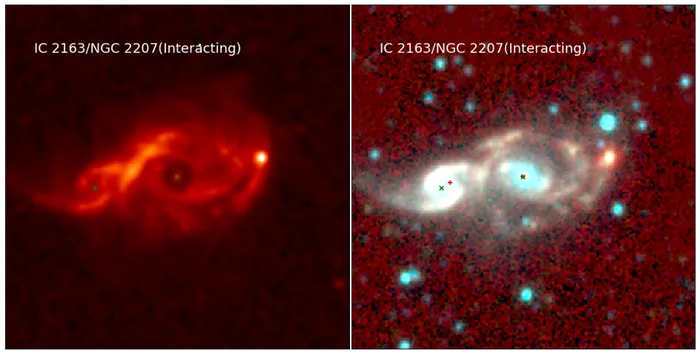
The left panel shows the MeerKAT radio image, and the right panel shows the corresponding WISE mid-infrared RGB.
Image: UCT
A new University of Cape Town (UCT) study published in the Monthly Notices of the Royal Astronomical Society journal has shed fresh light on the classic connection between infrared and radio light in galaxies.
The research titled: “Probing the Infrared/Radio correlation of the full IRAS Revised Bright Galaxy Sample with MeerKAT and the VLA,” is led by Malebo Moloko, a PhD candidate in Astronomy at UCT.
It explores how galaxies’ glow in infrared light and is linked to their powerful radio emissions, using cutting-edge data from South Africa’s MeerKAT radio telescope and the United States’ Very Large Array (VLA).
Moloko explained: “ Stars are born in dense clouds of dust and gas. The most massive stars heat up their surroundings, making the dust shine in infrared light. Later, when these stars explode as supernovae, their remnants accelerate electrons to near-light speeds, producing synchrotron radiation observable at radio wavelengths.
“This physical chain of events underpins the famous infrared–radio correlation: a cosmic rule of thumb connecting star formation to radio emission.”
The team’s study focused on the Infrared Astronomical Satellite (IRAS) Revised Bright Galaxy Sample which is a cornerstone catalogue of nearby luminous galaxies, aimed at asking: how do galactic interactions affect the infrared–radio emission connection?
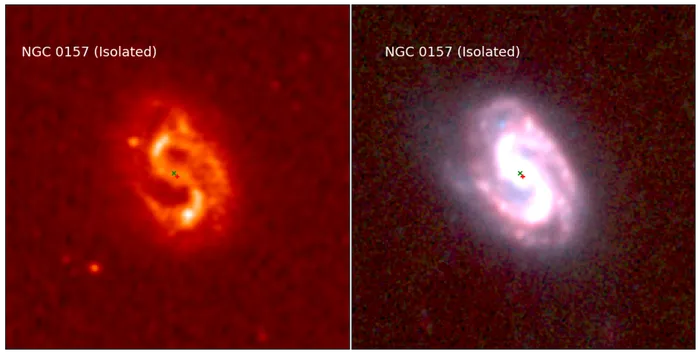
Highlighting the distinction between isolated and interacting/merging galaxies.
Image: UCT
“In some cases, galaxies were already in advanced stages of merging, making it impossible to distinguish their individual properties,” Moloko added.
He said the team found that interacting galaxies tend to show a weaker infrared–radio correlation and greater scatter compared to isolated galaxies and that this suggested interactions drive extra radio emission.
“Since astronomers can’t run lab experiments on galaxies billions of light-years away, the infrared–radio correlation is a critical tool.
“It allows us to estimate star formation rates, even in dusty systems invisible to optical light. But if interactions systematically skew this correlation, ignoring them could cause overestimates of star formation across the universe."
“What excites me most is that these findings show the power of using multi-wavelength observations to disentangle the complex interplay of galactic processes.”
Get your news on the go, click here to join the Cape Argus News WhatsApp channel.
Cape Argus