Cape Town City Hall: A landmark of culture and history


The iconic clock tower of Cape Town City Hall, a symbol of the city's rich cultural heritage.
Image: Facebook
Cape Town City Hall has stood at the edge of the Grand Parade for 119 years, its honey-coloured stone and clock tower a familiar mark on the city skyline and a witness to some of the country’s most important moments.
Completed in 1905, it was the last Victorian building to rise in Cape Town. Architects Harry Austin Reid and Frederik George Green won a public design competition, and contractors T. Howard and F. G. Scott carried out the construction. The limestone was shipped from Bath in England. The tower’s clock and bells were modelled on London’s Big Ben, with clock faces cast in iron and filled with opal thought to have come from Australia.
For decades the building served a double purpose. The administrative wing housed the mayor and city officials, while the Grand Hall became the main civic venue for concerts, boxing tournaments, music competitions and banquets. The Cape Philharmonic Orchestra and the Malay Choir performed under its soaring roof. At its heart is a 3 165-pipe organ known for powerful bass notes that can be felt through the floor and high notes prized for their clarity.
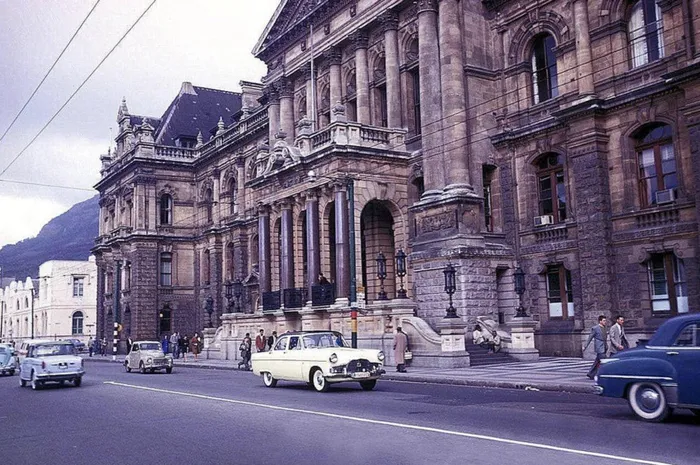
The City Hall and its rich history.
Image: Facebook
City Hall is also tied to the country’s democratic history. On 11 February 1990, only hours after his release from prison, Nelson Mandela addressed thousands of people from its balcony. A life-size statue of Mandela now marks that spot.
Today the building remains in use for council meetings and public events, its stonework carrying more than a century of Cape Town’s political and cultural story.
After completion in 1905, the City Hall became a focal point in the cultural and social life of Cape Town. Many local, national and international events hosted successfully over the years bear witness to City Hall serving the people of Cape Town. For a long time, the Grand Hall was the only venue capacious enough for large-scale social events.
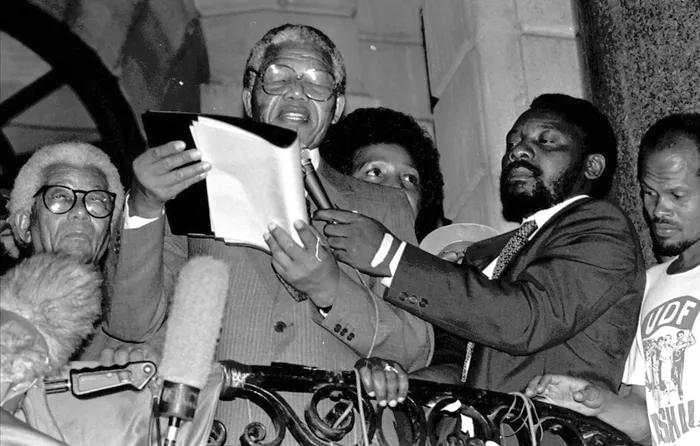
Nelson Mandela reads his famous speech on the steps of the Cape Town City Hall after his release from the Victor Verster Prison.
Image: .
This included orchestral concerts and rehearsals, music competitions, indoor sport and boxing tournaments, trade and product exhibitions, civic banquets and receptions, large religious services, international conferences, political meetings, society balls and dances, and others’
An event of historical interest was also the Royal Family Tour of South Africa in 1947, including Cape Town and a highlight was the 21st birthday of then Princess Elizabeth, celebrated with one of two balls and banquets.
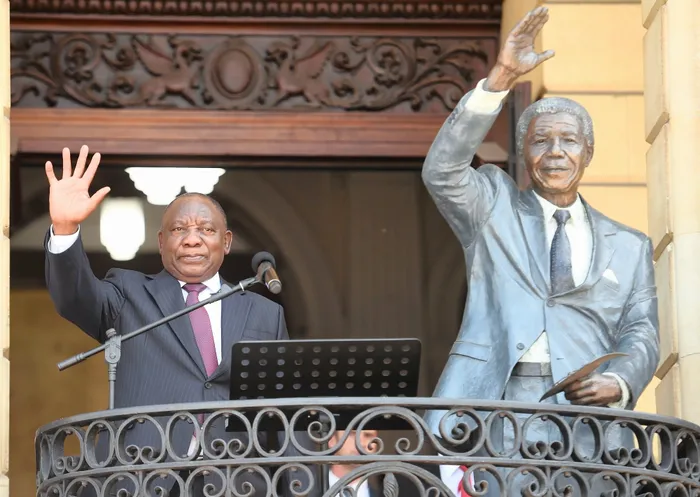
President Cyril Ramaphosa gave an address from the Cape Town City Hall balcony where Nelson Mandela delivered his speech after his release from prison.
Image: Independent Newspapers Archive
The Princess, later to become Queen Elizabeth II in 1952 upon her father King George VI’s death, made her iconic speech in Cape Town to serve the UK and the Commonwealth until the end of her days. Queen Elizabeth II served as the longest reigning monarch for 70 years until her death on 8 September 2022 at Balmoral Castle, Scotland.
Many may not know about this hidden gem inside the building, on the third floor of the City Hall, right at the top of the building, is a permanent exhibition called The Attic.
This exhibition gives visitors a chance to rummage through the city’s 'attic', and encounter some of the many artefacts and works of art that the city has collected over its history.
Get your news on the go, click here to join the Cape Argus News WhatsApp channel.
Cape Argus