Delay in forensic report on George Collapse criticised


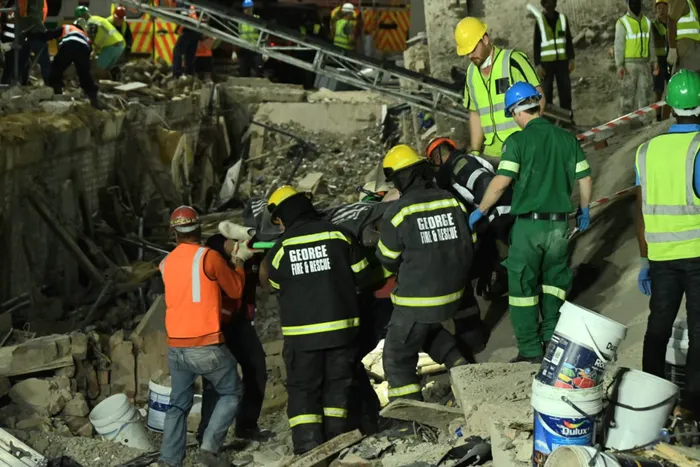
Parliament’s Public Works and Infrastructure Committee says the forensic report on the George building collapse reveals systemic failures, and has called for a joint investigation.
Image: Ayanda Ndamane/Independent Newspapers
The Portfolio Committee on Public Works and Infrastructure announced that much more work had to be done for the forensic report into the George Building Collapse to be acceptable and provide answers to who was responsible - and is calling for a joint meeting with stakeholders including a public participation process.
This was revealed by its chair, Carol Phiri during a media briefing on Wednesday in Cape Town where the Council for the Built Environment (CBE) and the Department of Public Works and Infrastructure (DPWI) provided outcomes of the George building collapse forensic report.
“It is unfortunate that the forensic report is not with us as the Department of Public Works feels that it contains sensitive information and the committee will have to view the report in camera first," said Phiri.
“There is nothing to tell the people of South Africa, but what we are getting is that they are afraid to go after the contractor based on legalities.
“It is a shame that, as the committee, we are unable to get the answers we need to properly understand who was negligent in the collapse of the building that resulted in deaths and injuries to workers.”
She also indicated that alarms were raised by workers prior to the collapse, that the building was “shaking” but that it was not considered - and that it was clear engineers had not been on site daily.
Phiri said: “In short, we need to go further with this investigation.”
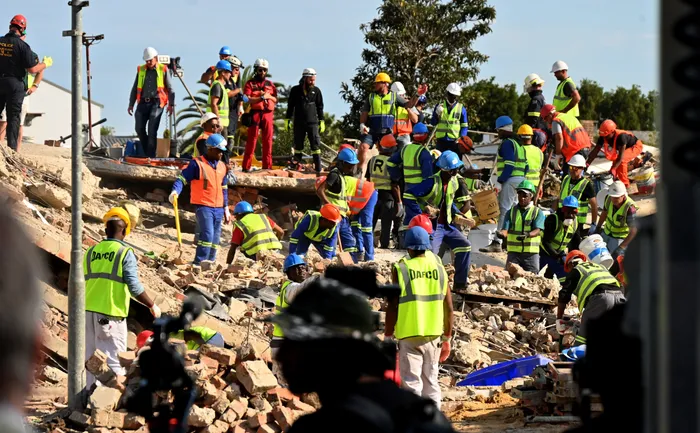
A five-storey building in Victoria Street collapsed on May 6, where 81 construction workers were present, resulting in the deaths of 34 people and numerous injuries.
Image: Ayanda Ndamane
She called for a joint meeting with stakeholders, namely the department of human settlements, saps, the department of employment and labour and others.
She added that a public participation process was also needed to dig deeper, citing that many buildings were being constructed without the correct protocols in place.
“What is outstanding, in legislation there is a lot of work to be done on the issue of the building collapse,” she explained.
“What we have from the report is that there are multiple stakeholders, be it the municipality, the department of employment and labour, human settlements, saps and ourselves and others which are dealing with the safety officers, your engineers, CBE.
“We need a joint meeting, where we will call human settlements as well.
“What we found out is that the main contractor is with the National Home Builders Registration Council (NHBRC), which reports directly to human settlements, not CBE, reports to us and it needs a lot of questions.”
She added that a decision whether to make the forensic report public was under consideration and consultation.
“There is a lot outstanding on the engineer and there is the issue of legalities in their report and it is very sensitive and we will discuss this in camera first,” she stated.
“We need a joint meeting with the stakeholders to find a resolution in making it public.”
She then gave insight into the structural issue of the building, indicating that alarms were raised prior to the collapse but ignored.
“And as a committee which is responsible for infrastructure, what is so disappointing is that the foundation, in the first place, it was for a four-storey building, when they started to push it for multiple, to increase to a seven storey building, there were no proper processes followed, so the process on its own was with fault and we found out that people who were working there, they made an alarm to say the building is shaking and they were not taken into consideration.”
She indicated that a consultation process with the community was vital to bind their findings: “We are still calling on the approval, that we can go to George for a public participation and an oversight on our own, where we can engage different stakeholders.
“It is not only about George, that incident killed a lot of people, but there are many buildings under construction without the right processes, you need municipalities to be part of that, you need professional bodies to be part of that and it tells you engineers were not on site on the daily basis to inspect, what was happening.
“In short, we need to go further with this investigation.”
The May 8 2024 tragedy claimed the lives of 34 people and left 28 injured.
In July the Cape Argus reported that the Director of Neo Victoria Development, Carel Swanepoel, who were the developers, has gone dark with his legal team also reserving their silence, according to Swanepoel’s LinkedIn account, he is the Director of Neotrend Property Group.
Earlier the Engineering Council of South Africa (ECSA) confirmed that the Engineer was charged with various violations of the Code of Conduct and the Code of Practice for the Performance of Engineering Work.
The charges include :
- Failure to discharge duties to employers
- Failure to give due regard to and prioritize the health, safety, and interests of the public;
- Failure to comply with relevant legislation.
The collapse was as a result of multiple failures such as systematic failures, non-compliance with regulations and mismanagement and that various parties were to be held accountable.
Public Works Minister Dean Macpherson said that serious safety concerns were ignored and that workers noticed cracks in columns, strange vibrations in the slab, and even visible holes through the walls in the basement while some of these observations were made as early as 2023.
Get your news on the go, click here to join the Cape Argus News WhatsApp channel.
Cape Argus