The sweet story of indentured Indians: Zenaéca Singh's Master’s exhibition
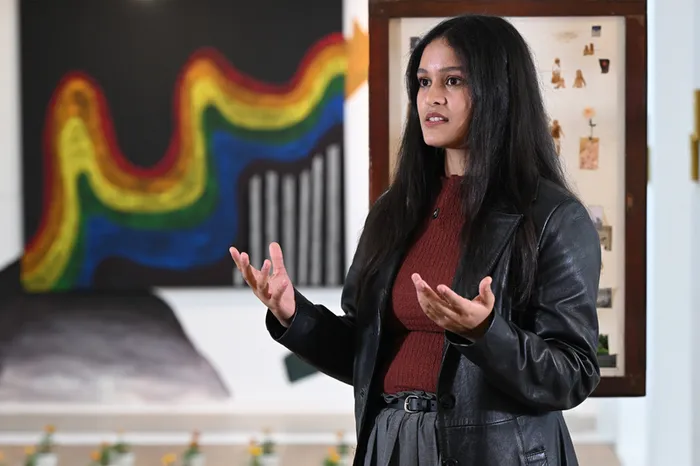
Visual artist Zenaéca Singh.
Image: UCT
As University of Cape Town (UCT) visual artist Zenaéca Singh graduates with her Master’s in Fine Art next week, she is using sugar properties to tell the rich story of indentured Indians who left their homeland to work in the sugar plantations in the British Colony of Natal from 1860 to 1911.
The university explained that more than 150 000 Indians migrated to Natal with promises of a better life, which never happened.
Instead, working conditions were punitive with pathetic wages, poor housing conditions, extended working hours and numerous injustices on sugar estates.
Now at the brink of her graduation, Singh’s work focuses on the “complex history of the sugar economy in South Africa.
It explores migration, colonialism, labour exploitation, and the dynamics of the domestic sphere,” through painting and sculpting with sugar.
“My use of sugar expands on its cultural economy to include the lost history of indenture, connecting the nuances between slavery and indentureship,” she said.
“I use sugar, in its varying liquid and solid properties, to reflect upon the sticky residues of the archive.
“I extend the medium of sugar as a marker of mourning and strength. The ways in which sugar reacts to different materialities represents the slow violence of indentureship.
Singh is a fourth-generation Indian born in South Africa.
“This investigation into indentureship is both a personal and political one. Her paintings, sculptures and installations aim to interrogate and reinterpret the mostly state-produced archival materials relating to the lives of indentured ancestors and their descendants,” the university detailed.
She uses family photographs to envision “an intimate picture of the lived experiences of South African Indians, which remains silenced in colonial documentation”.
Singh also creates sculptures of melting sugar ships to represent the shifting relations between India and South Africa via the Indian Ocean, including Britain’s colonisation of both nations during the late 19th century.
Born and raised in Port Shepstone on KwaZulu-Natal’s south coast, she received numerous awards for her BA in Fine Art and was also a UCT Accelerated Transformation of the Academic Programme (ATAP) fellow and completed her master’s with distinction at UCT’s Michaelis School of Fine Art.
Get your news on the go, click here to join the Cape Argus News WhatsApp channel.
Cape Argus