New fossil evidence reveals a stable environment in the Cradle of Humankind


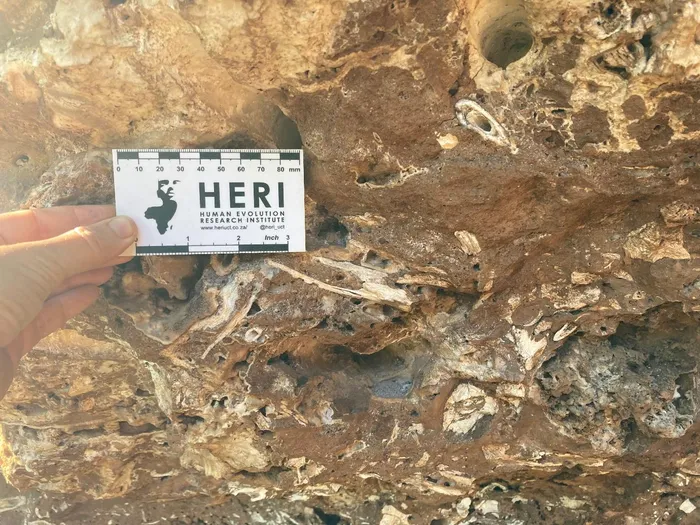
Antelope teeth from South Africa's Cradle of Humankind challenges the long-held belief that the area transformed from woodland to grassland 1.7 million years ago.
Image: UCT
A new study on fossil antelope teeth from South Africa's Cradle of Humankind challenges the long-held belief that the area transformed from woodland to grassland 1.7 million years ago, a shift thought to have influenced early human evolution.
Published in international journal for the geo-sciences, Palaeogeography, Palaeoclimatology, Palaeoecology, the research by the University of Cape Town( UCT) and University of Zürich suggests a stable environment for nearly two million years, remaining a mosaic of open and wooded areas.
For years, scientists believed around 1.7 million years ago, the Cradle of Humankind – a United Nations Educational, Scientific and Cultural Organization UNESCO World Heritage Site famed for its rich fossil record of our early pre-human relatives – transformed from a closed woodland into open grassland.
According to UCT, this idea was based largely on the types of herbivore fossils found at cave sites and on chemical signatures in their tooth enamel that reflect diet and vegetation.
They said the groundbreaking theory at the time paved the way for this new study.
Researchers have now found compelling evidence that this transition never happened, at least not in the way previously thought.
Lead author, Dr Megan Malherbe, recent PhD graduate from the University of Zurich’s Evolutionary Morphology group and former UCT archaeology student said: “Our results show a remarkably stable environment over nearly two million years. The Cradle of Humankind’s landscape remained a patchwork of open and wooded areas, supporting a variety of grazing and browsing animals, rather than shifting wholesale from woodland to grassland.”
Malherbe examined 623 fossil teeth from seven caves in the Cradle of Humankind – Cooper’s Cave, Drimolen, Haasgat, Hoogland, Malapa, Sterkfontein and Swartkrans, spanning between 3.2 million and 1.3 million years ago.
“The mesowear results were consistent across all seven sites and all seven antelope tribes studied. The fossils showed a stronger signal for grazing than browsing, suggesting that grasslands were always an important part of the environment,” the university added.
Instead of detecting a sudden change at 1.7 million years ago, the team found that this grazing signal remained constant over the entire 1.9-million-year period.
Associate Professor Robyn Pickering, co-director of UCT’s Human Evolution Research Institute (HERI) and an author of the study explained: “We often think of ancient environments changing dramatically in response to climate shifts.
“But our data indicate that, at least in this part of southern Africa, the landscape was a stable mosaic. That stability would have had significant implications for the animals, including early pre-humans living there.”
Get your news on the go, click here to join the Cape Argus News WhatsApp channel.
Cape Argus