Dorothy Jacobs: The woman behind South Africa's second heart transplant


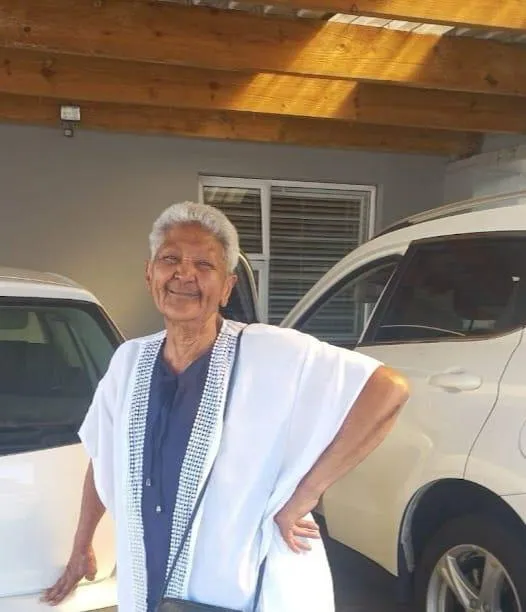
Dorothy Jacobs, previously Haupt, died at the age of 81.
Image: supplied
The woman who played a significant role in South African history after she granted permission for her coloured husband’s heart to be used for the world's second heart transplant, on a white doctor during apartheid, has died.
Dorothy Jacobs, previously Haupt, 81, passed away on July 1 and is expected to be laid to rest next week.
The Cape Argus spoke with her only child, Angelo Jacobs, 51, and his wife, Bronwyn Jacobs, 48, from Mitchell’s Plain, who relayed the pivotal role she played in history.
Jacobs was married to Clive Haupt in 1968 for three months and lived in Salt River.
They were both factory workers.
During a visit to Fish Hoek beach, Haupt suffered a stroke and later died.
His body was taken to Groote Schuur Hospital where Dr Barnard had performed the world’s first human heart transplant just a year earlier, in 1967, on Louis Washkansky.
Haupt had a strong heart that could be harvested for a second recipient, Dr Philip Blaiberg.
According to historical news reports about the day in question, Barnard had asked Blaiberg whether he would agree to receiving a “coloured man’s heart", to which he agreed and permission had to be granted from Jacobs.
The transplant itself went on to make history with Blaiberg having lived for 563 days post surgery.
Barnard honoured Haupt by attending his funeral and walked alongside his widow, Jacobs, captured on video footage which is still available today.
Jacobs was also previously commended by the Western Cape Health Department for playing a role in organ donations.
Angelo told the Cape Argus that while growing up his mother would often show him newspaper clippings of the history made.
“She traveled with Barnard to Argentina where she received a medal,” he said.
“She always had newspaper clippings where she would tell us what happened.
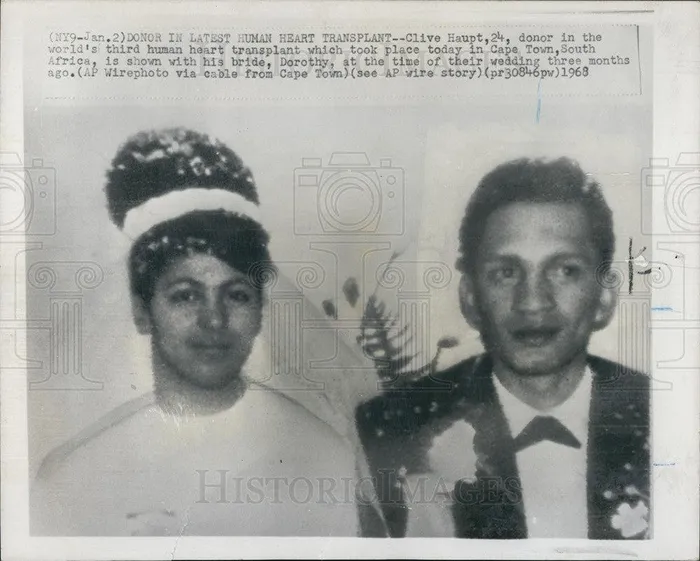
Dorothy Jacobs, formerly Haupt, with her then husband, Clive Haupt on their wedding day in 1968.
Image: Historical Images
“It was a big issue back then because it was apartheid and this was a coloured man and a white man receiving his heart but these are the things one never reads about in our history books so we do not want people to forget.
“She made an impact in history because of the decision she had to make."
Angelo said following Haupt's passing, his mother, with a broken heart went to find new love - his father, Alexander Jacobs, who died in 2016.
“My dad worked at the Palace Bioscope (cinema) in Salt River and that was where my parents met one another.
“I was born in 1974 and my dad went on to become a bus driver for Golden Arrow.”
Angelo said his father displayed a heroic act during his time as a driver when he delivered a baby and also made news headlines.
Bronwyn said her mother-in-law was a humble woman who had an impact on their lives.
“She was always smiling and had a lot of love to share.”
Jacobs's passing comes as the country continues to make advancements in organ transplant, with Stellenbosch medical students launching the country's first transplant support unit at Tygerberg Hospital.
The dedicated specialised support unit for organ donors – dubbed the “Life Pod” – was officially launched at the Tygerberg Hospital on July 4.
The first of its kind in Africa, is the flagship achievement of Save7, a non-profit organisation established and managed by medical students at Stellenbosch University’s Faculty of Medicine and Health Sciences.
The Life Pod will provide specialised care for consented organ donors, maintaining their organs’ viability during the critical 12 to 36-hour period before transplant surgery.
This dedicated space addresses a fundamental bottleneck in South Africa’s transplant system: a shortage of ICU beds that often forces potential donors to be transferred to morgues before their organs can be used to save lives.
“Transplantation in South Africa is fairly stagnant,” said Prof Elmi Muller, Dean of the Faculty of Medicine and Health Sciences and past president of The Transplant Society.
“We have, over the past 10 years, had more or less the same number of donors in the country, particularly deceased donors. Meanwhile, our patients that need transplants have been growing, and the waiting lists have become longer.”
To become an organ donor, register online or call the Organ Donor Foundation’s toll-free line on
0800 22 66 11 or https://odf.org.za
Get your news on the go, click here to join the Cape Argus News WhatsApp channel.
Cape Argus