SAPS denies claims of inadequate support for paralysed police officer
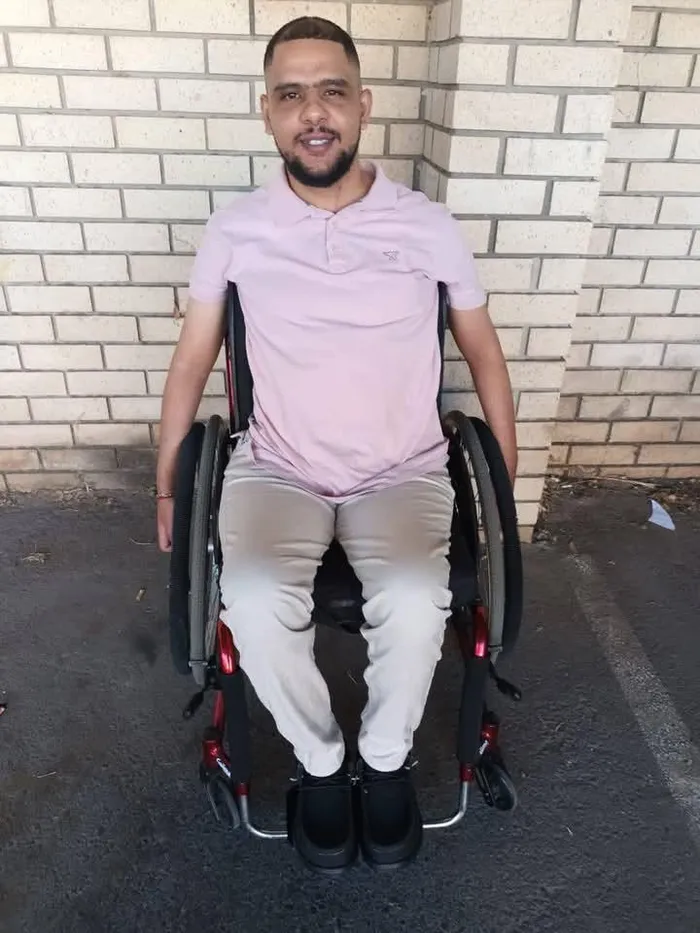
Constable Ahzerian Esterhuizen claims SAPS has failed to provide adequate rehabilitation support after a serious car accident.
Image: supplied
The South African Police has responded to claims made by a police officer left paralysed during a car chase. Constable Ahzerian (Aziz) Esterhuizen alleged he was relying on fundraising to cover his physiotherapy and biokineticist costs, despite being supported with over R 2 million in medical coverage.
The police officer acknowledged this support but said they fell short in aftercare following his discharge from rehabilitation.
Last week the Cape Argus reported on Esterhuizen, who became paralysed from the shoulder down after a car accident along the N7 in February 2023.
He began fundraising publicly for his biokineticist therapy sessions, claiming SAPS failed to cover this or twenty of his physiotherapy sessions after his rehabilitation discharge.
The matter has drawn the attention of Ian Cameron, the National Assembly Chairperson of the Portfolio Committee on Police, who has written to management for answers.
In a statement, National Police spokesperson, Brigadier Athlenda Mathe said Esterhuizen’s version was misinformation, and that in fact saps was fully supported of him.
“It’s not true that SAPS folded their arms in the case of the member who was left paralysed by a motor vehicle accident. The SAPS believes we are playing our part and are working on improving our services,” said Mathe.
Mathe gave a detailed breakdown of the medical costs covered by SAPS, saying that the injury was registered with the Department of Employment and Labour: Compensation Fund (CF).
The incident was accepted as an “IOD,” and SAPS has supported Esterhuizen as follows: R 2 031 306.50 for medical bills, which includes R 33 860.79 for physiotherapy sessions, a monthly allowance of R 5 460.00 for home nursing, and two wheelchairs and accessories valued at R 163 281.68. Additionally, computerised assistive devices were provided, valued at R 18 662.20.
In response, Esterhuizen said the R 5 460 did not cover the care of a day and night nurse. He claimed he forked out R 7 000 per month for an additional nurse and that twenty physiotherapy sessions were unpaid.
“What they have said is true, they did cover the rehabilitation for the seven months and the surgery,” he told Cape Argus.
"The problem I had was when I was discharged from rehab. The people who did the physio did not receive payment for twenty sessions. I sent emails to SAPS, and they only responded two months later.”
“They say now after I went to the media I can go to the Dr and be referred for biokineticist. In the beginning they would only pay for physio and now they are saying I can get motivation. I never said they did not support me."
He also mentioned that doctors and nurses encouraged him to seek 24-hour care.
Esterhuizen said he was keen to become more operational at work and that police are now assisting with these computerized bluetooth devices.
Mathe stated that Esterhuizen's concerns were raised during a visit. “Despite the support rendered, the member remains dissatisfied. The SAPS did reach out to the member,” she added.
“The computerised assistive device which was procured for the member needed a bluetooth installation to be able to function optimally.
“Although the member is being granted an allowance for a home nurse, the member needed two home nurses for both day and night care.
The employee was informed that according to the SAPS policy, there is only a standard allowance of R 5 460.00 and that since an additional home nurse is needed our office would have to consider the feasibility of deviating from the policy based on exceptional circumstances, however, without offering any promise in this regard as we could not create an unsustainable precedence.”
Cape Argus