Mandela Children’s Fund grows up
|Published


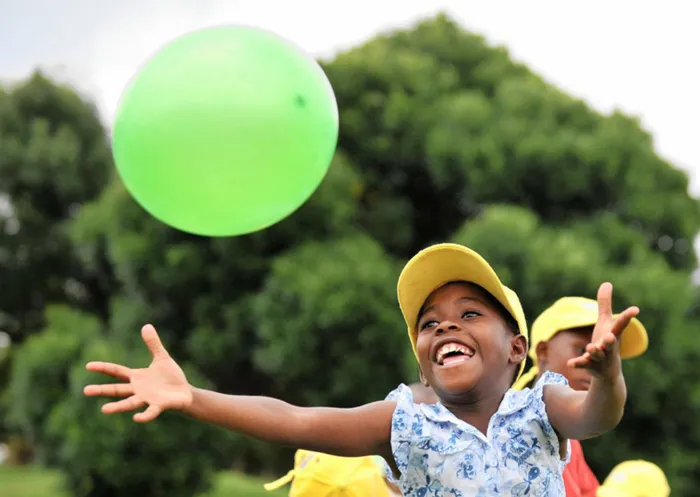
12 One of the special kids from The Nelson Mandela childrens fund amuses herself by playing with a balloon. Mrs Graca Machel who is Patron of The Nelson Mandela Childrens Fund was invited to the launch of the 'Champions for the Children Campaign' and logo unveiling at Willow Park Coference Centre and resort in Bredell 12 One of the special kids from The Nelson Mandela childrens fund amuses herself by playing with a balloon. Mrs Graca Machel who is Patron of The Nelson Mandela Childrens Fund was invited to the launch of the 'Champions for the Children Campaign' and logo unveiling at Willow Park Coference Centre and resort in Bredell
Directing world attention to the good of humanity. That’s the Nelson Mandela Children’s Fund, which owes its origin to the vision of a father to the global community and one of Africa’s greatest sons.
Of the many causes that South Africa presented to him upon his release on February 11, 1990, Mandela prioritised the one most dear to him – the well-being of children. This year, the fund turns 18.
Established within a year of Mandela assuming political office, the fund has a vision that endures to this day: changing the way society treats its children and youth.
When Mandela emerged from prison, he was not wealthy, and foundations require money. But, upon becoming president, he pledged a third of his salary for five years to start the fund. This brought a selfless dimension to his philanthropy.
On the basis of his pledge, Mandela challenged all and sundry, locally and abroad, to match his contribution.
He was also prudent enough not to burden his administration with the same request. Being head of state, he would have left it with little option but to uphold his appeal for financial support, which is how government funding was excluded.
The fund would emerge to claim its place as a non-partisan, non-sectarian platform to change the plight of the youngest, most voiceless and defenceless members of our society – the children.
Starting off as a grant-making organisation, and driven by various needs, the fund started off as everything to everybody. Every appeal was met. There were food parcels for the most needy. Shoes were sought and delivered for those without.
Wheelchairs were sourced for those in need. Coastal trips were planned for children living on the streets, some of whom were not only experiencing travelling by air for the first time but also seeing the sea.
Giving was the driving motive. Doing more for as wide a range of causes was uppermost. And during December, Mandela’s birthplace in Qunu in the Eastern Cape was a point of convergence for little ones who would be touched by Madiba’s charitable heart. With each year, the queues of women and children grew longer. Oprah Winfrey joined the act of giving. These were joy-dispensing occasions, even if it was a relief when the parties passed without incident.
But the image of Santa Claus soon proved unsustainable. Resources were limited and needs unlimited. Reality gradually came knocking on the door. However much the fund wished to spread its goodwill, it could only do as much as it could.
What was certain, though, was that Madiba’s picture of the fund did not change. He wanted it to help children out of their unhappy circumstances. And changing their circumstances effectively meant changing the future. The fund was called upon to build that future.
The Zulu equivalent, name and description of this mandate finds expression in the phrase “Sakha Ikusasa”, meaning “We are building the future”.
With that in mind, the evolution of the fund has been graded in five-year terms at each turnaround point.
The years 1995 to 2000 could best be described as the formative stage, when South African children in emergency circumstances could be helped.
It was welfarist in approach.
From 2000 to 2005, the fund was repositioned as a development-cum-advocacy agency using grant-funding as a tool. With the HIV and Aids pandemic affecting many families, with many children becoming orphans, the key message of the fund was a call for the strengthening of communities and families and for responsive government.
While the fund saw the sheltering of children as a temporary measure, it strongly argued that the best setting for children was in families. Sheltering was considered as the last resort when all else had failed. The government responded by entering in groundbreaking partnerships with civil society organisations, culminating in the National Co-ordinating Committee for Children Affected by Aids (NACCA), with the Department of Social Development (DOSD) acting as a secretariat.
The NACCA remains active as a civil society-public sector platform under Minister Bathabile Dlamini, while the Fund has reinforced its message: that it would like to be known for the work it does, rather than the global icon behind it.
The fund has firmly focused on specialised programme areas since then. Children have dreams to dream. They must be exposed to games and sports for their talents to be nurtured. They must be given skills to prepare them to enter the world of work. And those with special needs must be integrated into mainstream society.
The areas for focused programmatic intervention have included children’s well-being, leadership and excellence, skills, disability and vulnerable children.
Community-based partners have been identified through Requests for Proposals (RFPs) and viable models of child care have been introduced on an affordable scale.
For the period 2010 to 2015, the plan is not only to strengthen proven models of child care and youth development and then advocate for their application on a national scale by the government, but also to build a countrywide child rights movement. The inspiration for this is Section 28 of Chapter 2 of the constitution, dealing with children.
Activities have not all been serious and sombre. Even serious work finds joy, such as when children drop by at the fund to sing and wish Madiba well on his birthday.
Today is also known as the Annual Children’s Celebration.
Before 2011, Mandela and his wife, Graça Machel, would make provision in their diaries to spend time with children at the fund. Tents would be pitched. Tables would be laid. Drinks and food would be prepared. Jumping castles would be rolled into the yard for the fun to begin. The sound of children playing would cheer the premises at 21 Eastwold Way, where the offices of the fund are located.
Children would deliver their messages. Cake would then be cut, and Mandela would eventually depart. But nothing pleased him more than being with the children. Let us not forget his words on his 91st birthday: “Our bodies may give in to the force of age but the dreams that lie in our hearts may not retire.”
When Madiba retired, he assured all of us that his humanitarian work would carry on through the Nelson Mandela Children’s Fund, the Nelson Mandela Centre of Memory (established in 2002) and The Mandela Rhodes Foundation (also 2002).
Eighteen years later, the world remains demonstrably moved by the remarkable stature of the man.
He’s in every heart that cares.
* Oupa Ngwenya is the corporate strategic and communications head of the Nelson Mandela Children’s Fund
** The views expressed here do not necessarily reflect those of Independent Newspapers
The Star