Cities new frontiers for eco-battles

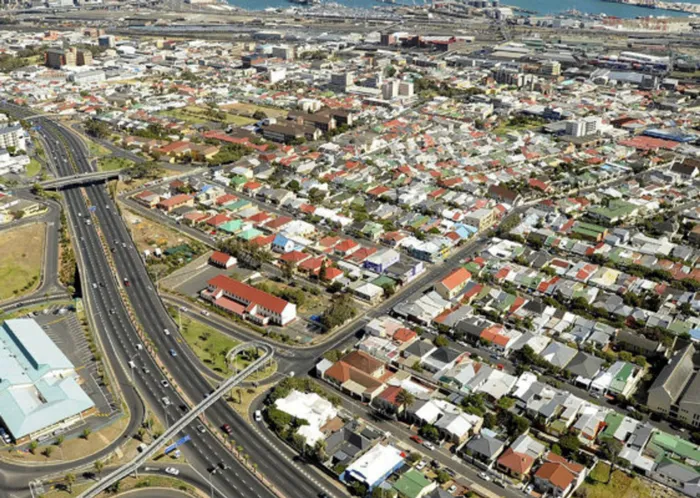
The global trend of rapid urbanisation, as reflected in the Woodstock and District Six area, means efforts to achieve a sustainable future must increasingly focus on the world's cities. The global trend of rapid urbanisation, as reflected in the Woodstock and District Six area, means efforts to achieve a sustainable future must increasingly focus on the world's cities.
JOHN YELD
Environment & Science Writer
CITIES are the world’s environmental battlefield where the struggle to achieve global sustainability will be won or lost, says Kobie Brand, regional director of the African chapter of Iclei.
Formerly the International Council for Local Environmental Initiatives, it is now known simply as Local Governments for Sustainability.
Iclei is an international association of some 1 220 local governments and associates, representing around 570 million people in more than 70 countries that share a commitment to sustainable development.
It is one of five partners in a South African collaboration – Changing the Climate – aimed at building consensus on a new vision for a sustainable future and on the strategies required to achieve this.
The other partners are Wessa (Wildlife and Environment Society of SA), NBI (National Business Initiative), auditing giant PricewaterhouseCoopers and the Standard Bank Group.
In its documentation describing the collaboration, the partners point out that climate change is “the most pressing issue that we face as humanity”.
“Our cities, businesses and lifestyles are increasingly at odds with the planetary systems that provide the resources, diversity and beauty that enable and enrich life on Earth.
“Given that it is our social and economic systems that are the root cause of the environmental challenges that we face, it will take all sectors of our society working together to create a new vision and a different future to the one we are currently creating.”
Speaking at a Changing the Climate Dialogue at Kirstenbosch last week, Wessa chief operations officer Mike Ward explained that the initiative was aimed at developing collaborative action to address environmental challenges and take advantage of environmental opportunities.
“How do we create added value by working together? That’s really what this process is about – to build a shared vision for the future, and then build strategies that will take us where we want to be, in a logical progression,” he said.
In her talk, Brand pointed out that although cities covered just 0.12 percent of the Earth’s surface, they were home to 50 percent of the world’s 6.94 billion population.
Three-quarters of global energy was consumed in cities, which also used some 73 percent of the world’s natural resources.
Of the world’s 50 fastest growing cities, 15 were in Africa – none in South Africa – and three were in the top 10: Bamako in Mali (sixth), Lagos in Nigeria (seventh) and Dar es Salaam in Tanzania (ninth).
Brand said it had been estimated that by 2050, when the world population is estimated to level off at about 10 billion, the same amount of urban capacity would be required as had been built globally over the past 4 000 years of modern human existence.
“We will have to double the infrastructure, basically.”
There was now a “huge opportunity” to develop an agreed global strategy on how to develop these new urban areas in a sustainable way, she added.
Quoting UN Environment Programme head and UN Under-Secretary-General Achim Steiner – “The quest for sustainability will increasingly be won or lost in our urban areas” – Brand said: “With foresight, political will and intelligent planning, cities can be the map and blueprint for a sustainable future.”
The Changing the Climate partners say that although they plan to use the COP17 climate change conference in Durban at the end of the year as a high-profile opportunity to promote their initiative, it will continue afterwards.