Facility’s tweet success
|Published
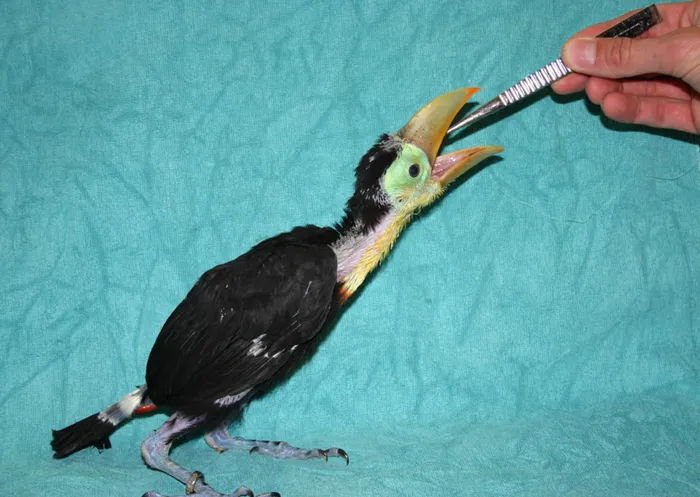
The collection of toucans and Cape parrots are the largest in South Africa. The collection of toucans and Cape parrots are the largest in South Africa.
An internationally renowned bird-breeding centre for rare and endangered species is thriving quietly, barely noticed by even its closest neighbours, in a rural corner of Assagay outside Durban.
The Amazona Endangered Parrot Breeding Facility is now a sprawling complex, well hidden from the public eye, with the most modern of facilities which include a “hospital” and “operating theatre”.
Its owner, William Horsfield, has been a breeder for the past 32 years and is now a recognised leader in the breeding of many species, especially parrots and toucans. The value of these birds ranges from R500 to R100 000 per bird.
While Horsfield and his facility do not seek the limelight locally, he has over the years become a speaker of note on the overseas lecture circuit. Soon he will be visiting as a specialist guest speaker.
“I prefer not to be noticed,” said Horsfield when asked why he is better known abroad.
But his work has been impossible to ignore. He has bred the largest collection in captivity of the critically endangered Cape parrot, which still hovers on the edge of extinction in the wild.
The Cape parrot, which exists in small numbers, mainly in KwaZulu-Natal and the Amatola mountains of the Eastern Cape, is threatened by the avian ceirco virus (ACV), which manifests itself in a similar way to HIV/Aids in humans.
ACV can have devastating effects on flocks of parrots because of the ease with which it spreads, as infection is airborne.
“There are now less than 1 500 Cape parrots left in the wild,” said Horsfield. “Our own birds were hit by the virus too. In 1998 we had 38 Cape parrots, but 28 tested positive for the virus and had to be euthanased.”
His collection of birds has since recovered very well. “Those remaining 10 parrots have now built up to nearly 80 birds.”
Horsfield breeds a variety of other parrots and also has the largest collection of toucans in South Africa, if not the world.
The toucan comes from Central and South America, and is a beautiful, brightly coloured bird with a spectacular beak. “We have 10 different species – 40 breeding pairs,” said Horsfield.
He has exported toucans to other breeders in many countries of the world with some exceptions. “We don’t sell to Australia, where you are not allowed to import or export birds, or to the US where the whole process is so long-winded that we prefer not to,” he explained.
“We prefer to sell to Europe where people tend to have smaller properties and specialist collections. Birds get better individual attention there.”
He said toucans did not make good indoor pets as they were particularly messy birds. They were bought mainly by people with small bird collections for outdoor “display” purposes. “They are not as intelligent as parrots, but look exquisite.”
Horsfield is, of course, known to other South African breeders, who are his main customers, but he has little contact with the public.
“We don’t like to sell birds as lone pets,” he said. “We prefer to sell them in pairs to other breeding facilities – to sell an unrelated male and a female to other breeders.”
Birds are not just business but a passion as he says he places a big emphasis on socialising them – keeping them in pairs and making sure they identify with their own kind. This also, obviously, improves their breeding success.
“If you keep a bird in isolation – as often happens with pet parrots – among humans, they imprint on people. They become human fixated.
“If you one day get that bird a mate, there is a likelihood of severe aggression, especially in birds like cockatoos that are tame and imprinted, and many have been maimed or killed in that way. That is why we always try to sell birds in pairs so they will mature together.”
His great love in his varied collection is still the parrot.
“They are exceptionally intelligent. They rate on the same cognitive level as dolphins and great apes.”
Horsfield started breeding birds in Knysna when he was five. His hobby became commercial years later when living on a fairly small property in Pretoria.
“But the neighbours started complaining about the noise and I had to farm the birds out all over the place as breeding pairs to friends. But there were many problems with that so I realised I had to get all the birds under one roof. I came to Durban looking at smallholdings.”
He eventually saw and bought his property in Cliffdale Road, Assagay, which was then “just bush”.
He started building, bit by bit, and has since spent “quite a few millions of rands”, as he puts it.
His collection of birds has also grown over the years.
“We now have 300 breeding pairs and another 200 pairs of juvenile birds waiting to be sold, either locally or for export.
“We also have a floater flock – birds I call my pensioners – of about 100. These are birds that either bred for many years and have now stopped, or have been sold to us and because of some latent defect have never bred.
“We have a lot of birds that were once other people’s pets and have been given to us. Many are real personalities. They are all on pension and living out their retirement in style.”
He also, of couse, has his own pet parrot. She’s a 22-year-old African Grey named Satchmo because of the trumpet sound she made when she was young. “She hates everybody except me,” he said, laughing. - Sunday Tribune