A farmer’s dilemma
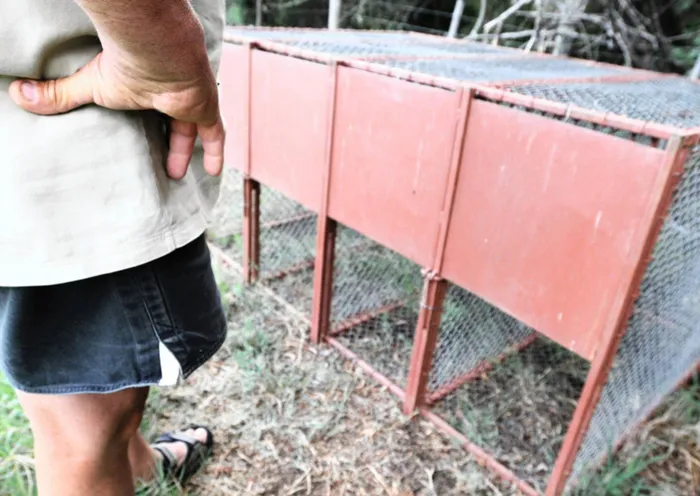
A Carlitzdorp farmer shows the cages that he uses to trap baboons. Picture: Gareth Smit A Carlitzdorp farmer shows the cages that he uses to trap baboons. Picture: Gareth Smit
Leaning on a cage built to trap four baboons, a farmer barked a single, perfect, simian grunt across the Gamka River valley. In response, there was only an echo.
For the benefit of two journalists he was trying to locate a troop of 50 baboons from a neighbouring valley that has raided his farm in recent weeks. Eight similar cages were set out along the lucerne patch, ready to be baited at a time when the baboons return.
During dry times, such as now, they eat the lucerne, which feeds the farmer’s dairy cows. They break his ostriches’ eggs and frighten the adult birds which bolt, killing themselves against a fence.
The farmer estimates that in 2008 baboons damaged his farm to the tune of R87 000. So, over time, he trapped 173 baboons in cages he built.
For months he battled with CapeNature to get a permit, and after eventually inspecting his farm they obliged and he was able to sell 20 of these baboons to the Medical Research Council (MRC).
The other 153 baboons were transferred into smaller cages on starry Karoo nights and driven a few kilometres away from their troop. He shot them each in the head with a .22 revolver and buried the carcasses in a pit. The exercise cost him about R45 000.
In the last 20 years he has killed 1 127 baboons, and sold another 60 to the MRC during the 1990s on the understanding this was for breeding purposes.
Now only 15 remain in his valley. Killing them would have resulted in several troops vying for the territory, causing even more trouble. But even now he says he will have to kill the neighbouring 50.
The farmer says he also struggles with leopards, caracal, porcupines and kudu from a neighbouring game farm.
“I’m suffering to get my farming in place. If it’s going to get drier than it is now, all these kudus are going to be in my lucerne.”
His is the fifth generation of his family to live in the small farmhouse, deep in the foothills of the Swartberg. He has three sons, two of whom are working professionals in a nearby town. The other is 13: “I have a problem. They don’t want to come back to farm. I told them not to – there’s no future here.”
But as the farmer gets older, he will need the help as he does most of the labour himself. He hopes his youngest will be interested in the challenge.
“No, it’s a fight. I’m trying to keep this business afloat,” he said, seated at his rickety kitchen table.
He says he tries his best to cull the baboons properly. He keeps records, does it at night when they are calmer, and makes sure he catches mothers and their babies together.
“I try to work with CapeNature all the way.” He electrified the fence around the farm, but the baboons still jump over.
He erected a gas cannon which fired loud blasts: “The baboons just sit on the hill and wait for the shot. Instead of running away, they run down, fill their arms with grapes and run back. On the second day, they broke the gas pipe and the baboons were playing with the canister, rolling it down the hill and walking on top of it.”
He quit farming grapes some time back, and his neighbour’s apricot trees, which should be bursting with yellow fruit, are bare – baboon food.
He says the area is overpopulated with baboons, and he has done his own count: 2 050 baboons in 400 km2. “That’s five baboons every square kilometre. Tell me where are they going to find food in this veld, especially when it’s dry like this. For the last two years we haven’t had rain.”
How does it feel to kill all these baboons? He raises his voice for the first time, gesturing to his young son: “Do you want to ask him?”
The farmer glared silently across the table. “That night when I fired the first shot, he asked me if he should stay. I said take the quad bike and go. The boy came back here and he was crying and crying because of what’s going on up there. It’s not easy. I hate it every time, but I have to do it.” - Cape Times