REVIEW | BMW 118 makes a strong case for premium hatchbacks


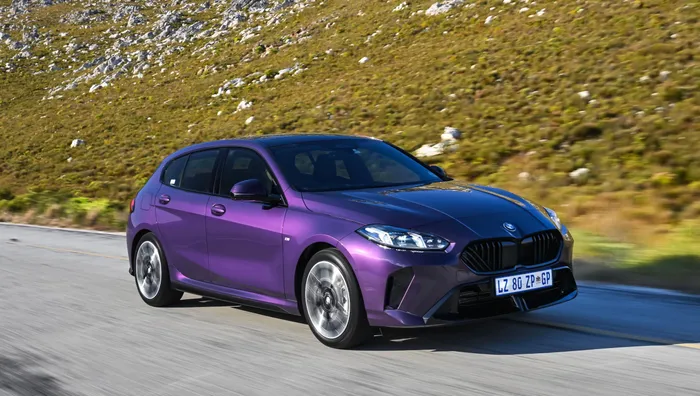
The BMW 118 remains one of the most engaging premium hatchbacks on sale.
Image: Supplied
When the BMW 1 Series first hit the scene over two decades ago, it was a trendsetter, bringing rear-wheel-drive thrills into a world hungry for premium hatchbacks.
Fast forward to 2026 and the entry-level Bavarian persists in the face of a completely different reality. Having moved to a more practical front-wheel-drive layout from the third generation onwards because most buyers didn’t seem to appreciate its original USP, the latest 1 Series also has to contend with a dwindling appetite for hatchbacks as buyers flock to SUVs.
Yet while rivals such as the Mercedes-Benz A-Class prepare to exit the segment, BMW’s ‘little one’ appears to be hanging on rather well.
The vehicle you see here, first introduced locally in 2025, is officially classified as the fourth-generation 1 Series. Yet it is, in essence, a heavily updated version of its predecessor, retaining the UKL2 architecture that it shares with Mini, while even the wheelbase remains unchanged at 2,670mm.
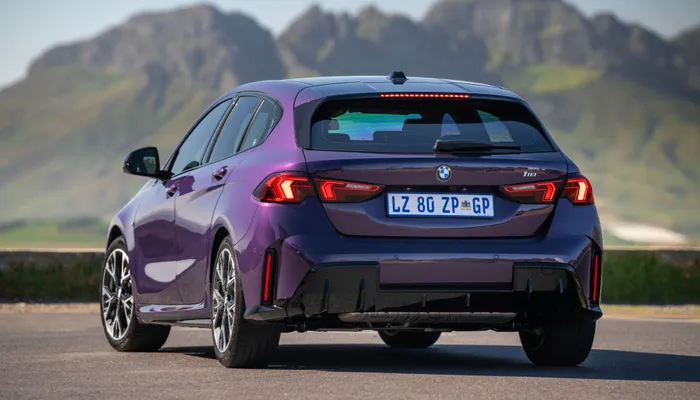
BMW has sharpened up the 1-Series with updated styling and improved dynamics.
Image: Supplied
The new model has, however, grown by 42mm in length and 25mm in height, while gaining completely fresh front and rear styling, ditching the somewhat frumpy face of its predecessor for an appearance inspired by the BMW Z4.
The mainstay of the range is the 118, which is priced from R713,395 in base form, moving up to R753,395 for the M Sport and R761,895 for the Pure Design grade. Buyers can also opt for the far more potent M135 at R899,768.
The entry-level 118 is priced slightly north of the most expensive Volkswagen Golf 1.4 TSI, which tops out at R688,100, while also undercutting the least expensive Audi A3 (R779,000) and Mercedes-Benz A-Class (R815,674).
The cabin has been given a substantial overhaul, with a new dual-screen system that combines a 10.25-inch driver information display and a 10.7-inch central infotainment unit into a single curved panel.
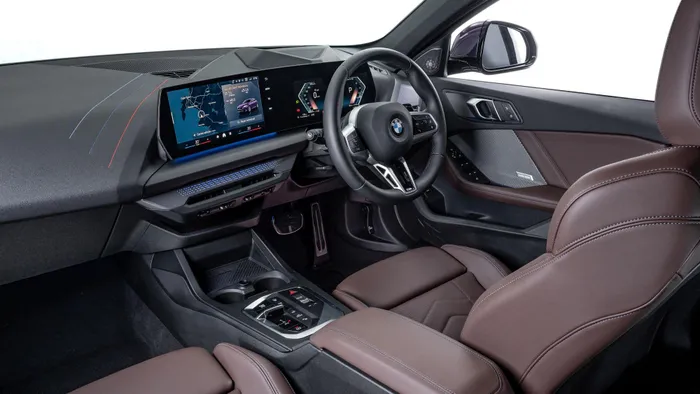
BMW 118 cabin feels modern and well-finished.
Image: Supplied
BMW’s latest Operating System 9 provides the computing power and, in keeping with modern trends, the number of physical controls and buttons has been reduced. Most functions are now activated via the screen, including the climate control.
Although operating the climate system this way is not ideal, the interface is still relatively easy to use, and there are shortcuts on the screen for regularly used functions.
BMW has also put a great deal of thought into making the start-up process as intuitive as possible, with the start button, electronic gear selector and handbrake all positioned within close proximity on the centre console.
Cabin features include BMW’s Live Cockpit Plus with cloud-based navigation, automatic climate control, Driving Assistant with front collision warning, Lane Departure Warning and Parking Assistant with Reversing Assistant. There is a long list of options too, including Active Cruise Control, a Head-Up Display and Parking Assistant Plus.
Overall, the 1 Series cabin is a comfortable place to be, particularly up front. Rear legroom is hardly stretch-out ample, but it is reasonable by class standards, as is the 308-litre boot.
What’s it like to drive?
Here’s where the BMW 1 Series edges ahead of the competition in our view.
Its 1.5-litre three-cylinder engine, with 115kW and 230Nm on tap, might not sound like much on paper, but in the real world it delivers a surprisingly refined experience. It has a rorty three-cylinder hum that is pleasant to the ear, but without the shakes and rattles one would normally expect from this unusual cylinder configuration.
The engine feels solid, refined and delivers effortless performance. While not a performance car by any stretch of the imagination, it feels lively in everyday urban conditions and there’s enough power to overtake comfortably on the open road.
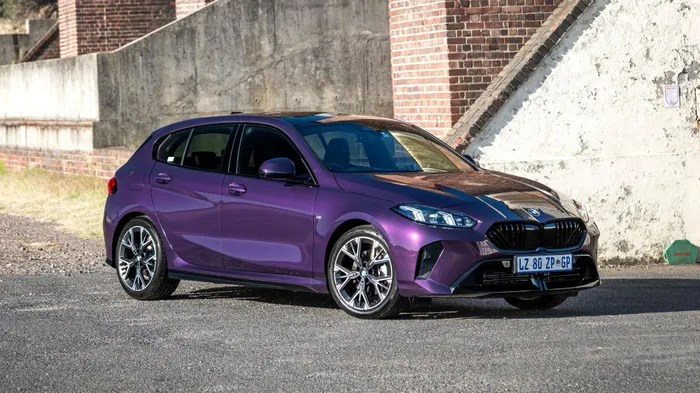
The BMW 118 may not be a hot hatch, but it’s still rewarding to drive.
Image: Supplied
Although front-wheel drive is not the holy grail of engaging handling, BMW has still nailed the chassis dynamics of this car, within its context of course.
The fourth-generation model has a more rigid structure, and there have been suspension tweaks, particularly to the dampers, while the caster offset of the front wheels has also been increased.
These changes make the 1 Series feel even more nimble through the bends, while the steering feels weighty and communicative — something rare in the modern era of electric power steering.
On the flipside, the ride is a little firm over harsher surfaces, but not to the point of discomfort.
VERDICT
The latest BMW 1 Series makes an enticing case for itself for those shopping in this space. Though not overtly sporty, it is more engaging than most vehicles on the road today, while its refinement and interior tech impress. This may be a small niche, but BMW is certainly back in the game.
IOL Motoring