REVIEW | Omoda C7 SHS stands out with bold design and impressive tech


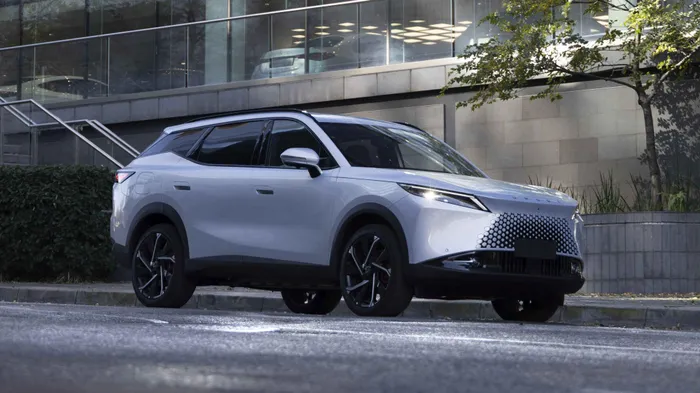
The Omoda C7 SHS blends bold design with a highly efficient plug-in hybrid system.
Image: Supplied
It is often said that the middle child is the “wild child”, and in pure design terms the new Omoda C7 arguably lives up to that stereotype.
While its smaller C5 sibling is certainly striking and the larger C9 is the brother in a tux, the C7 takes a more daring, and perhaps even slightly polarising approach with its shark-like face and highly sculpted profile.
By contrast, many buyers are demanding boxier SUVs, a need that Omoda’s Jaecoo sister brand serves all too well, but the C7 is unashamedly sporty.
We recently spent a week with the plug-in hybrid version, and also put it through its paces during the SA Car of the Year test days in early March. Though it’s not necessarily an obvious winner, I certainly feel it’s in the running, given its innovative powertrain, luxurious interior, striking design and reasonable price tag.
At R689,900, correct as of March 2026, it’s priced identically to its Jaecoo J7 cousin, while commanding a slight premium over rivals such as the Geely E5 Apex and Chery Tiggo 7 Ultra flagship model, although the latter two can also be had in base form for a shade under R600,000 if you’re willing to live with less specification.
It’s not the cheapest then, but still a strong value proposition in the broader market context.
Powering it is Chery’s Super Hybrid System (SHS), in this case pairing a 1.5-litre turbocharged engine with an electric motor and Dedicated Hybrid Transmission for combined outputs of 255 kW and 525 Nm.
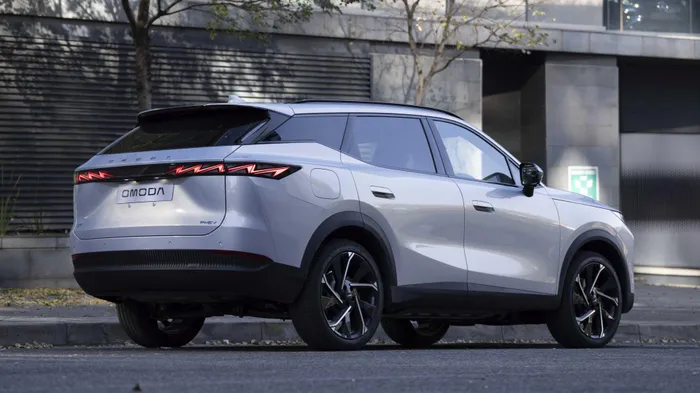
Bold looks. Hybrid power. The Omoda C7 SHS makes a statement.
Image: Supplied
According to Omoda, its 18 kWh battery enables an electric-only range of up to around 90–105 km under ideal WLTP conditions. However, in real-world South African highway use, a more realistic EV range is closer to 50–75 km depending on speed, terrain and conditions. The petrol engine may also begin to intervene well before full depletion, depending on load and driving style.
Given that this is a series–parallel hybrid, the electric motor does most of the driving in low-load conditions, resulting in a smooth EV-like driving experience. The petrol engine acts primarily as a generator but can also drive the wheels directly when required for higher speeds or hard acceleration.
Slam the accelerator, and performance borders on exciting. You’ll never be wanting for performance in this vehicle, and the powertrain also impresses with its quietness and overall smoothness of operation. Chinese manufacturers have previously been criticised for less-refined petrol engines, but in this case, the focus has clearly shifted toward hybrid calibration and efficiency.
Given that this is a PHEV, fuel consumption is heavily dependent on charging habits. With regular charging, consumption can be minimal. Once our test car’s battery had depleted to around 25%, we achieved consumption in the region of 7.0 litres per 100 km in mixed conditions, without making any particular effort to save fuel, which is very decent for a car of this size.
I mentioned earlier that the C7 boasts sporty looks, and while the performance is certainly in that vein, its road holding is no better than average, and the steering feels artificial, providing very little feedback. The ride quality is very comfortable, however, and that is likely what matters most to buyers in this segment.
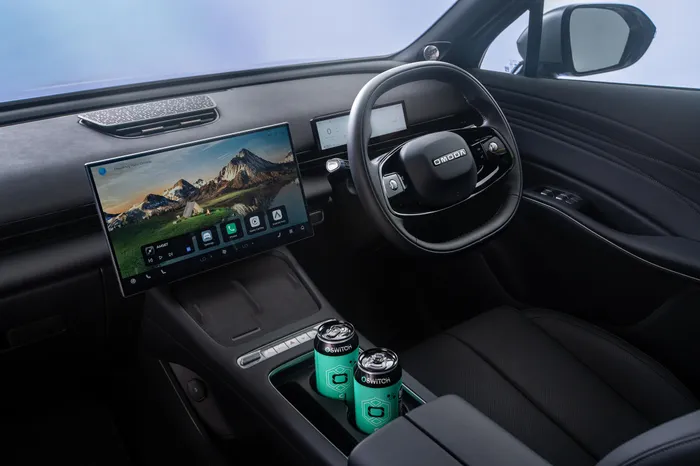
The Omoda C7 SHS features a minimalist cabin dominated by a large central touchscreen.
Image: Supplied
The interior boasts the kind of minimalist design that will make you think you’ve just stepped into a Tesla, as there is very little present besides a steering wheel and a large 15.6-inch floating central screen. The latter attempts to soothe you with animated screensaver imagery — ours featured a burning campfire next to a tent in the mountains.
The interior features an inductive charging pad, and connectivity comes in the form of wireless Apple CarPlay and Android Auto, as well as a decent voice command system and a combination of USB-A and USB-C ports.
The downside of the minimalist cabin design is that you have to control the ventilation system via the central screen, although you can shortcut to it by pressing the A/C button. The demisting functions also have physical buttons.
Overall cabin quality and ambience are impressive at the price point, and practicality is a strong point too, with reasonable rear legroom and a spacious boot that offers 537 litres of capacity with the rear seats in place. A potential dealbreaker for many South Africans, though, is the lack of a spare wheel.
The seats are upholstered in black leather and are electrically adjustable as well as heated and ventilated up front. Other standard features include dual-zone climate control, 56-colour ambient lighting, an eight-speaker Sony sound system and an electrically operated tailgate.
VERDICT
Although not likely to be as popular as its more conventionally styled Jaecoo J7 sibling, the Omoda C7 makes a strong case for itself with its striking design, luxurious interior and innovative powertrain that provides for a smooth, effortless and highly efficient driving experience - providing you keep the battery charged.
It faces stiff internal competition at the price level, but emerges as a distinctive option for those seeking to stand out from the crowd.
IOL Motoring