REVIEW: Leapmotor C10 REEV offers electric motoring without the range anxiety


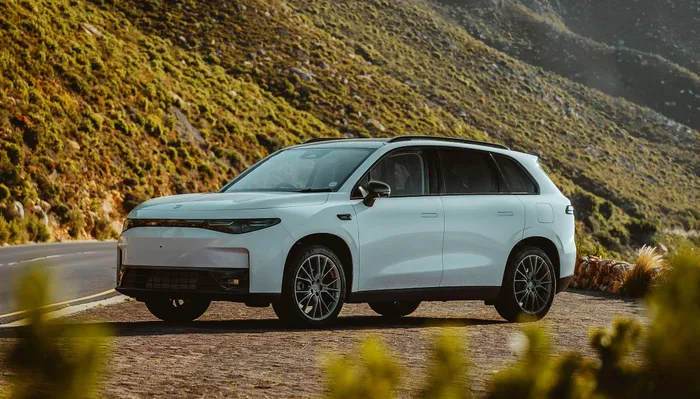
Not a head-turner at first glance, but the C10’s clean lines grow on you.
Image: Supplied
Let’s not beat around the bush: South Africans are not going to switch to electric vehicles (EVs) in their masses until two things are sorted out: range anxiety and high purchase price.
Plug-in hybrids (PHEVs) are often touted as the perfect ‘bridge’ between EV and ICE, but they remain relatively expensive, and their EV range is often limited. The Leapmotor C10, a new Chinese offering marketed by Stellantis, is a 'range extended electric vehicle' (REEV) that aims to offer an alternative solution.
Although it's still rather expensive, with the 'Style' version priced at R759,900 and the 'Design' at R799,900, it does present an interesting alternative for those seeking a longer range than what a typical PHEV would offer.
It’s not a new concept, given that one of SA’s first EV products, the BMW i3, was a REEV. But this is a format that we feel will enjoy further refinement as the industry dives deeper into the electric era.
Unlike a PHEV, whose wheels can be powered by both the electric and combustion motors, separately or simultaneously depending on the situation, a REEV is powered solely by an electric motor, while the internal combustion engine (ICE) acts purely as a generator. As the ICE motor only has one major role in life, it can be engineered for maximum efficiency. This is because it can operate in a narrow, optimised rev and load range rather than having to provide responsiveness and torque over a wide spectrum.
Its battery size is typically bigger than a PHEV's but much smaller than an EV's, theoretically making it lighter and cheaper than the latter.
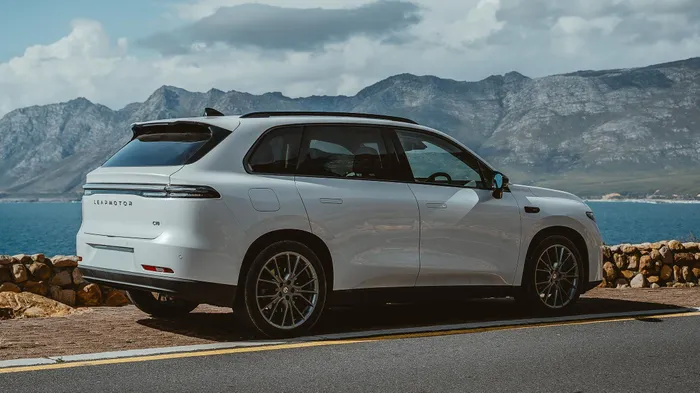
A sleek rear-end design gives the C10 a more upmarket presence than its badge suggests.
Image: Supplied
The C10 has an electric motor that powers the rear wheels with 158kW of power and 320Nm of torque, while the petrol-powered ‘generator’ is a 1.5-litre unit that produces 63kW.
Its 28.4 kWh lithium iron phosphate (LFP) battery pack is said to allow an all-electric range of up to 145km between charges, which is way more than the average commute. But once again, its ultimate fuel-saving ability rests solely on how diligent its owners are when it comes to charging it.
Thanks to DC fast charging capability, something many PHEVs don’t offer, the C10 can charge 50% in just 18 minutes, according to Leapmotor.
In theory, the vehicle can cover almost 1,000km on a single charge and tankful, but keep in mind that once the battery has depleted, with the generator kicking in automatically once you go below 9%, you are looking at fuel consumption in the region of 6.0 to 8.0 litres per 100km, depending on your driving style.
So what’s it like to drive? Acceleration is as smooth and effortless as you could possibly expect from an EV with this kind of power. It’s not a performance machine, but you are certainly not left wanting.
It offers four driving modes. EV+ mode maximises electric range, with the generator only kicking in when the battery dips to 9%, while EV mode brings an ‘intelligent’ mix of motor interaction once the state of charge falls below 25%. In Fuel Mode, the engine runs constantly to maximise overall range, while Power+ mode prioritises performance.
It is a heavy vehicle, weighing just over two tonnes, so agility isn’t its strongest suit, but the ride quality is certainly comfortable in our book.
Is it a desirable vehicle to own?
At first glance, the C10 is not much of a headturner. In fact, it looks rather generic from the front, but move to the side and back, and it has an elegance about it that’s almost Jaguar-like, and certainly very premium.
The interior is very much Elon Musk-approved, as practically everything is operated via a large 14.5-inch central touchscreen, and the driver also has a 10.25-inch digital display for key info.
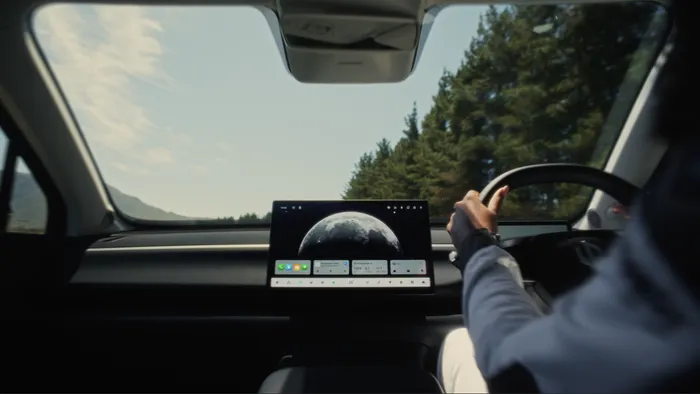
Almost everything is controlled via the central display — for better or worse.
Image: Supplied
But there are a few quirks to this vehicle that could detract from the overall ownership experience. It has a card instead of a key, and you’re required to lock and unlock it via a ridged section of the driver’s side wing mirror. To activate, or ‘start’ the car, you then need to place the card on a specialised pad on the centre console.
That and the lack of physical buttons mean it loses marks for overall user-friendliness, although the big screen set-up is relatively straightforward and there are shortcuts for commonly used functions, such as the climate control, at the bottom of the screen.
The C10 also has the usual list of driver assistance gizmos, but I found the ‘driver distraction alert’ system to be particularly erratic, pinging and chiming even when I was making a concerted effort to only look straight ahead just to prove my point. Often, I would get an on-screen message stating that it failed to activate, which I was particularly glad about. Until the next journey. Because even if I switched it off via the screen menu, more often than not, it would reactivate every time I started the vehicle. An online search showed many owners are annoyed by this distraction warning system, with some claiming it cannot detect their eyes through sunglasses.
VERDICT
The Leapmotor C10 REEV, which is marketed by auto giant Stellantis, is a modern and luxurious vehicle that packs some very advanced and impressive technology. If you can stomach its price tag, it could certainly be a decent alternative to other EVs in that price bracket if you’re looking to eliminate range anxiety, but you also want a longer range than your typical PHEV.
Sweet spot? Yes, certainly. But for now, it is destined to remain rather niche.
IOL Motoring