Uber and Wayve partner with Nissan Leaf for groundbreaking robotaxi initiative in Tokyo


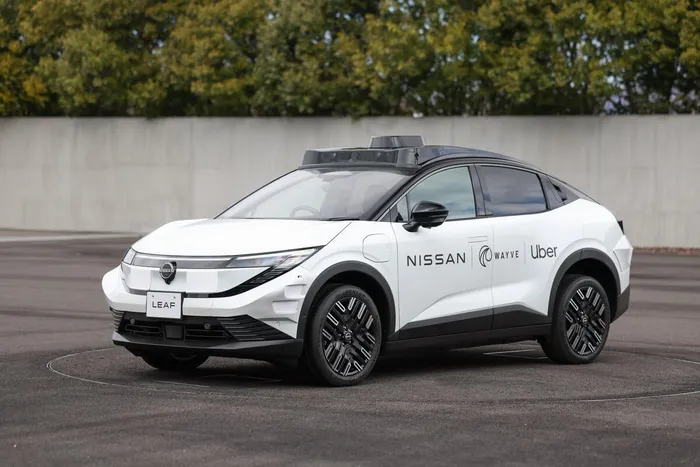
Nissan, Uber, and Wayve are set to revolutionise urban mobility with a robotaxi pilot programme in Tokyo.
Image: Supplied
Nissan Motor Corporation, Uber and Wayve have signed a memorandum of understanding to collaborate on the development of robotaxi services, with a pilot programme planned in Tokyo by late 2026.
The three companies aim to deploy autonomous vehicles based on the Nissan Leaf, fitted with Wayve’s artificial intelligence driving system and connected to the Uber ride-hailing platform, allowing riders to request autonomous vehicles through the Uber app.
The agreement marks Uber’s first autonomous vehicle partnership in Japan and forms part of a broader global rollout of robotaxi services.
Integrated autonomous system
Under the collaboration, Wayve’s end-to-end AI driving system will be integrated into Nissan vehicles. The technology, known as the Wayve AI Driver, is designed to operate without high-definition maps and instead learns from real-world driving data.
The system is intended to adapt to new cities and road networks by learning from its environment, which they say allows faster deployment across different global markets.
Vehicles used in the pilot will connect directly to Uber’s ride-hailing platform, matching autonomous vehicles with passengers requesting trips.
Safety operators
During the initial phase of the programme, robotaxis will operate with a trained safety operator inside the vehicle.
This approach is intended to allow the companies to gather operational data while enabling passengers to experience autonomous rides as part of everyday travel.
Testing of Wayve’s technology in Japan began in early 2025 as part of preparations for potential deployment in the country’s urban environments.
Why Tokyo?
The companies say Tokyo was selected because of its complex road network, dense traffic conditions and strict safety standards.
Wayve co-founder and CEO Alex Kendall said the project would allow the companies to introduce autonomous driving technology in one of the world’s most demanding urban mobility environments.
“Tokyo represents an important step forward in bringing embodied intelligence to one of the world’s most sophisticated mobility markets,” Kendall said.
Wider global rollout
The Tokyo pilot forms part of a wider programme by Wayve and Uber to introduce autonomous mobility services in multiple global cities.
Uber intends to operate the service in Japan through a licensed taxi partner and is currently working with local authorities while selecting operators for the pilot programme.
The companies also revealed a prototype robotaxi based on the Nissan Leaf as part of the announcement.
If the pilot programme proceeds as planned, the initiative could mark one of the first real-world deployments of autonomous ride-hailing vehicles.