Hyundai SA responds to Grand i10 crash test controversy - but aren't they missing the point?


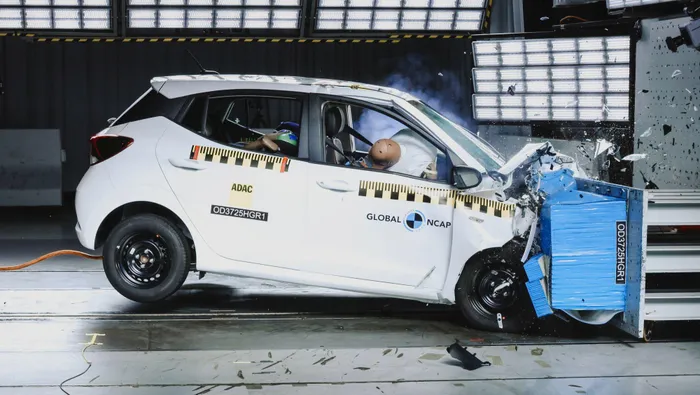
The Hyundai Grand i10 received a zero-star Global NCAP rating.
Image: Supplied / Global NCAP
Hyundai South Africa has weighed in on the ongoing controversy surrounding a zero-star safety rating given to its Hyundai Grand i10 hatchback.
The Korean brand’s entry-level hatchback hit the headlines in early December after independent crash testing authority Global NCAP handed it a zero-star rating for adult occupant protection and a three-star rating for child protection. Although the vehicle is built in India, the rating applies to the South African specification as it was evaluated in accordance with Global NCAP’s #SaferCarsForAfrica campaign.
Hyundai South Africa did not immediately respond to the crash test report after it was released late last year, but after mounting pressure on social media – with even the Automobile Association weighing in to say it has no authority to ‘ban’ such vehicles - the importer released a statement on January 20.
In essence, Hyundai South Africa stated the obvious by pointing out that it meets all the minimum legal and homologation requirements as stipulated by the National Regulator for Compulsory Specifications (NRCS).
“For a vehicle to be approved for use on South African roads, it must meet 53 NRCS compliance requirements, including but not limited to braking performance, frontal impact protection, door latch integrity, child restraint anchorage systems, airbags and other regulated safety features. The Grand i10 meets all 53 of these compliance requirements,” the statement read.
While the carmaker described independent assessments as “useful”, it reiterated that they do not replace or override SA’s established regulatory standards.
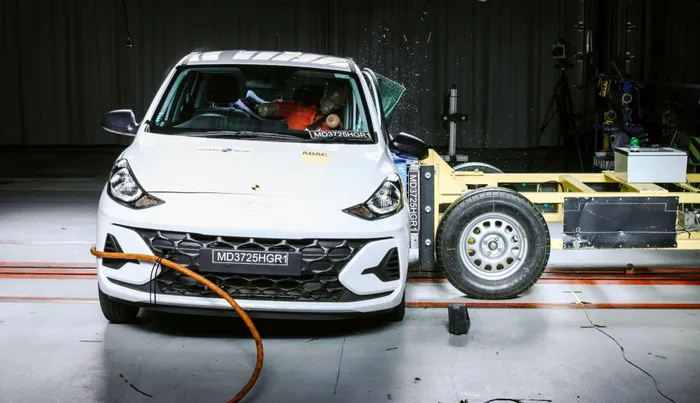
A lack of side and curtain airbags counted against the Grand i10 in the side impact test.
Image: Global NCAP
But given the carnage on our roads, is meeting the minimum legal requirements really good enough in 2026? After all, the Nissan NP300, which crumpled like a cardboard box during its Global NCAP test in 2018, also met the minimum SA safety standards.
Anecdotally speaking, and to the naked eye, the Grand i10’s structure did not appear to deform as severely during the Global NCAP test, but there are a number of factors to consider here.
Firstly, there is the actual crash load on the occupant’s body, and here Global NCAP cited weak protection for the driver’s chest in both the frontal and side impact tests, potentially leading to life-threatening injuries in the latter case. In fairness, though, it did offer “good” head protection for both the driver and front passenger in a frontal impact. Read the full report here.
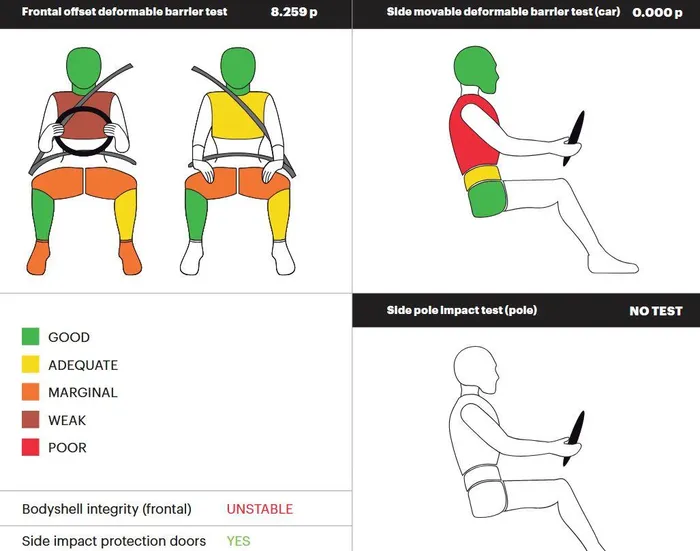
The Grand i10's adult occupant protection levels as rated by Global NCAP.
Image: Global NCAP
It’s also worth noting that Global NCAP’s crash testing protocol has become stricter over the years, and test criteria have been tightened across the board. Since August 2025, additional safety equipment such as electronic stability control (ESC) and side impact protection has been required in order to achieve higher ratings.
And that’s where the Hyundai lost many of its points, given that it has no standard ESC, nor does it have side or curtain airbags, and a seat belt reminder is only provided for the driver. That said, is it really fair to hold a company responsible for the thoughtlessness of those who don’t buckle up?
On the upside, Hyundai SA’s CEO Stanley Anderson did at least state that the importer was working closely with its global supplier to “respond to the increasing safety requirements” of South African motorists.
It is hoped that we will see some action on that front, especially given that rivals such as the Suzuki Celerio and Toyota Vitz, as well as the Suzuki Swift, now have six airbags as standard, as does the range-topping Renault Kwid. ESP has also become commonplace in entry-level cars.
Granted, Hyundai is in a bit of a bind as this is a very price-sensitive market, and this is by far the local importer's best seller. But with the Grand i10 now being offered with six crash bags as standard even in its home market of India, shipping them to South Africa with just two is becoming very hard to justify.
ALSO READ: These are the best (and worst) new cars you can buy for less than R200,000
IOL Motoring