Just five steps to health
|Published


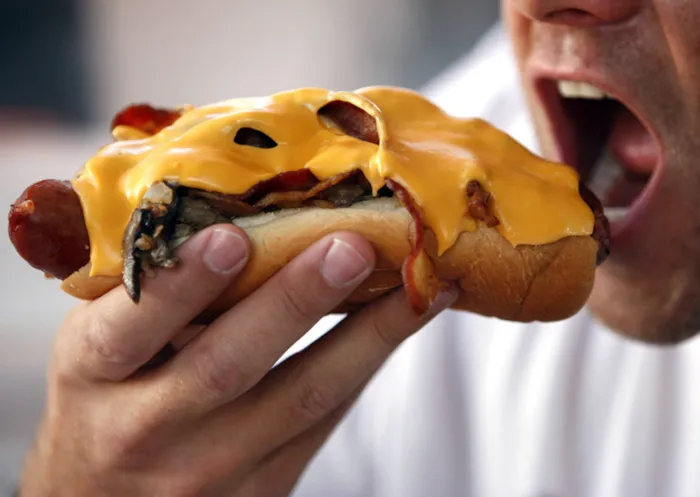
Drop that hotdog! An ideal diet contains unsaturated fatty acids, fruit and vegetables, little red meat and a lot of fish. Drop that hotdog! An ideal diet contains unsaturated fatty acids, fruit and vegetables, little red meat and a lot of fish.
World-renowned cardiologist Professor Lionel Henry Opie’s advice for those wanting long-term healthy hearts and minds is to change their lifestyle.
Following the “Big Five” lifestyle choices can play a major role in preventing heart attacks, strokes and cancer.
Opie is Director Emeritus at the Hatter Cardiovascular Research Institute at the UCT Medical School and the recipient of the National Science Award for Life-Long Achievements. The first edition of his award-winning book Living Longer, Living Better: The Heart-Mind Relationship (Oxford University Press) sold out in India.
Interviewed in his UCT office, Opie said he had been motivated to write the book for his cardiac patients to put over in layman’s language the scientific data about lifestyle choices, thus counteracting printed fallacies such as “Cholesterol isn’t too bad”, or “High blood pressure gives higher thoughts”.
“An important study was conducted of 114 090 health professionals in the USA, among informed doctors, nurses and physiotherapists, whose lifestyles were followed for 16 to 18 years. This represented almost two million person-years for analysis.
“What emerged was that the “Big Five” lifestyle choices could collectively give a total of 79 percent protection against heart attacks, strokes and cancer. They are:
* Not smoking: 28 percent (Protection of arteries)
* Exercise: 17 percent – 30 minutes or more a day (slows the heart, lowers blood pressure).
* Ideal weight: 14 percent (avoids toxic chemicals released from fat cells).
* Ideal diet: 13 percent (high unsaturated fatty acids, high fruit and vegetables, low red meat, high fish).
* Modest alcohol: seven percent (one to two drinks for women two to three for men. Helps anti-stress and improves blood cholesterol patterns).
“Sticking to all five principles is a tough call and in the men’s study only four percent could do so… but there is good news. We can still get most of the benefit without exhausting ourselves.
“Combining the three more feasible criteria, non-smoking, physical exercise and light to moderate alcohol and you get two-thirds of the maximum benefit. That is a definite advantage over the desperate situation of those who have no protective lifestyle components.”
Asked about the remaining 21 percent, he said this involved psychological factors not scientifically evaluated.
“It’s got to do with those who somehow surmount life’s problems, somehow seem happy, and feel integrated, particularly in the workplace.”
Someone like Lionel Henry Opie. At 78, he is a survivor. His three younger sisters pre-deceased him. He has twice been savagely beaten by armed robbers in his home. He has a serious back problem, yet he is an active academic who sees patients twice a week and was recently appointed by UCT to the new post of Senior Scholar for the next three years.
“Why do I survive? Because I feel in the biggest terms that life is worth living and despite all the hazards and the physical problems, I still have that spirit to look to the future.
“I’ve got a strong drive to write and to teach and I’ve got a strong background in my wife Carol, who has supported me in many ways. One of my greatest occupations was walking on the mountain and now I can just about walk in Newlands Forest on the flat... but all of these things are better than nothing and are better than lying down.That’s why I survive.”
He points out that lifestyles that protect the heart also protect the brain, which is a far more complex organ than the heart with less well-defined criteria for damage prevention.
“However we do know from an amazing study on London taxi drivers that exercising the brain does help with memory loss.
“London taxi drivers require an enormous knowledge. A study was done of the drivers’ memory sector by making visual slices of the brain with brain-penetrating radiography. Five years later it was repeated and it was noted that the hippocampus, which is associated with memory, had improved. It had got fatter! More work, better memory.
“Most of us don’t want to be London taxi drivers, but I think that it is an important study to show that exercising the brain, helps to expand the bit of the brain that you are using!” - Cape Times