The housing divide: mapping the expansion of informal settlements in SA cities


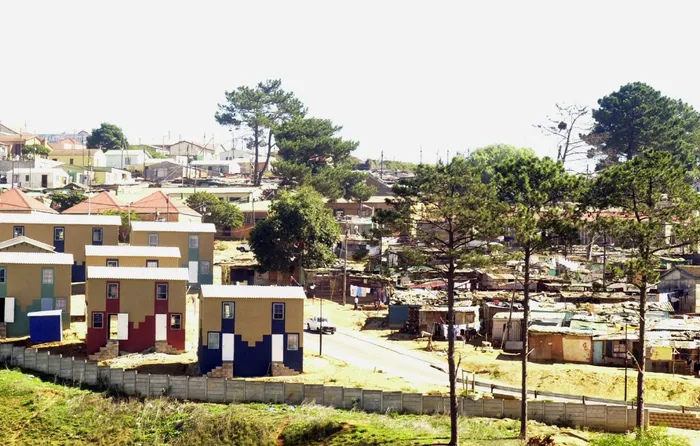
Over time, the conditions formed at the urban edge begin to press inward, reshaping the city itself.
Image: Lulama Zenzile
Informal settlements stretch along highways and vacant land long before South Africa's major cities formally appear.
Approaching Johannesburg along its main entry routes, or entering Cape Town, Durban or Tshwane from their peripheries, a pattern becomes difficult to ignore, says Professor Joseph Sekhampu, the chief director of the North West University (NWU) Business School.
He says that the city does not begin at its centre, but at its margins.
“These spaces are often described as zones of incomplete incorporation. But that misses their deeper significance. They are not simply the edges of the city. They are where South Africa’s municipal crisis is being relocated,” Sekhampu says.
More than a spatial feature of urban life
The chief director of the business school says this is more than a spatial feature of urban life. He says it reflects a deeper ordering of how the country functions.
“The edges of our cities are no longer transitional spaces waiting to be integrated, but visible landing zones of a municipal system that cannot continue to hold together across its full territorial extent.
"What appears here is not only urban poverty but also the afterlife of collapsing local economies and municipalities that no longer sustain social and economic life in place.”
Earlier this year, the City of Tshwane said it requires R32.5 billion to upgrade or relocate all existing informal settlements in the municipality. This figure far exceeds the City’s current budget and available resources.
The professor says in several parts of South Africa, towns remain administratively intact without a sustaining economic base. Agricultural activity has become more capital-intensive and less labour-absorbing, he says, while small local industries have disappeared or failed to scale.
“Public sector employment is no longer sufficient to anchor local demand. What remains is a municipal structure without the productive depth required to sustain it. These municipalities persist in law and administration, but no longer in any meaningful economic sense.
"While governance failures have accelerated this process, they do not fully explain why many municipalities no longer rest on a sustaining economic base.”
The university's business school says that as local economies hollow out and services deteriorate, people leave. It adds that for many, staying is no longer a viable option.
“They leave for the country’s major cities, arriving at their edges, where informal settlements spread along roads, rail lines, and vacant land. They are places where households live without secure housing, stable work, or reliable services, close enough to depend on the city, but too far to be part of it.”
The strain on the country’s metros is often framed as a problem of urban management, as if cities are simply failing to absorb migration quickly enough.
In reality, Sekhampu says it is produced upstream by a municipal system that continues to sustain the administrative structure long after its economic rationale has eroded. He says the consequences are redistributed towards metropolitan regions, where they are reassembled at the urban edge.
“There, population inflows, weak labour absorption, and limited infrastructure combine to produce a more diffuse form of instability, less visible than collapse but more difficult to contain.”
Informal settlements at urban periphery: a frontier of collapsing local economies
The professor says informal settlements at the urban edges of the main cities are not merely sites of deprivation. He says they are frontier zones where collapsing local economies meet an urban system that cannot fully integrate those who arrive.
“The result is partial incorporation, where proximity to opportunity does not translate into stable access. What is taking shape is not simply a hierarchy of stronger and weaker municipalities, but a narrowing of where local government still functions.
"Viability is concentrating in specific locations, while other areas persist in administrative form without equivalent effect.”
Municipal finances, capacity, and local economies pressures are becoming more pronounced
Recent policy reflection is beginning to acknowledge this strain, Sekhampu says. He says the review of the White Paper on Local Government recognises that the assumptions underpinning the post-1994 system no longer hold uniformly, as pressures on municipal finances, capacity, and local economies become more pronounced.
Yet the response remains framed in terms of reform rather than redesign, avoiding the harder implication that some municipalities may no longer be viable in their current form.
The chief director says SA may already be undergoing a form of municipal consolidation in practice, not through deliberate reform but through a quiet reallocation of viability.
He says the municipal map remains intact, but the conditions that give it meaning are being unevenly withdrawn.
“This is not simply uneven development, but a process of systemic contraction, in which the capacity to sustain governance, economic activity, and social life is concentrating in fewer spaces. What falls away elsewhere is carried outward.”
Conditions formed at the city edges end up pressing inwards
It is at the urban edges of the country’s major cities that these processes begin to converge, Sekhampu says.
He says that over time, the conditions formed at the urban edge begin to press inward, reshaping the city itself. The risk is not only that parts of the country fall away, but that the places expected to hold everything together begin to change in ways that are less stable, less predictable, and harder to contain, he says.
“The next time you drive into a city like Johannesburg or Cape Town, the settlements that line the road are not simply the margins of the urban system. They are where its limits are already visible.”
City planning key to inclusive cities
According to the South African Cities Network, how a city is planned shapes who gets to participate in it.
The network that promotes good governance and management in cities says that where people live, how far they travel to work, and whether they can access basic services or opportunities are all outcomes of spatial decisions.
“In South Africa, the legacy of fragmented, unequal urban form is still visible in long commutes, uneven service delivery, and limited access to economic hubs for many residents. This is why spatial governance is not just a technical function; it sits at the heart of building fair, inclusive and resilient cities.”
Independent Media Property