Oil rallies after Donald Trump's 'unimpressive' speech: Latest developments in the Middle East


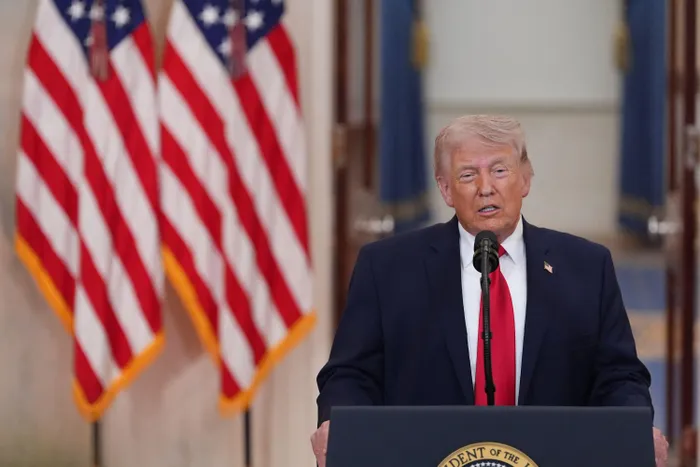
US President Donald Trump speaks from the Cross Hall of the White House on April 1, where he used the prime-time address to update the nation on the war in Iran.
Image: Getty Images via AFP
Oil prices spiked and stocks sank on Thursday after Donald Trump reiterated that US forces would hammer Iran for another two to three weeks but offered no solution to the closure of the Strait of Hormuz that has crippled global markets.
Investors appeared to be unimpressed with the US president's much-anticipated address to the nation, in which he again called on countries that rely on the waterway for their energy supplies to reopen it themselves.
The comments came amid growing fears about the economic impact of the crisis, which has seen governments introduce support measures, with the World Bank saying it was "extremely concerned".
In a speech lasting less than 20 minutes, Trump added little to what he has said in the past, warning that "over the next two to three weeks, we are going to bring them back to the Stone Ages, where they belong".
He also told the nation that US forces would meet all their battlefield goals "very, very shortly".
The address dented a nascent recovery in world markets that had come after Trump said earlier this week that the war would be ending "very soon", while his Iranian counterpart said his country had the "necessary will" to end it.
Brent crude, which had fallen back below $100 a barrel on Wednesday, surged as much as five percent to hit $106.29, while West Texas Intermediate jumped more than four percent to as high as $104.29.
Trump "spoke of objectives met, but not of resolution. Of continued strikes, not withdrawal. Of optional escalation, not closure", wrote Stephen Innes at SPI Asset Management.
"The message was not one of panic, but it was unmistakably one of unfinished business. And in markets, unfinished business is oxygen for volatility.
"So oil did what oil always does when the illusion cracks. It surged, not because the war suddenly worsened, but because the market had prematurely priced in the expectation that it would end."
The reaction among equity traders was no better, with Seoul — which soared more than eight percent on Wednesday — losing three percent. Tokyo, Hong Kong, Shanghai, Singapore, Taipei and Sydney were also well down.
The speech "did not contain what the market had hoped for — namely, indications of an end to the fighting", Jumpei Tanaka, of Pictet Asset Management, said. "Instead, he suggested a potential escalation of the situation, which is a clear negative for stocks."
Markets have endured huge volatility since the US-Israeli war on Iran was launched on February 28, with the president frequently U-turning after making policy statements, particularly with regard to foreign relations and military operations.
His announcements that Washington and Tehran were in peace talks have often been denied by the Islamic Republic, while its Revolutionary Guards insisted the strait will remain closed to the country's "enemies".
Trump's repeated demand that countries that rely on energy through the Strait of Hormuz "get your own oil" comes as Britain prepares to host a meeting of about 35 nations on Thursday to discuss how to reopen the waterway.
The meeting will "assess all viable diplomatic and political measures that we can take to restore freedom of navigation, guarantee the safety of trapped ships and seafarers and resume the movement of vital commodities", UK Prime Minister Keir Starmer said.
Iran fires missiles at Israel after Trump threatens weeks of strikes
Israel said it came under Iranian missile fire on Thursday after US President Donald Trump threatened to bomb the Islamic republic into the "Stone Ages" with heavy strikes in the next two to three weeks.
Despite Trump's threats, Israel's military said Iran twice fired missiles at the country after his address, part of four barrages detected within six hours on Thursday.
Iran has dismissed Washington's ceasefire overtures, describing US demands to end the conflict as "maximalist and irrational".
"Messages have been received through intermediaries, including Pakistan, but there is no direct negotiation with the US," said Iranian foreign ministry spokesman Esmaeil Baqaei, quoted by the ISNA news agency on Thursday.
Pro-government Iranians in the capital, Tehran were also defiant at the funeral of a Revolutionary Guards naval commander who was killed in an Israeli strike.
"This war has lasted a month. However long it takes, we will continue," said Moussa Nowruzi, a 57-year-old pensioner.
"We will resist until the end."
Gulf protection
Trump also assured regional allies Israel and Gulf nations that Washington would protect them from Iranian retaliatory fire, as more attacks were reported across the region on Thursday.
He addressed Israel, Saudi Arabia, Qatar, the UAE, Kuwait and Bahrain — all battered by Iranian drone and missile attacks — that the United States "will not let them get hurt or fail in any way, shape or form".
As Israel prepared for the Passover holiday, which began at sunset Wednesday, air raid sirens sounded repeatedly in the Tel Aviv area.
On Thursday, the United Arab Emirates said its air defences were again responding to missile and drone "threats".
The Revolutionary Guards also confirmed hitting an oil tanker in the Gulf, which they said belonged to Israel. A British maritime security agency said the vessel was struck off Qatar, reporting damage but no casualties.
In Lebanon, militant group Hezbollah said its fighters launched drones and rockets at northern Israel on Thursday, with the Israeli military's Home Front Command saying air raid sirens were activated across the border.
A day earlier, Israel killed a top Hezbollah commander, two sources told AFP, in a Beirut strike that the Lebanese health ministry said killed seven people.
Authorities in Lebanon say Israeli attacks have killed more than 1,300 people in the country since war erupted between Israel and Iran-backed Hezbollah on March 2.
Hormuz 'courage'
Hours before Trump's address, Iran's President Masoud Pezeshkian asked the American people whether the conflict was truly putting "America First", accusing Washington of war crimes and of being influenced by Israel.
Trump had claimed earlier Wednesday that Iran's president had sought a ceasefire, but said the Islamic Republic must first reopen the Strait of Hormuz — which he said in his address would happen "naturally" once the conflict ended.
Iran's Revolutionary Guards vowed on Wednesday to keep it shut to the country's "enemies".
After a wave of anti-government demonstrations that crested in Iran in January over economic grievances, some Iranians still privately long for political change, particularly after Trump himself had promised to come to their aid.
"He betrayed the Iranians," said one woman in her 30s, requesting anonymity for security reasons.
Sounding resigned, she added she no longer expects a change of government, but "if they could grant us more freedoms, we could live with that".
AFP