School’s out: What you need to know about 2026 university fees in South Africa



Making an informed choice about university isn’t just about what you want to study.
Image: Freepik
Choosing a degree and university is one of the biggest decisions that learners and their families will have to make.
Tuition fees vary across universities and programmes, and different degrees open doors to very different careers.
Here’s a quick guide to the main degree types, what you might study, potential careers, who it might suit, and how to make sense of the costs.
Bachelor of Arts (BA)
What it is: A BA is a broad, humanities-focused degree covering subjects like languages, history, sociology, psychology, media, and the arts. Many universities offer different streams, such as digital arts, drama, or development studies.
Potential careers
- Journalism, media and public relations
- Teaching and education
- Social work or counselling
- Policy research or government roles
- Cultural and arts management
Would suit you if…
- You enjoy reading, writing, and storytelling
- You are curious about people and society
- You like creative expression or critical thinking
- You prefer flexible career options rather than a strict technical path
Bachelor of Commerce (BCom)
What it is: A BCom focuses on business, finance, economics, and management. Specialisations include accounting, marketing, human resources, econometrics, and supply chain management.
Potential careers
- Accounting and finance roles in firms or banks
- Economic or policy analysis
- Corporate management or consulting
- Marketing or human resource management
- Business analytics or entrepreneurship
Would suit you if…
- You enjoy numbers, problem-solving, and strategy
- You are organised and analytical
- You like working in business, finance, or structured environments
- You are motivated by career growth and leadership opportunities
Bachelor of Science (BSc)
What it is: A BSc is science-focused and can cover natural sciences, technology, or mathematics. Common fields include biology, chemistry, physics, computer science, environmental science, and mathematics.
Potential careers
- Research in labs, universities, or industry
- Health sciences, biotechnology, or environmental work
- Technology, data analytics, or IT systems
- Conservation and ecological roles
- Quantitative or mathematical analysis
Would suit you if…
- You enjoy experimentation, problem-solving, and discovery
- You are curious about how things work
- You are comfortable with math, technology, or scientific methods
- You prefer structured, technical or analytical work environments
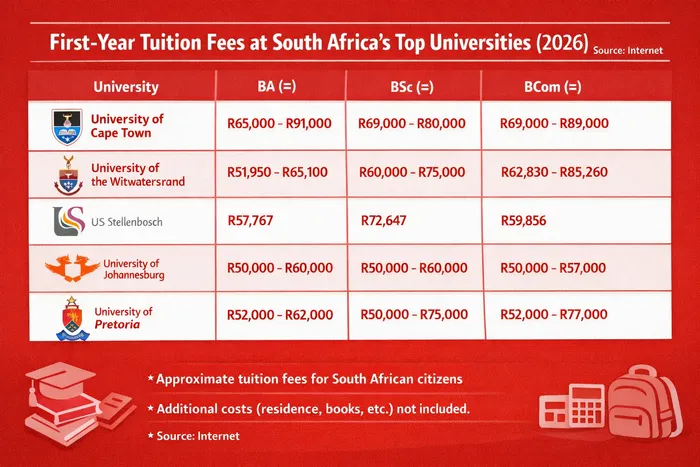
Here's what some degrees will cost you this year.
Image: ChatGPT
Making sense of the numbers
Tuition is only part of the cost. Fees vary depending on:
- How many modules you take in a year
- Your choice of specialisation or faculty
- Additional costs like residence, textbooks, campus services, and transport
Understanding these factors helps families plan for the total cost of studying, not just the headline tuition figure.
How you can pay for university
Bank loans
- Student loans cover tuition and living costs. Interest rates vary, and repayment usually starts after graduation.
Scholarships
- Merit-based awards from universities or external organisations can significantly reduce tuition. Some cover full tuition for top-performing students.
Bursaries
- Offered by companies or professional bodies. They may require work back or internships in the sponsoring company after graduation.
Government support (NSFAS)
- For qualifying students from lower-income households, NSFAS can cover tuition, accommodation, and some living expenses.
Making an informed choice isn’t just about what you want to study – it’s about understanding career options, personality fit, costs, and funding opportunities. Giving school leavers this guidance helps them plan smarter and reduces financial and career surprises down the line.
IOL BUSINESS