What’s next for Geordin Hill-Lewis and John Steenhuisen in the DA?


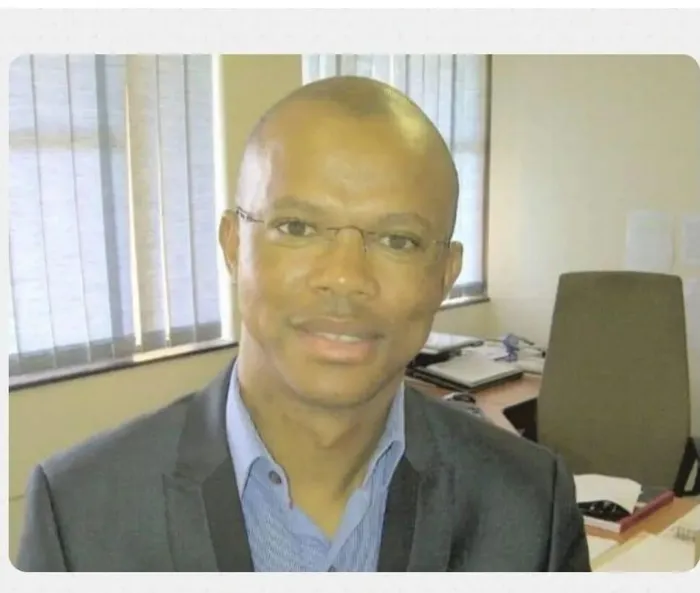
Jason Lloyd a political and economic commentator.
Image: Supplied.
Jason Lloyd
The new leader of the Democratic Alliance (DA), in all likelihood Geordin Hill-Lewis, may soon be compelled to make a difficult decision: whether to replace John Steenhuisen as Minister of Agriculture. Should this occur, Steenhuisen would likely remain in Parliament as an ordinary member, confined to the back benches until the next national election in 2029.
Having recently turned 50, he remains relatively young in political terms. Yet, questions inevitably arise as to what his professional and financial future might look like beyond that point. Steenhuisen, the current leader of the DA, has already indicated that he will not stand for re-election at the party’s federal congress scheduled for 11 and 12 April in Johannesburg. His leadership style has never resembled that of overtly populist figures such as Donald Trump, Boris Johnson, or Nigel Farage.
Rather, it belongs to an earlier political grammar—one defined by disciplined messaging, measured communication, and controlled media engagement, reminiscent of the era of Tony Blair and Bill Clinton. In the contemporary age of social media politics, where immediacy, personality, and emotional resonance often carry greater weight, this approach has arguably limited Steenhuisen’s ability to project a distinctive and compelling political identity. The period from roughly 2016 to 2026 has marked a shift in voter expectations — one that favours visibility and authenticity over technocratic restraint.
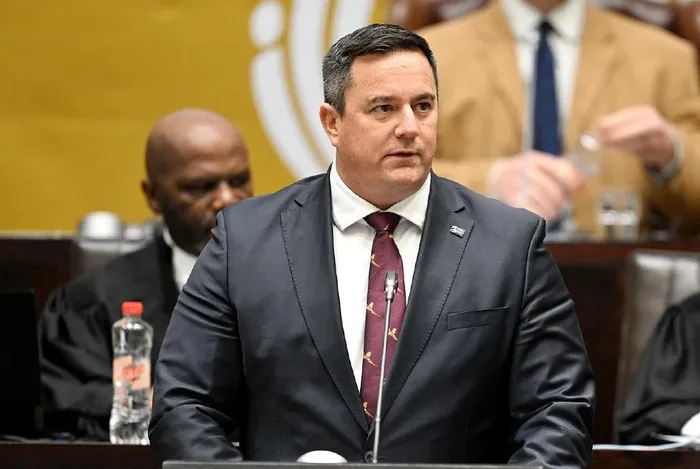
Minister of Agriculture John Steenhuisen.
Image: Phando Jikelo / Parliament of RSA
Nevertheless, Steenhuisen has worked diligently as leader of the DA, demonstrating notable political resilience in navigating the often-unforgiving terrain of South African politics. He has generally conducted himself with sincerity and integrity and is widely regarded as well-read, possessing a natural intellectual acuity despite lacking formal university qualifications. The distinction between academic credentials and intellectual capability is frequently overlooked in public discourse, particularly in his case.
As an English-speaking politician from Durban North, Steenhuisen has also made a deliberate effort to improve his Afrikaans in order to engage more effectively with Afrikaans-speaking Coloured communities in the Eastern, Northern and Western Cape, as well as predominantly Afrikaans-speaking farmers across the country. These efforts are noteworthy and merit recognition. It remains to be seen whether Hill-Lewis, a Cape Town native from the largely Afrikaans-speaking Western Cape, will pursue a similar course. Some observers have, somewhat ironically, suggested that his Afrikaans is less developed than Steenhuisen’s, and that strengthening it could broaden his appeal among Afrikaans-speaking voters.
Within Parliament, Steenhuisen has long established himself as a disciplined and capable debater within South Africa’s legislature, which is rooted in the traditions of the Westminster system. His contributions are typically structured, procedurally fluent, and aligned with party discipline—hallmarks of a managerial approach to parliamentary politics. However, when compared with notable Westminster figures such as Tony Benn, Enoch Powell, and Michael Foot, the contrast is instructive. These individuals elevated parliamentary debate into moments of intellectual and moral theatre. Steenhuisen, by contrast, operates with restraint and technical precision, reflecting a modern, professionalised style that is effective, reliable, and strategically sound, though less rhetorically memorable.
Under his leadership, the DA has continued its evolution into a more modern political party, seeking to engage with the realities of a post-COVID economy and shifting global dynamics. The party has strengthened its policy capacity, focusing on updated and forward-looking positions on economic policy, foreign relations, diplomacy, trade, and industry—intended as both an alternative to and a counterweight against the policy direction of the ANC. Following the 2024 national election, the DA entered the Government of National Unity (GNU), marking a significant transition from opposition to a constructive governing partner.
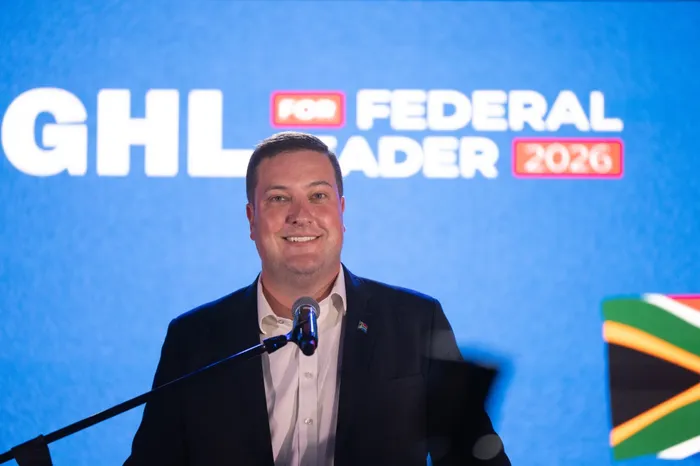
Cape Town Mayor Geordin Hill-Lewis addresses supporters and party leaders ahead of declaring his bid to succeed John Steenhuisen as leader of South Africa's Democratic Alliance (DA).
Image: Henk Kruger / Inependent Media
In this role, it has advocated fiscal discipline, regulatory reform, and private-sector growth, contributing to improved investor confidence and a degree of economic optimism. It has also influenced policy debates around merit-based appointments, education, healthcare, and infrastructure, positioning itself as apragmatic and responsible partner in governance. Yet Steenhuisen’s tenure has not been without controversy. Questions have arisen regarding his personal financial management, including reports of outstanding personal debt despite a substantial combined income exceeding R3 million per annum. Additional scrutiny followed requests for a clothing allowance and disputes surrounding the use of a party-issued credit card, which led to internal tensions involving Dion George.
Strategic political appointments have also drawn criticism. The appointment of Alexandra Abrahams as Deputy Minister of Trade, Industry and Competition was intended to strengthen representation and broaden appeal among Coloured voters, particularly in the Western Cape. However, limited public visibility and subsequent electoral setbacks—most notably gains by Gayton McKenzie’s Patriotic Alliance—have highlighted the risks associated with such decisions. More recently, Steenhuisen’s handling of the outbreak of Foot-and-mouth disease has intensified scrutiny. Media narratives have portrayed him as constrained by bureaucratic inefficiencies and ANC policy frameworks, raising doubts about his command of the situation. Structural weaknesses within veterinary services—such as capacity constraints, budgetary pressures, and fragmented coordination—have further complicated the state’s response.
The consequences have been significant. Farmers and industry stakeholders have expressed dissatisfaction, particularly in light of stringent containment measures,including large-scale culling—reports indicate that approximately 300,000 pigs in Gauteng were destroyed—as well as quarantine zones and movement restrictions that have disrupted agricultural production and supply chains. The crisis has also raised broader concerns regarding bio security, food security, and the resilience of rural economies. Within the DA itself, concerns have emerged that Steenhuisen’s handling of the crisis may carry electoral consequences, particularly ahead of the upcoming local government elections.
His strained relationship with Theo de Jager of Saai has further fuelled concerns about potential losses among Afrikaner and Afrikaans-speaking farming constituencies. The broader question, however, is whether Steenhuisen could become SouthAfrica’s next “Kortbroek”—a colloquial and somewhat pejorative term historically associated with Marthinus van Schalkwyk. The nickname has come to symbolise a political figure perceived to have abandoned their original constituency or principles in pursuit of political survival or advancement.
Van Schalkwyk’s decision to dissolvethe National Party and align with the ANC remains the defining example.Could Steenhuisen follow a similar trajectory? Should he be removed from his ministerial post and fail to secure re-election to Parliament in 2029, it is conceivable—though speculative—that he might explore alternative political pathways, including alignment with the ANC.
Such a development would carry significant implications for the DA. It could signal internal instability, weaken party cohesion, and undermine confidence among core supporters. It would also reinforce narratives advanced by political opponents that the party struggles to retain senior leadership during periods of transition. Yet such comparisons should be made with caution. South Africa’s political landscape has evolved, and individual decisions are shaped by complex and context-specific dynamics. Nonetheless, the question remains both provocative and consequential: does Steenhuisen’s future lie within the DA, or might shifting political currents ultimately place him on a path similar to that of Van Schalkwyk—and what would that mean for the future of South African politics?
*Lloyd a political and economic commentator.