OPINION: Navigating the legal complexities of Cape Town's municipal charges


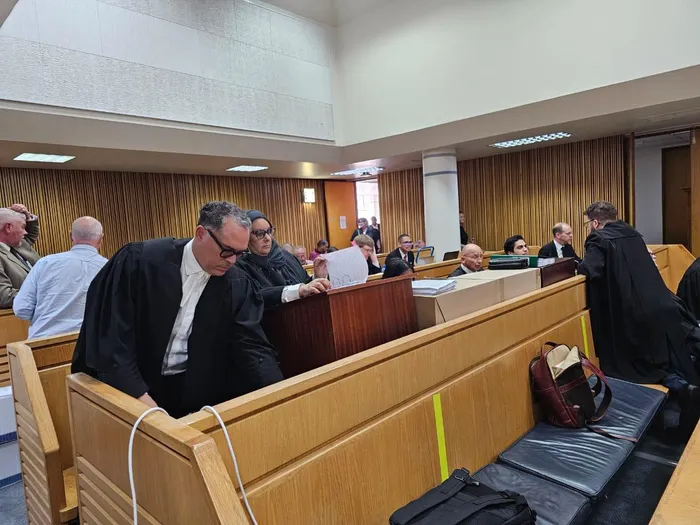
Advocates Nazreen Bawa SC, (right) and Nick de Jager (left) in the Western Cape High Court.
Image: Theolin Tembo
It goes to show the calibre of the legal prowess on display when one almost feels sympathetic for the City of Cape Town, whose legal team gave voice to what they had described as one of the “most complex cases that we’ve ever had to articulate”.
Advocates Nazreen Bawa SC, Karrisha Pillay SC, and Nick de Jager should be commended for their herculean effort of not only having to articulate the City’s position on its fixed three tariffs, but also doing so in a manner that was as complex as the matter at hand, but still clear enough for everyone to follow.
Since Tuesday, Judge President Nolwazi Mabindla-Boqwana, as well as presiding judges Judge Andre Le Grange and Judge Katharine Savage, heard from legal representatives from SAPOA, AfriForum, the City, GOOD, Cape Town Ratepayers Association, SA 1st Forum and Cogta.
In its main application, SAPOA and AfriForum were asking for the three tariffs in the budget, namely the Cleaning Tariff, the Fixed Water Charge, and the Fixed Sanitation Charge, to be declared unconstitutional and invalid.
The City has maintained that its fixed charges are not rates but service charges.
In the City’s counter-application, they are seeking that, should the court rule in favour of AfriForum and SAPOA, they want Section 75A of the Systems Act be declared inconsistent with the Constitution and invalid, as it impedes their ability to exercise their full municipal powers and deliver services to communities.
While the judges had reserved judgment in the matter, the case has brought to light a few difficult realities that have to exist simultaneously.
Not only does the City of Cape Town have to navigate generating revenue for municipal services and ensuring service delivery is maintained, but it also has to do so within the strict confines of the Value-Added Tax Act, Municipal Systems Act, and the Municipal Finance Management Act.

The City of Cape Town's legal representatives are seen leaving the Western Cape High Court on Thursday after judgment was reserved in the SAPOA and AfriForum matter. SAPOA and AfriForum are asking for the three tariffs in the budget, namely the Cleaning Tariff, the Fixed Water Charge, and the Fixed Sanitation Charge, to be declared unconstitutional and invalid.
Image: Theolin Tembo
They also have to keep the challenges of Cape Town’s poorest residents front and centre as well.
In striving to do all of this, come the challenges faced by ratepayers and residents who are already struggling to make ends meet. AfriForum’s Advocate Etienne Botha SC put it succinctly when he said, “one does not ignore the fact that the City has challenges”; however, “one must not forget what the challenges of the people in the municipality are”.
All throughout the week's proceedings, it was felt like a scale weighing up the cost of a municipality delivering on what it has been elected and mandated to do, versus the price of residents bearing the financial burden of funding that mandate, and protecting their quality of life.
In court, the City’s lawyer brought up the Budget wherein the value of how every Rand in Rates and Tariffs is spent was re-emphasised. For every R1:
- 29 cents is allocated to law enforcement, traffic services, metro police, fire department.
- 15c for rate rebates
- 8c for infrastructure
- 8c for parks and recreation facilities
- 6c for MyCiTi bus service
- 6c for Cost of borrowing to fund infrastructure
- 6c for investing in Information Systems & Technology
- 5c for Citizen engagements and Customer Care
- 4c for City clinics and Health care
- 4c for City Facilities, Fleet & Walk-in Centres
- 4c for Informal trading, Tourism and economic growth
- 3c Public spaces, environment and amenities
- 2c for libraries
Advocate Bawa further stresses that this doesn't even take into account the services rendered. While the intent is meant to illustrate how every rand is spent, it does manage to undercut the frustration of feeling like your money is being wasted… albeit by only a smidge.
Or is it just the power of a good pie chart?
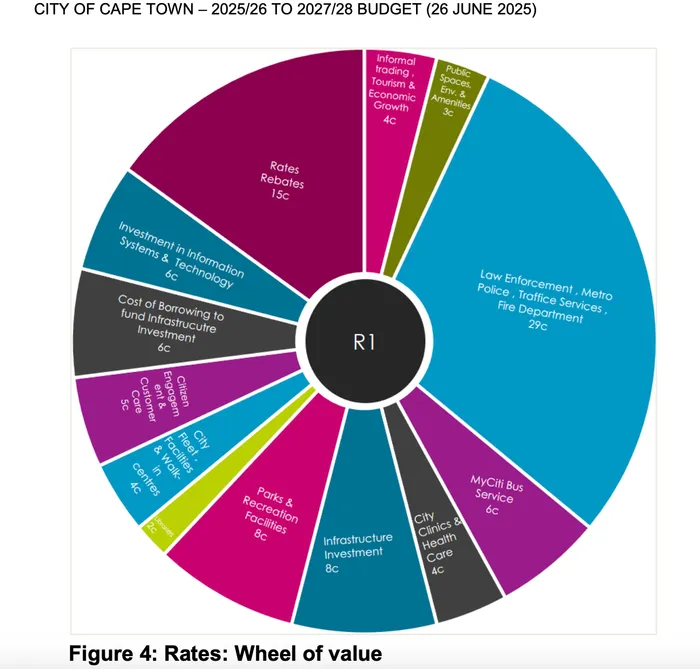
City of Cape Town's Wheel of Value for Rates
Image: Screenshot
Judge Savage articulated the complexity of the matter on Thursday, when she said: “It is really impossible for us to get to the bottom of this… One really needs to understand, it is a highly technical situation. I have no difficulty with the City rolling out infrastructure.
“The difficulty that I've got is trying to unpack at what point is it a service, and what point is in infrastructure development cost?”
“The court needs to be careful in a case like this. To constrain that sort of infrastructure development and the availability of funds for that service, versus we (us) not coming up with a judgment, which allows for dysfunctional municipalities to put on service charges for absolutely anything that they choose, without any recourse.”
As residents, we want to live in a thriving City where we feel safe. We don’t want to feel like the hard-earned money paid to the municipality is being recklessly spent. We don’t want to feel like we're being taken advantage of by a money-hungry municipality, finding every loophole at their disposal to line their pockets.
As residents, we understand that everyone has their part to pay, including the subsidising for the poor; we just don't want it to come at the cost of our quality of life.
Ratepayers don’t want to sacrifice providing for their families and paying their debts because of exorbitant rates and tariff fees.
When people are forced into a corner, to weigh up between paying their utilities and food… it isn’t a difficult choice.
Residents can understand the City’s situation to provide services, and the means they go to do so, but at the same time, they feel like the City doesn’t understand theirs.
The Bench has a difficult job ahead of it, and personally, I do not envy having to weigh up the responsibilities and powers of a municipality with those of the people who reside within it. The wealthy, the poor and the middle class.
* Tembo is a Features Journalist at Independent Media. He writes in his personal capacity.