Rediscovering history: The letters of Louis 'Speedy' Weber from the Normandy invasion


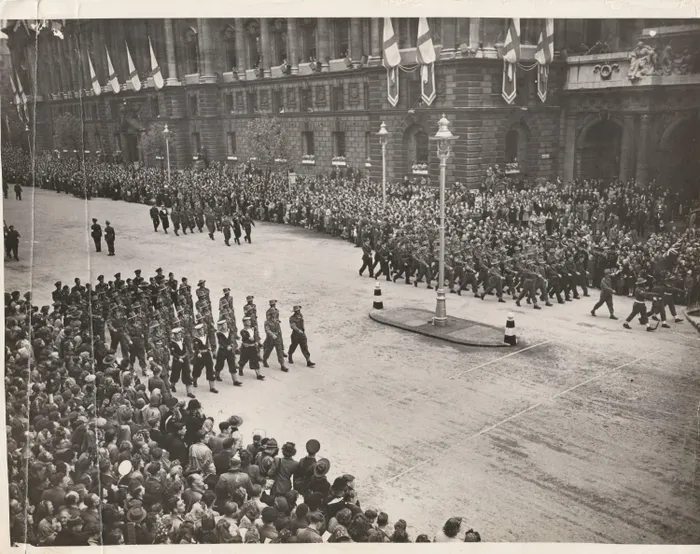
The first VE Day parade in London in 1946, marking the end of WWII.
Image: Photo Courtesy: SA Legion.
Louis “Speedy” Weber was 25 in June 1944 when he crossed the English Channel as part of the massive Allied invasion force that landed on Normandy beaches to push the Nazis out of Western Europe.
Even as a hardened American soldier who had fought in Africa and Italy, Weber was overwhelmed by the scope of Operation Overlord.
“This invasion made my other invasions look feeble,” he wrote in a letter to his wife, Frances, a few days later. “I never before saw as many ships, airplanes, and equipment in my whole war time experience.”
But during the crossing, he told her, he felt as safe as if he were in her arms, “because as far as the eye could see, there was nothing but ships of every description. When I looked up into the sky I had a hard time seeing the sun, because of the planes we had up there. It was a sight I’ll never forget.”
That single page of correspondence alone would be a treasured artifact, bringing to life a seminal event of the 20th century as seen through the eyes of a young private who wrote not knowing what the rest of the war held for him, not knowing if he would one day return to the Bronx home where he and Frances began their life together.
But the letter is just one of hundreds that Speedy sent to Frances during his time in the service.
In 2022, an anonymous donor gave the remarkable collection of dispatches to the USO, a nonprofit based in Arlington, Virginia, that offers hospitality, entertainment and support to service members.
Two years ago, the organization began digitizing them and publicizing its efforts in the hope that it would find out more about what happened to Speedy and Frances after the war, said USO archivist Michael Case.
So far, the USO has had little luck locating any relatives or friends of the couple to fill in the rest of their story.
It’s a bit of a long shot, but a new movie could help change that.
The USO is hoping that a tie-in to “Pressure,” a film released this week about the lead-up to the Normandy invasion, starring Brendan Fraser and Andrew Scott, will spark more interest and perhaps lead to new clues.
“We’re putting the letters back out there as people are talking about this movie,” said Jennifer Passey, vice president of communications at the USO. “We would love for anyone who may know more about Speedy or his wife, Frances, to reach out to us.”
The organization has posted a link to a video the film’s producers made for the USO of Scott reading one of Speedy’s letters to his wife.
“Pie in the sky is that someone will see this and say, ‘Hey, that’s my great-uncle and -aunt,’ and we can make the connection that way,” Case said. But, he said, he would also be happy just to find out who donated the letters and how that person came to have them.
The USO has posted photos and transcriptions of 26 of the letters on its site, placing them at the fingertips of online sleuths or anyone interested in immersing themselves in missives that capture love and longing in wartime in ways that are often intimate and funny, matter-of-fact, and magical.
They begin in 1942, after Speedy enlisted and was sent to training camp at Fort Dix in New Jersey.
“They got me up at 5:30 a.m.,” he wrote in one of his first letters to his wife. “I don’t know whether they want to make men of us or kill us before we get to Japan.”
Speedy is a lively correspondent: playful, reassuring, lusty, cranky. Most of his letters begin “Darling” or “Dearest.” But he also mixes it up: “Hi legs,” “Hi Knucklehead” and “Dear Meatball.”
“Hi Shape,” he writes in a letter from England not long before D-Day. “That’s just what you are in the pictures I received. What are you trying to do, get me hot. Showing me those gams of yours. You’re pretty smart aren’t you.”
Earlier in the war, he writes to her about the Allied invasion of Sicily in July 1943, and how German planes attacked American troops. “But not for long,” he writes, “because, when our planes weren’t taking care of them, the boys on the ground were giving them hell. Your husband wasn’t doing so bad either. (I’m not bragging, just part of a day’s work.)”
Speedy isn’t above complaining about conditions, and many letters contain requests for Frances to send him things including razors, money and food. In one letter, he asks her to send pimento cheese, Ritz crackers, sardines (no anchovies) and Italian salami. “That Orbit gum you sent is on the money, try to get more of that brand,” he adds.
In another, he has more than food on his mind. He asks Frances to wrap herself up in a package marked “fragile” and have it sent his way: “I’m pretty sure it will get to me in good order.”
While almost all of the letters are from Speedy to Frances, there are two she sent him while he was still at camp.
On board a train to Washington in 1942 that she described as “hot as all holy hell,” Frances wrote that she was eager to find out where he would be sent. “Don’t forget to let me know as soon as possible,” she told him. “I can’t write any more because this train is worse than the roller coaster in Coney Island. Please excuse the scribble. Don’t ever forget that I love you more than anything in this whole wide world.”
The sheer volume of letters the couple sent is impressive but was not out of the ordinary for the war, Case said. The instantaneous exchanges offered by email, texting, FaceTime and Zoom were still a half-century or more in the future, and letters were the only way troops maintained contact with family and friends back home.
In 1945, the Army Postal Service processed 2.5 billion pieces of mail, and an additional 8 million pieces were moved through Navy post offices, according to the National WW2 Museum.
Speedy had a wry ability to convey personal news with a bit of war reporting.
“I don’t think you’ve received the perfume I sent you yet, but in case you already don’t know, I bought the stuff in gay Paree,” he wrote Frances on Sept. 17, 1944, their third anniversary. “Paris is the most glamorous city in the world. Even though the Germans had just left and some stayed behind to do a little sniper work.”
The letters continued as the war in Europe drew to a close. Finally, in May 1945, Speedy wrote to Frances from Czechoslovakia to let her know that because he had taken part in the Africa and Normandy campaigns, he wouldn’t have to serve in the ongoing fight in the Pacific.
“Baby that's the best news I’ve heard in three years of Army life,” he wrote to Frances. Soon enough he would be returning to the Bronx and their home at 1517 Jesup Ave., the address he’d scrawled on hundreds of letters.
The couple’s first three years of marriage - spent almost entirely apart - are memorably chronicled in those yellowed and fading pages secured in the USO’s archives in Arlington.
But almost nothing is known about what their life together was like in the years that followed the war, other than that they apparently remained married. According to the spare obituaries available online, Speedy died at 78 on Feb. 19, 1997. Frances died at 87 on Feb. 24, 2005.
They are buried together in a Jewish cemetery near Fort Lauderdale, Florida. The rest of their story is untold.
The first VE Day parade in London in 1946, marking the end of WWII.
Image: Photo Courtesy: SA Legion.