In Slavery's Wake: A Cape Town exhibition on healing and resistance


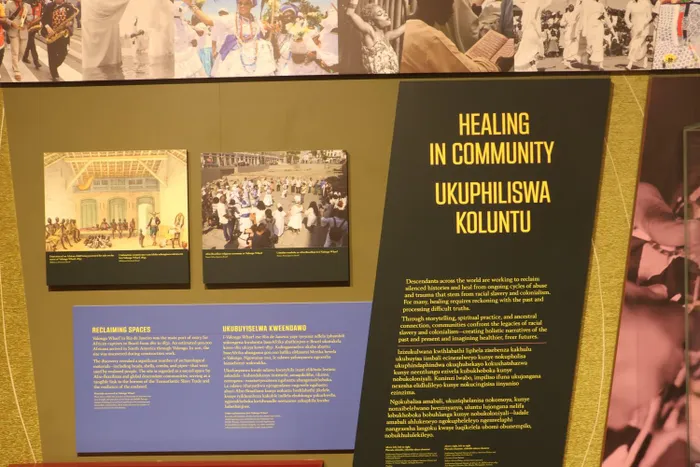
A section on healing which “requires reckoning with the past” is part of a new exhibition about slavery.
Image: Yazeed Kamaldien
A multi-media exhibition about slavery, that just opened in Cape Town, makes space for something often overlooked in this conversation — healing.
The exhibition, ‘In Slavery’s Wake: Making Black Freedom in the World’, is a reminder of what people in many parts of the world endured during Europe’s colonial period, as well as the many people who resisted it.
It depicts slave routes, stories of enslaved people, the abolition movement and the enduring effects of slavery in today's society.
This international exhibition is currently housed in multiple rooms at the Iziko South African National Gallery, in the Company’s Garden, until October. It has already been shown in the United States and Brazil, both countries with slave histories.
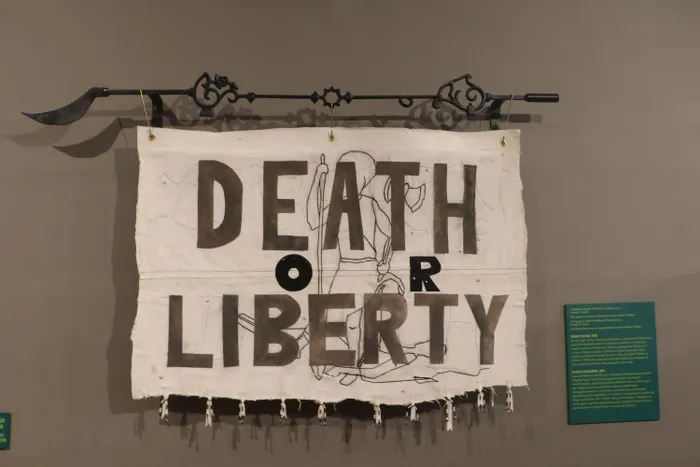
An artist’s interpretation of a banner that enslaved people made to voice their political stance.
Image: Yazeed Kamaldien
Curators at the recent exhibition preview were Shanaaz Galant from Iziko’s Slave Lodge, as well as Johanna Obenda and Paul Gardullo from the National Museum of African American History and Culture. A fourth curator, Paul Tichmann who is also from the Slave Lodge, could not attend the preview.
The section on healing is located towards the end of the exhibition, before visitors are asked to reflect on what freedom means to them.
Obenda said: “We end with healing because there are ongoing wounds related to this history.”
She said there was now also a “the need for creative engagement with existing archives” and to “create new archives and elevate ones that have been oppressed or not deemed official through a colonial lens.”
“We have a deep engagement with artists. One artist created banners based on historical flags that were carried. These flags do not exist but are (mentioned) in records. Think about how enslaved people used flags and banners to assert their political identity.”
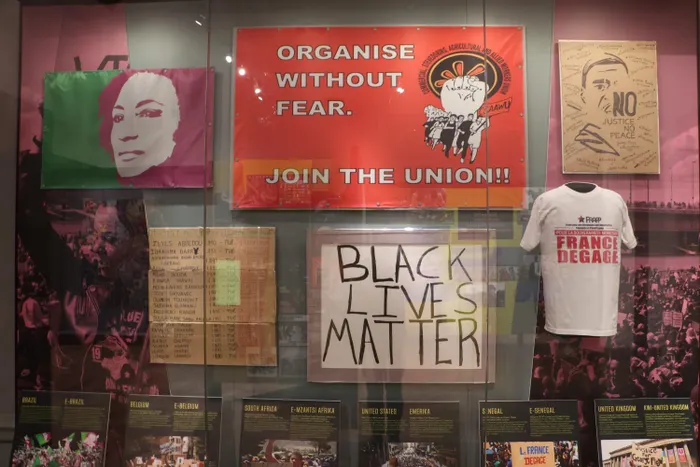
The exhibition questions how slavery continues to manifest in contemporary society.
Image: Yazeed Kamaldien
Obenda said they were — like most historians — “telling the story without having seen it” and this was “an opportunity”.
“Just because we can’t see the flags, doesn’t mean we can’t tell that story. The artist collaborated with researchers to utilise the available elements. It’s a deep engagement with the archive.”
Gardullo said: “Too often museums will say this is the limit of what we can know and we will go no further. We’re saying what do we know and let’s grow from that. And what can we do creatively with what we know to recover something instead of just saying this has been erased?
“Researchers were mining colonial archives and we learned we need to create new archives. Sometimes there was just traces of history. We would learn fragmentary parts of the archive and work with artists to bring new imaginations of the past into being.
“We need to think in new ways. This is a history exhibition rooted in scholarship and research. But it also engages art and artists and they have a voice and vision and something to say that helps us get into a past that has been forgotten.”
Gardullo said there was still a “vast universe of stories that need to be told”.
“We learned so much in doing this work. We are barely scratching the surface. Thinking globally with a curatorial team about stories that have not been told has been the beginning of a process,” he said.
Galant said people needed to learn about their slave history so they could “be proud” of their ancestors who resisted injustice.
The curators wanted to honour enslaved people by showing their faces and stories throughout the exhibition. Gardullo said they wanted to show “people’s whole lives despite their oppression”.
“Slavery is unevenly discussed in public places. Too often it is thought of as something disconnected from our lives. It is told as a story of only victimisation. There was that and dehumanisation,” he said.
“But we approach this with an intent of honouring the people who were enslaved, in their full humanity.”