Stained uniforms: the heartbreaking toll of violence on South African schoolchildren


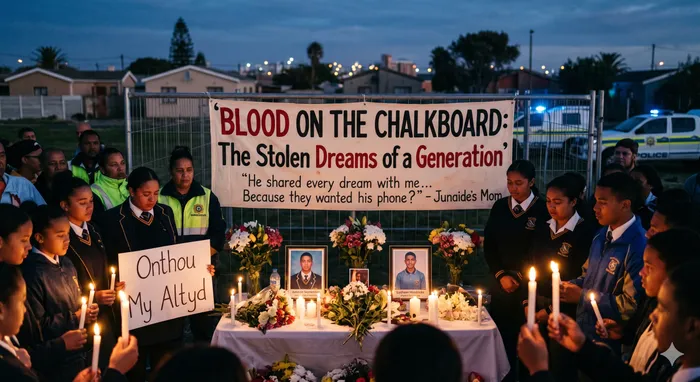
Children that are still at school have become targets of killers who rob and kill them, leaving parents and communities shattered.
Image: AI generated/Gemini
South Africa's children of school going age are under attack and their uniforms meant to symbolize a future are increasingly being stained with the blood of the innocent. From the gang-hardened streets of the Cape Flats to Gauteng, a wave of senseless killings has left families shattered and schools in mourning.
As Gauteng Education MEC Matome Chiloane aptly stated recently, “Violence against our learners, whether within or outside school premises, is unacceptable and cannot be tolerated.”
The Gauteng crisis: a failure of safety
In Gauteng, the tragedy of Danté Diederik, a 16-year-old special-needs learner from Pro-Practicum School, has sent shockwaves through Toekomsrus. Danté was doing what thousands of children do every morning—eating his breakfast while waiting for the school bus—when he was stabbed to death. “Danté was a quiet, sweet child who didn’t bother anyone,” a neighbour recalled. “He just wanted to go to school. Now his life has been stolen for nothing.”
His death is not an isolated incident. In a span of days, a 17-year-old from Forest High was beaten and stabbed to death, and a Grade 12 learner from Daleview Secondary was killed while walking through an open veld. These tragedies have exposed a glaring infrastructure of insecurity, with 34 schools in Gauteng found to be non-compliant with the Occupational Health and Safety (OHS) Act. Shadow MEC Sergio Isa Dos Santos expressed deep concern that “thousands of learners remain in unsafe environments due to a lack of meaningful intervention.”
The Cape Flats: a war zone for the young
In the Western Cape, the situation is even more dire. Between 2020 and 2025, 472 children were tragically murdered on the Cape Flats. In Atlantis, a 14-year-old Grade 8 girl was killed outside her school gates during a taxi-related shooting. In Hanover Park, 16-year-old Lushaan Hendricks was gunned down in gang crossfire. Community leader Kashiefa Mohammed said after the incident the place is a “graveyard,” lamenting, “Hanover Park is so tense and broken because how can gangsters just shoot an innocent child and not think anything of it?”
The face of potential: Junaide September
The human cost of this crisis is perhaps most poignantly captured by the life of 17-year-old Junaide September. A Grade 11 learner at Valhalla High in Elsies River, Junaide was a boy who "always spoke life." His principal, Diego Adams, remembered him as a model student: “He didn’t say, ‘let’s bunk class.’ He didn’t say, ‘let’s disrespect an educator.’ ... He always spoke life, he always spoke dreams and positivity.”
Junaide was stabbed to death during a robbery for a cellphone. Kitchen staff member Kathleen Arendse recalled his final, haunting words to her just a week before his death: “‘Onthou my altyd, Miss’—those were his words. I was so heartbroken when I saw his picture on Saturday.”
His mother, Colleen Lee, shared his "Dream Big" aspirations through her tears. “He shared every dream with me. He really did dream big. He was so excited for his future, and now it’s been taken away—why? Because they wanted his phone?”
The response from the government has been a mixture of condolences and financial incentives. Cape Town Mayor Geordin Hill-Lewis offered a R100,000 reward after the death of the learner in Atlantis and said, “The safety of commuters and learners is non-negotiable and must never be compromised.”
However, community leaders argue that rewards are not enough. Michael Jacobs of the Mitchells Plain Community Forum has called for a Provincial State of Disaster to be declared to “arrest the out-of-control gun violence and gang killings.” Currently, the statistics show that gang-related murders of minors have more than doubled over the past year, moving from 27 to 59 recorded deaths. The army has been deployed, but the killings continue.
The verdict
The death toll of South African learners is a national indictment. As families gather to identify bodies at state mortuaries—a task, as one resident noted, “no parent has to do”—the demand for real intervention grows louder.
Whether it is a child eating breakfast at a bus stop or a student walking home from trials, the message from the community is singular: “We need real action, not just more promises. We’re tired of burying our children.” Until the state secures the streets and the schools, the "Dream Big" mantra of learners like Junaide September will remain a tragic reminder of what South Africa is losing.