Kaaps dictionary launch: a step towards language equality for Coloured children


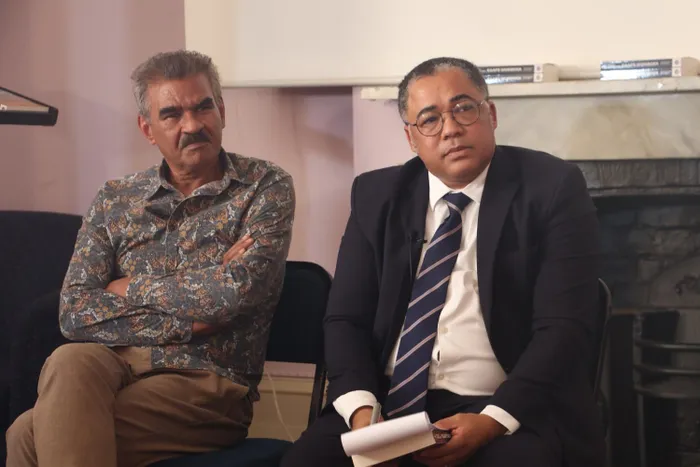
Professor Quentin Williams (right) with Castle of Good Hope chief executive Calvyn Gilfellan at the launch of his Kaaps dictionary this week.
Image: Yazeed Kamaldien
Sports, arts and culture minister Gayton McKenzie should push for Kaaps to be recognised as a legitimate language to ensure coloured children are “not marked down but understood” at school, asserts a local language expert.
Professor Quinten Williams said at the launch of his Kaaps dictionary, Kaaps Woriboek/Wordbook/Dictionary, this week that millions of coloured people spoke a language that remained undermined.
“Gayton McKenzie should put together a task team so we can change the (national) language policy. Kaaps should be recognised so that it can be (spoken) at schools and institutions. It’s important that children are not marked down but understood,” said Williams.
“Language policies must change so there is a trickle down effect. We want to see real, tangible change. We have all the experts. Just call on them. Set a task team and then review (policies) so that you can expand the language.”
Williams said Kaaps was a “mother tongue” which children should have the right to be taught at school.
“Educational structures reproduce power and inequalities.” he asked.
Apart from schools, Kaaps was also needed at institutions such as prisons.
Williams explained: “There are groups of people in Pollsmoor prison (who speak Kaaps). They find themselves in legal jeopardy because the court can’t understand them… They want to punish a prisoner for using Kaaps.”
Williams said Kaaps faced other social barriers too — racism and classism — as the “majority of people who speak Kaaps are working class”. This led many coloured people to rather speak English to break free of stereotypes associated with Kaaps.
Williams said many people still believed Kaaps emanated from Afrikaans, but it was a unique language with numerous words not found in the standard Afrikaans dictionary. It was named Kaaps in reference to its origin in the Cape region, but was spoken countrywide and wherever coloured people traveled globally.
The new Kaaps dictionary contains 1,600 words translated into English and Afrikaans. Williams said these were among “more than 2-million” unique Kaaps words he and a team collected.
The dictionary was launched at the Castle of Good Hope in the city centre. The Castle’s chief executive Calvyn Gilfellan said the event was described as 'revolutionary' and 'decolonial' in a space established by Dutch colonisers.
“Only Dutch would have been spoken in this room (at the Castle) and other languages were forbidden.This is a historical moment,” said Gilfellan.
The dictionary launch featured poetry, rap and songs in Kaaps.
Deon Daniels, known popularly as DJ Ready D, was among the audience of academics, artists, writers and community activists.
He said the event reminded him of the Kaaps rhymes he used to recite as a child.
Daniels recalled his days as a rap artist
“We are part of the first generation of hip-hip practitioners in our country. Prophets of Da City recorded the first Kaaps hip-hop song called ‘Dallah Felt’. That was released in the 1990s,” he said.
“Prophets of Da City had an album called Ghetto Code. It is practically the same as Kaaps. We didn’t have a name or terminology for it. But we needed something that could celebrate the language. As a hip-hop community the language is still very much healthy.”
Williams, who is the director of the Centre for Multilingualism and Diversities Research and a linguistics professor at the University of the Western Cape, said he was currently writing a grammar guide so that “children can learn how to structure a sentence in Kaaps”.