Why does your dog steal shoes? insights into canine behaviour



Marlie the Westie moves her food onto the mat under her bowl before eating it.
Image: The Washington Post
Humans and dogs have shared hearths for millennia, yet we remain surprisingly inept at reading their emotional lives. While we often view their quirks through a human lens, experts from the Canine Science Collaboratory and the Duke Puppy Kindergarten reveal that your dog’s most baffling behaviours—from "kidnapping" your sneakers to howling at the news—are actually sophisticated echoes of their wild ancestry and deep emotional bonds.
When a dog like Fae steals a shoe to her bed, she isn't being naughty; she is writing a love letter to her owner’s scent. Because dogs are primarily driven by olfaction, shoes serve as high-intensity "scent sponges" of their favourite human. While humans might find a well-worn sneaker pungent, a dog’s brain associates that concentrated aroma with safety and affection. This behaviour typically peaks when owners are away, as the dog seeks a physical reminder of its "pack" to soothe separation anxiety.
Similarly, vocal outbursts like howling at the radio are rarely about the content of the broadcast. Whether it's the specific frequency of a violin or the cadence of an NPR host, these sounds can trigger the "rallying call" instinct inherited from wolves. To your dog, that radio tone sounds like a distant pack member calling for a location check. If you’ve ever laughed or filmed these performances, you’ve likely reinforced the habit; to a dog, your amusement is a high-value reward that ensures an encore.
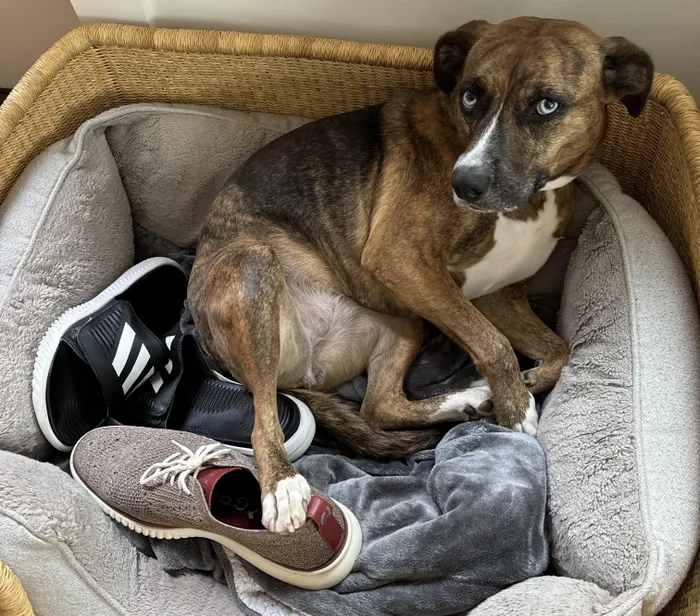
Fae is a very good girl with an odd habit of collecting her humans' shoes.
Image: The Washington Post
Even the common habit of moving kibble from a bowl to a rug is rooted in ancient survival. In the wild, canines frequently carry food away from a communal kill site to a private den to avoid competition. In a modern home, this "resource guarding" persists, though it can also be a matter of simple comfort—avoiding the scary "clink" of a metal collar tag against a ceramic bowl or finding better traction on a carpet than a slippery kitchen floor.
Finally, the "destruction" of household objects like traffic cones or plush toys is rarely an act of malice. It is the completion of the predatory sequence: search, chase, grab, and—crucially—dissect. For many dogs, the act of pulling something apart is the most satisfying biological "jam" they have. They aren't trying to ruin your property; they are simply satisfying a hardwired need to finish the hunt. By understanding these ancient drivers, we don't just stop the "bad" behavior—we finally begin to speak their language.