How Nick Fuentes turns radicalisation into a profitable business model


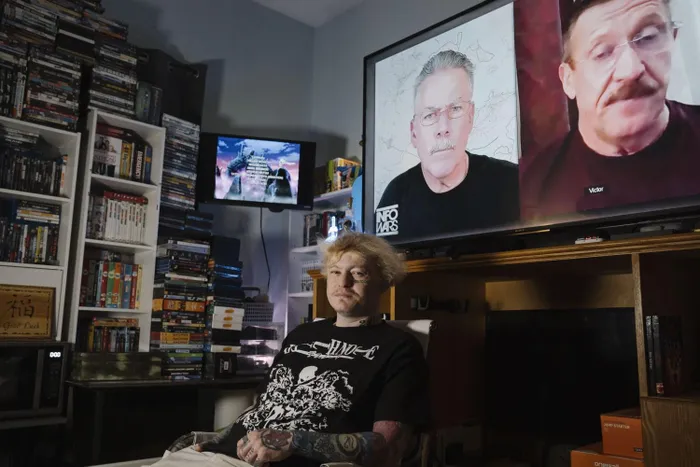
Stephen Ryan in his bedroom.
Image: The Washington Post
For seven years, Kristine Kasubienski, a 57-year-old Air Force veteran, binged the near-nightly monologues of far-right influencer Nick Fuentes from her home in Ohio. She viewed the 27-year-old college dropout not as a political extremist, but as a "second son." Despite struggling financially while working on a food truck, she frequently sent him digital gift payments, convinced he was a starving martyr for a diversifying America.
She was wrong. While Kasubienski was dipping into her modest earnings to support him, Fuentes was building a lucrative financial engine. A Washington Post analysis of more than 1,400 hours of his streams reveals that since early 2025, approximately 11,000 donors have sent Fuentes nearly $900,000 in "superchats"—paid messages that flicker across the screen in real time. Fuentes has been banned from almost every mainstream social network due to his extreme bigotry. He has openly praised Adolf Hitler, suggested Black people should be mass-imprisoned, and argued that women belong in "breeding gulags." Yet, he remains a disruptive force in American conservatism, funded by a shadow economy of loyalists who treat donations as a form of participatory politics.
Fuentes’s revenue highlights a growing crisis within the American right-wing. While some Republican leaders hoped his influence would fade as his views became public, the data suggests he has instead cultivated a die-hard audience eager to insulate him from the financial consequences of his rhetoric. Through his broadcasts on Rumble—an alternative platform where his videos have been viewed over 100 million times—Fuentes promotes a "Heart Culture" of belonging. He sells swastika-imprinted T-shirts and $100-a-month subscriptions to private chatrooms. "We’re an invisible empire," Fuentes told his viewers in January. "We’re building a cadre of professionals... and we need them to all be waving the flag, but quietly."
The Post analysis found that Fuentes is supported by a remarkably concentrated group of donors. Just 10 accounts were responsible for $77,000, while the top 500 accounts provided nearly half of his total superchat income—more than $400,000. These "micropayments" allow provocateurs whose content is too toxic for traditional advertisers to reap massive rewards from online outrage. Megan Squire, a researcher at the Southern Poverty Law Center, compares donating a superchat to "showing up to a Ku Klux Klan meeting." It is a community builder that provides "keyboard warriors" with a sense of status. For donors like Kasubienski’s son, Stephen Ryan, the money wasn't about hatred but about supporting someone who "said everything I really feel, but try not to say out loud."

An undated photo of Kristine Kasubienski. The Air Force veteran, known on Fuentes's stream as “Kristine in Ohio,” worked as a cake decorator before opening a Polish food truck.
Image: The Washington Post
Fuentes himself is unapologetic about his wealth. In text messages to reporters, he dismissed the investigation as "pocket watching," though he has previously bragged to viewers about being a "famous millionaire." He refers to traditional workers as "wage slaves" and claims he is too rich to ever need a "real job." Despite being disavowed by high-profile Republicans—including Vice President JD Vance, who labelled him a "total loser"—Fuentes’s digital infrastructure has granted him significant reach. His popularity spiked following an interview with Tucker Carlson, which saw his average monthly donations climb by 10 per cent.
Fuentes’s strategy involves "groyper wars," where he marshals fans to troll mainstream conservatives. He has recently turned his vitriol toward Donald Trump, claiming the former president "betrayed MAGA." He now urges his followers to burn the GOP to the ground to make way for a more explicitly "fascist" regime. The parasocial bond between Fuentes and his followers often proves one-sided. In June last year, Kasubienski used a superchat to tell Fuentes she had been diagnosed with Stage 3 pancreatic cancer. Her final message, sent 18 days before her death in January, told the "groyper family" she loved them and was praying for their safety.
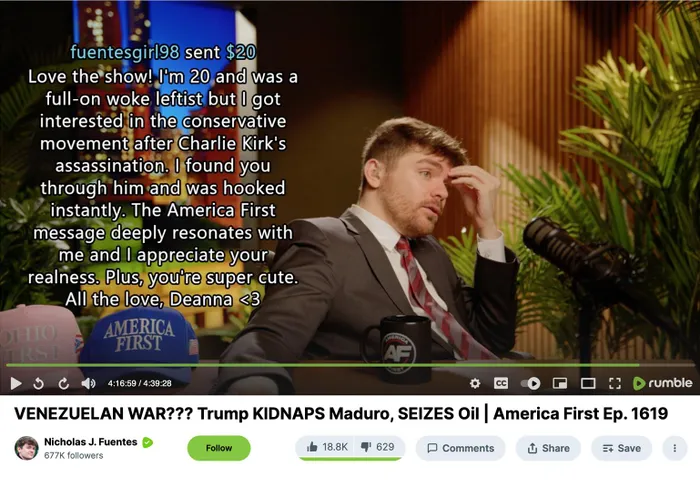
One follower mentions that Fuentes's “America First” message “deeply resonates.”
Image: The Washington Post
After she died, Fuentes praised her on his stream as a "salt-of-the-earth person" who proved his followers weren't just "loser white men." He promised to visit her family in Ohio. However, Stephen Ryan says he has not heard from the millionaire influencer since his mother's passing. Ryan has considered reaching out to him one more time—perhaps via another superchat—to ask when he might arrive. As extremist researchers at Rutgers University note, Fuentes is a master of "algorithm hacking." By providing a sense of emotional connection to those who feel misunderstood, he has turned radicalisation into a sustainable, highly profitable business model. He isn't just selling an ideology; he is selling a sense of belonging to those willing to pay the price.