Zimbabwean Bird and human remains returned: a historic repatriation ceremony


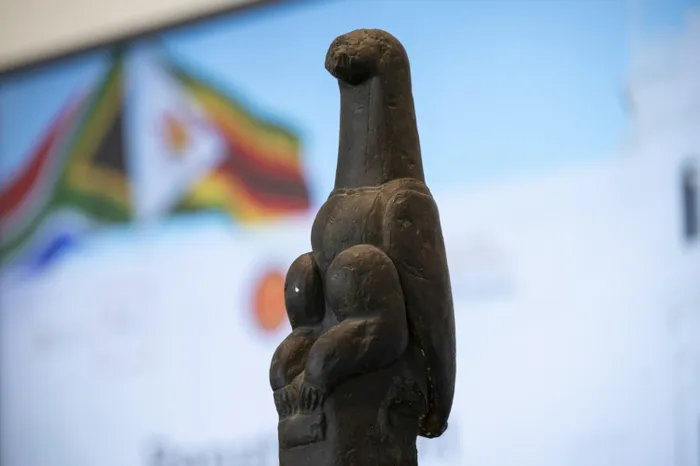
The Zimbabwean Bird is flying home after a repatriation ceremony at Iziko Museums in Cape Town.
Image: Armand Hough/Independent Newspapers
At a solemn and historic ceremony this week an injustice was rectified when human remains and a statue of a bird was returned to Zimbabwe where it was taken more than 130 years ago.
The Zimbabwean Bird, a symbol of Zimbabwean heritage and culture along with remains of ancestors taken from Zimbabwe for scientific study will return to their land of origin in a deal between Iziko Museums and the National Museum and Monuments of Zimbabwe.
At the ceremony in Cape Town, attended by the minister of Sport, Arts and Culture, Gayton McKenzie as well as officials from his department, Iziko Museums, the embassy of Zimbabwe and the government of Zimbabwe, the colonial legacy was referenced to explain how the artefacts and remains came to be in possession of Iziko Museums and South Africa.
Dr. Paul Mpira, of the National Museums and Monuments of Zimbabwe reflected on the history of the Birds and how it was taken from Zimbabwe.
"This journey started 137 years ago when the first bird was collected from the sacred enclosure of the hill complex of the Great Zimbabwe. At the time of collection, it was said, this was the best in the collection. So we lost the best and that was in 1889. In 1891 four more followed from the same sacred enclosure. The person who had collected the first bird had hoped to go back and collect the other four, but then somebody else came and collected the other four before him.That person was (James) Theodore Bent. He also brought the other four to the SA Museum.
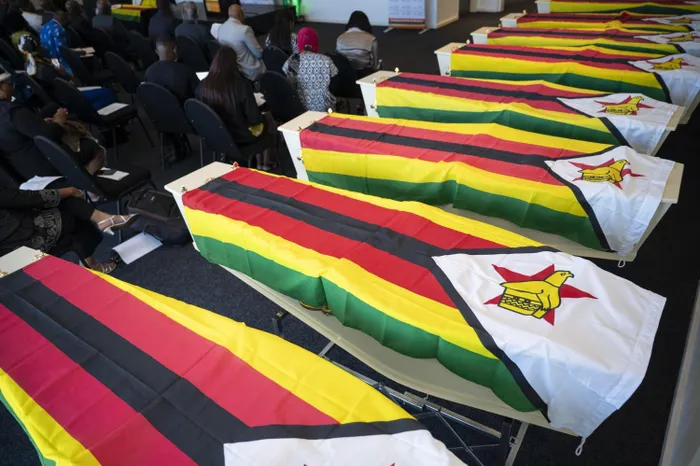
The human remains in the coffins draped with Zimbabwean flags that will be repatriated and reburied in Zimbabwe.
Image: Armand Hough/Indepedent Media
"The first one was handed over to (Cecil John) Rhodes, the other two birds remained in Zimbabwe, the other one found its way to Germany. The repatriation started immediately after independence in 1981 when we received the four from the SA Museum. So we have always collaborated on the return of cultural property, We lost a collection of 30 insects because it was an exchange. So we are also looking at our colleagues to relook at that collection, because it was also the best collection of insects in Africa. We don't know the exact location where human remains came from."
Professor Ciraj Rassool, professor of history at the University of the Western Cape, said much work was done at Iziko Museums on decolonisation.
"We were attending to the work of enabling our ancestors to go home to rest. We are dealing with the practical work of bringing an end to the vestiges of colonialism and Iziko Museums is one of the leading museums in the world doing this work. We come from a very deep colonial history of multiple colonialisms. As you know we had a Dutch Mercantile colonialism, we had a British colonialism, we had an internal colonialism inside our country. We also had South African expansionist expressions of power in the region, built upon these layers of colonialism that we are trying to overcome."
He said as much as South Africa was a victim of colonialism, it has also exercised colonialism in the region.
"And today we are attending to that by returning these important sacred belongings and Zimbabwean ancestors back to them."
In front of the dignitaries, a row of coffins draped with the Zimbabwean flag stood and in the corner was the stone figure of a bird. The stone-carved Zimbabwe Bird is the national emblem of Zimbabwe, appearing on the national flag and coats of arms of Zimbabwe.
Kgereshi Mokwena, Chairperson of the Provincial Heritage Resource Authority in Gauteng said the National Heritage Resources Act provides for the regulation of movement of heritage objects, to ensure that those moveable pieces of memory cannot simply be exported or imported without proper authorisation.
"Colonialism and its activities have resulted in a situation where communities and countries are stripped of their cultural assets and they've been left poor as a result of the work of colonialisation. Standard practise is that we know colonialisation only politically, but the fact of the matter is that colonialisation was also cultural.
He said the South African Heritage and Resouce Agency (SAHRA), has worked closely with Iziko Museums of SA, Groote Schuur Museum, Zimbwean authorities,and heritage practitioners to ensure the repatriation was done with urgency, care and the importance it deserves.
"The Zimbabwean bird, as it is known to be, was removed during a colonial era that often disregarded custodianship of local communities.and this return will affirm the dignity of the citizens of the people of Zimbabwe. As such we do not see this just as a transaction of material, but this is an act of recognition and restoration.
He said the return recognise the importance of f heritage, not merely as an act of compliance, but as as a means of healing.
Ron Martin, an indigenous activist and tour guide said they've been working with Iziko Museums since 1997 to make sure that the voices of indigenous peoples are heard in the discussions around the repatriation of remains.
"The study of African remains is still the most contentious in practise in science worldwide. And why particulary African? Because African remains are the most studied. It's the most trafficked, the most distributed around the world. Still today there are debates taking place at academic, and institutional level. But these debates around the ethics of those practises often excludes the indigenous voice, the African voice, the very subject that gets debated about.
He said Iziko Museum assisted them to understand scientific terminologies to participate in the discussions around repatriation and the remains of ancestors.
" We have all directly or indirectly been affected by the sins of those who went before, the ones who plundered, the ones who did grave robbing, the ones who removed artefacts and objects without consultation with the indigenous custodians."
Dr. Bongani Ndlovu, acting CEO of Iziko Museums said the process of repatriation started on the 13 March last year, at an event marking the bi-centenary of Iziko Museums, formerly the SA Museum.
"We looked at the how the SA Museums, alongside other museums, as we reflected last year, has played an important role and a key role in the act of unethical collecting, in the act of grave robbing, in the act of looting, in the act of dehumanising indigenous communities, and in the act of making the other inferior. We also acknowledge that the museum wasn't alone in this. The museum was working with academics, miissionaries, millitary officials, embassies and other actors in this process of collecting, looting and what was called making the other inferior."
He said from this traumatic past, new relationship are being built and a new future is being forged, grounded in Ubuntu.
Dr. Mpira and dr. Ndlovu then proceeded with the signing of official documents to enable the repatrian.
Minister McKenzie praised those that made the repatriation and handover possible and said it was the fulfilment of a request from president Cyril Ramaphose to make it happen.