High Court showdown: Rastafari nation and small-scale farmers challenge ‘arbitrary’ cannabis laws


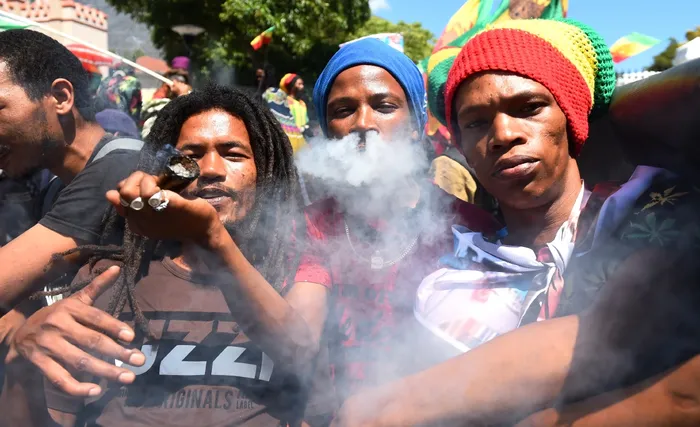
Rasta protest The RasTafari Nation Counci and a collective of small-scale farmers are seeking immediate relief against ongoing law enforcement practices and regulatory exclusions under current cannabis legislation.
Image: Phando Jikelo/ANA
In a move set to test the bedrock of South Africa’s constitutional democracy, the High Court is preparing to hear an urgent application that could fundamentally reshape the country’s relationship with cannabis.
On Tuesday 14 April 2026, legal activist Gareth Prince, the RasTafari Nation Council, and a collective of small-scale farmers will stand before the bench to demand an immediate end to what they describe as "ongoing state-sponsored marginalisation" and "unlawful arrests." The application seeks to halt current law enforcement practices while a broader battle over the constitutionality of the Cannabis for Private Purposes Act 7 of 2024 looms on the horizon.
A struggle for dignity and privacy
The heart of the application lies in a profound contradiction: while the private use and cultivation of cannabis have been constitutionally protected for years, the applicants argue that the South African Police Service (SAPS) continues to treat practitioners and rural farmers as common criminals.
Gareth Prince, the first applicant, contends that the "arrest and detention" of individuals for private cannabis conduct is not only an affront to the right to privacy but a failure of administrative justice. The legal team argues that even if legal intervention is required, authorities are ignoring "less restrictive" measures—such as summons procedures—in favour of heavy-handed detentions that strip citizens of their dignity.
'Economic Apartheid' in the green industry
Beyond the threat of arrest, the application sheds a harsh light on the "arbitrary exclusion" of traditional users from the emerging legal economy. Despite the burgeoning global value of the hemp and cannabis industries, rural cultivators and Rastafari practitioners claim they are being systematically locked out by restrictive regulations.
"The current framework perpetuates structural inequality," the applicants argue, noting that the "emerging legal cannabis economy" seems designed for large-scale corporate entities while leaving historically marginalised communities behind. The third applicants—a collective of small-scale farmers—maintain that the current Hemp Regulations effectively act as a barrier to entry for those who have cultivated the plant for generations as a means of survival.
Protecting the ‘Trees’
A particularly emotive point in the filing is the demand for a mandatory order prohibiting state authorities from destroying cannabis plants—referred to by the applicants as "trees"—without prior judicial oversight. For many in the traditional and Rastafari communities, these plants are not merely "crops" or "contraband" but a central part of their religious and cultural identity. The applicants are seeking a declaratory order to prevent what they call the "wanton destruction" of their livelihoods and spiritual sacraments by police.
The road ahead
The matter is brought against a formidable list of state respondents, including the Minister of Police, the Minister of Trade, Industry and Competition, and the Minister of Agriculture. This cross-departmental approach reflects the complexity of a plant that is simultaneously a criminal justice issue, a trade commodity, and an agricultural product.
While the hearing on 14 April focuses on Part A—urgent interim relief—it serves as the opening salvo for Part B, a comprehensive constitutional challenge to the 2024 Act.
As Gareth Prince prepares to address the media and the court, the stakes could not be higher. This case is no longer just about the right to "light up" in private; it is a battle for economic inclusion, the protection of traditional heritage, and a demand that the South African state aligns its police boots with its constitutional promises.
The eyes of the nation—and a growing global industry—will be firmly fixed on the High Court this Tuesday.