Israel/US war on Iran casts shadow over Holy Week in Jerusalem


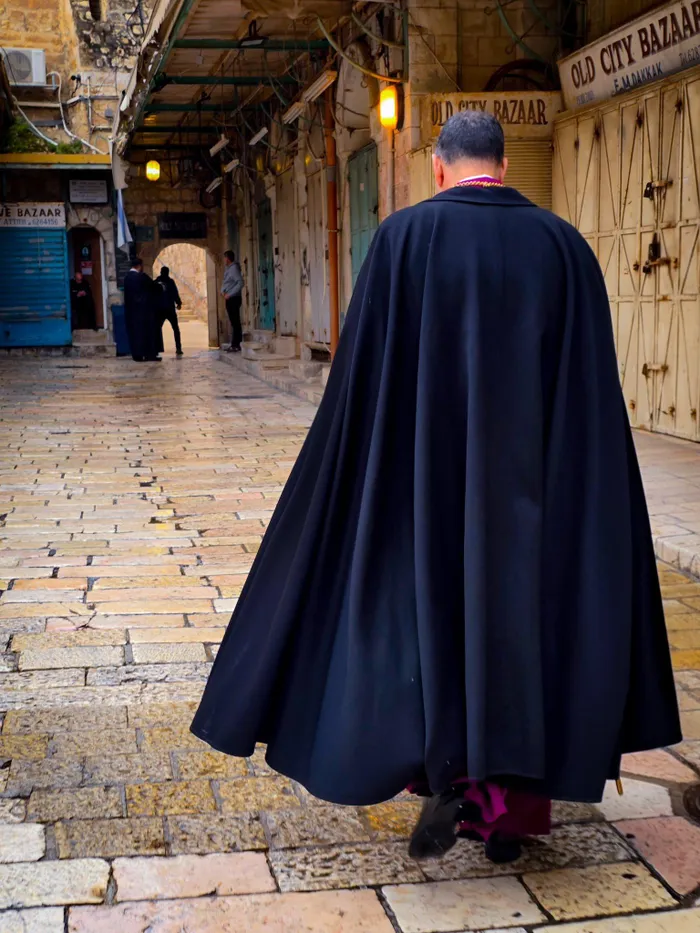
Archbishop Hosam Naoum walking in the empty alley-ways of the The Holy Eucharist at the Church of the Holy Sepulcher
Image: Facebook
For more than a month, life in Jerusalem and across the Holy Land has been marked by fear, uncertainty and near-constant disruption, as the Israel/US war on Iran intensifies in the region.
According to Sami El-Yousef, Chief Executive Officer of the Latin Patriarchate of Jerusalem, a particular church within the universal Catholic Church, residents are enduring what he described as the most difficult and dangerous period in their lifetime.
“Daily life is interrupted several times by the sounds of multiple sirens directing us to shelters, followed by the sounds of missiles, interceptors, and fighter jets flying so close overhead, and then explosions so close that the building shakes,” he said.
The constant threat has created a cycle of anxiety. “Then speculation starts with a rush to social media and TV screens to learn more about the impact and more importantly the safety of loved ones,” he said.
El-Yousef warned of broader regional consequences, drawing comparisons to the devastation seen in the Gaza Strip.
“One worries that when all is said and done, many areas in the Middle East will look like Gaza,” he said, adding that such destruction “should be something that the whole world should be ashamed it happened on their watch.”
The war has cast a shadow over one of the most significant periods in the religious calendar. “Holy Week in Jerusalem will be very sad without the tens of thousands of pilgrims making their way through the narrow alleyways of the Old City,” he said.
Major religious sites, including the Church of the Holy Sepulchre, Al-Aqsa Mosque and the Western Wall, were closed under strict security measures affecting observances during Ramadan, Passover and Easter. With the Old City lacking adequate public shelters, authorities imposed tighter restrictions than in other parts of Jerusalem, while most commercial activity came to a halt.
The extent of those restrictions was illustrated this week by Archbishop Hosam Naoum, who said in a Facebook post that he celebrated the Holy Eucharist at the Church of the Holy Sepulchre’s Abraham Chapel with only five people present. The limited attendance, he noted, was due to police restrictions linked to security measures amid the ongoing war.
Tensions had already escalated on Palm Sunday when Pierbattista Pizzaballa and Francesco Ielpo were prevented by Israeli police from entering the Church of the Holy Sepulchre to lead Mass, an incident church authorities described as unprecedented. Israeli prime minister Benjamin Netanyahu later relented and allowed them access.
Reverend Mzwandile Molo, General Secretary of the South African Council of Churches, offered a broader ecumenical perspective, explaining that Easter is marked as one of the most sacred moments in the Christian calendar.
“Across South Africa, member churches will mark this period through worship and prayer gatherings, with a continued focus on healing, restoration, and human dignity,” he said.
Highlighting the relevance of Easter to contemporary challenges, he noted that it speaks to a society facing inequality, economic hardship, and social strain.
“The message of the Cross continues to offer hope in suffering and renewal in brokenness.”
Molo also expressed concern about the restrictions in Jerusalem.
“The Holy Land holds profound significance for the Christian faith, and limitations on access to such sacred spaces raise serious concerns regarding religious respect and the freedom of coexistence,” he said.
“We are deeply troubled as this happens in a context of an ongoing genocide and attempts of the erasure of the centuries-old Christian presence in the Holy Land. Access to places of worship is a fundamental right and must be upheld with sensitivity.”
Offering a different perspective, Rolene Marks, national spokesperson for the South African Zionist Federation, said the broader security context is often overlooked.
“Jerusalem, alongside the rest of Israel, is currently under active threat,” she said, noting that Iran has “repeatedly targeted the city's holy sites with ballistic missiles,” with one strike landing metres from the Church of the Holy Sepulchre.
She said restrictions on gatherings were implemented to protect lives. “Israel's Home Front Command restrictions reflect that same protective reality, not a policy of religious discrimination as has been wrongly claimed,” she said, adding that similar limitations apply to Jewish worshippers at key sites. Marks also described what she called a “double standard,” saying Israel is blamed for restricting access to protect lives, and blamed when lives are lost.
She added that the decision to prevent entry to the church on Palm Sunday was later acknowledged as unintended, with arrangements made the same day to allow services to proceed.
Archbishop Thabo Makgoba, head of the Anglican Church in Southern Africa, said the conflict has shaped both prayer and reflection during the Easter period.
“We are asking our parishes for special prayers for those in Jerusalem and other towns and cities across the Middle East, who worship under threat of drones and missiles,” he said.
Makgoba said the Church continues to observe its traditional Easter programme, with Maundy Thursday services, Good Friday commemorations and Easter celebrations on Sunday, but stressed deep concern over access to sacred sites.
“We have been profoundly shocked by Israeli authorities who have blocked access to holy sites such as the Al Aqsa Mosque and the Church of the Holy Sepulchre in Jerusalem,” he said.
“Whether under Jordanian or Israeli rule, those sites are meant to be sacrosanct, and access to them guaranteed. It is precisely during times of conflict that people of faith need to be able to worship in their churches, mosques and temples.”
Despite sharply differing narratives, El-Yousef emphasised the enduring spiritual meaning of the season.
“Easter represents an end and a new beginning that is characterised by hope,” he said. “Despite the harshness of the war conditions, Easter brings a sense of hope that there is still some goodness in this world.”