Military deployment in Cape Flats raises questions on effectiveness against gang violence


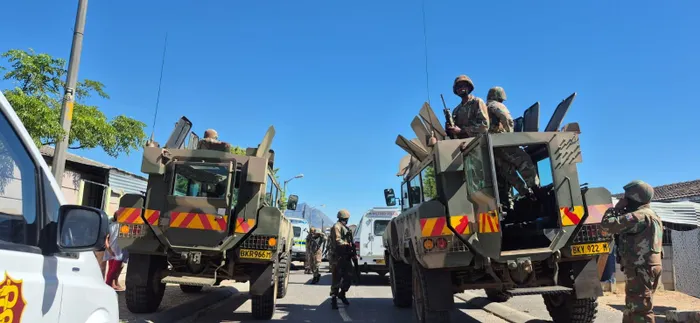
SANDF deployment meets mixed reception amid ongoing gang warfare.
Image: Tracy-Lynn Ruiters
More than 500 members of the South African National Defence Force (SANDF) have been deployed across the Cape Flats in a year-long mission aimed at stabilising communities plagued by gang violence and drug activity. Yet, as boots hit the ground, a wave of fresh shootings has raised urgent questions about whether a military presence can truly dismantle entrenched criminal networks.
The deployment, which supports the South African Police Service (SAPS), was sanctioned by President Cyril Ramaphosa during his 2026 State of the Nation Address. Described as a "focused measure" to restore public safety and support law enforcement in areas severely affected by organised crime, the intervention arrives at a time when residents feel increasingly under siege.
Despite the high-visibility patrols, the crackle of gunfire remains a nightly reality. Verified incidents have recently been reported in several hotspots, often occurring shortly after the SANDF has exited the area. Recent shootings include: Manenberg: Incidents near the police station in Venster Street; volleys of gunfire in Lentegeur, Beacon Valley, and Tafelsig; reports of violence in Clarke Estate, Heideveld, Ottery, Delft South, and Wallacedene in Kraaifontein.
Community activists, such as Patrick Solomons, director at Molo Songololo, described the initial phase as "disruptive" but necessary. While he urged residents to remain positive and learn from the intervention, he cautioned that military sweeps do not address the root causes of crime.
"What happens after the guns are confiscated? We need sustainable solutions, including keeping children in school and addressing the societal pressures that drive youth into gangs," Solomons said.
The operation has faced scrutiny over its strategic focus. Abie Isaacs, Chairperson of the Cape Flats Safety Forum, highlighted that shootings often spike after standard business hours, questioning whether SANDF patrol times align with peak criminal activity. He also pointed to a deep-seated distrust of the police-led intelligence guiding the soldiers.
"The challenge is that the same police who lead these operations are not fully trusted by communities," Isaacs said. He suggested that residents now have an opportunity to share information directly with soldiers to help build a clearer intelligence picture.
Furthermore, Ian Cameron, Chairperson of the Portfolio Committee on Police, raised alarms following an unannounced oversight visit to Mitchells Plain. His concerns include:
Logistics: Reports of an alleged fuel shortage affecting SANDF operations.
Capacity: Doubts over whether SAPS and the National Prosecuting Authority (NPA) can manage the extra workload of forensics, investigations, and prosecutions.
Clarity: Inconsistent reporting on troop numbers, which have fluctuated between 200 and 800.
"A serious operation cannot run on uncertain logistics," Cameron said. "Most importantly, there is still no clear explanation of how success will be measured. Communities cannot trust an operation without defined benchmarks."
Not everyone believes the military is the correct tool for civil policing. Former Mitchells Plain Station Commander, Brigadier Cass Goolam, has emerged as a vocal critic, labelling the deployment "costly, risky, and unlikely to have a tangible impact".
Goolam argues that the core function of a soldier is not policing and that the move diverts essential local resources. He contends that success lies in "unconventional policing" and the restoration of dismantled systems—such as sector policing, school-based prevention programmes, and the targeted use of the Prevention of Organised Crime Act (POCA).
For leaders like Sandy Schuter-Flowers, chairperson of the Strandfontein CPF, the mission’s success hinges on the active cooperation of the residents. "The call for SANDF support came from communities themselves. Now it is crucial that residents provide accurate information on where guns and drugs are being stored," she said.
As the year-long operation unfolds, the Cape Flats remains a theatre of conflicting emotions: hope for peace, frustration over logistical delays, and a desperate plea for a strategy that leaves a lasting impact long after the troops withdraw.