Why the Blue Crane, South Africa's national bird, is facing a serious threat


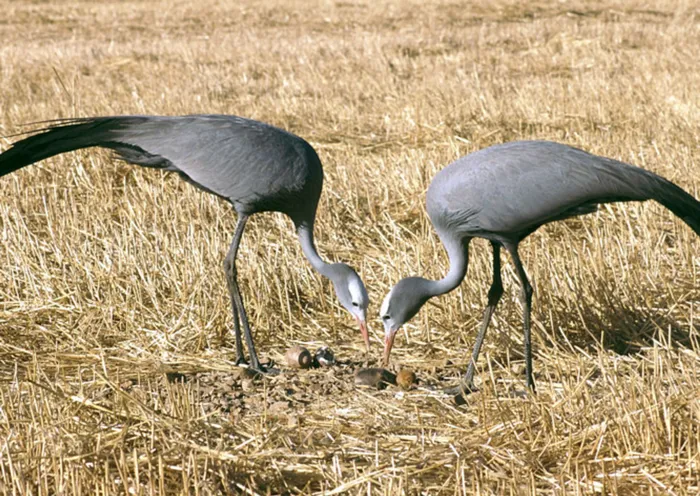
A blue crane prepares to take off at the Berg River bird estuary in Veldddrift. The blue crane, also known as the Stanley crane and the paradise crane, is the national bird of South Africa.
Image: ENDANGERED WILDLIFE TRUST
South Africa's iconic Blue Crane, a familiar sight across the nation's landscapes, is facing a severe threat in the Western Cape's intensive agricultural areas. A recent study, a collaboration between the University of Cape Town's (UCT) FitzPatrick Institute of African Ornithology and the International Crane Foundation/Endangered Wildlife Trust, has raised alarms about the long-term future of one of the country’s most significant Blue Crane populations.
The core finding is stark: Blue Cranes breeding in the Western Cape’s wheat-growing regions are producing significantly fewer chicks than their counterparts in the Karoo and eastern grasslands. Researchers believe these farmlands have become an "ecological trap"; a habitat that looks appealing for nesting but ultimately undermines the birds’ ability to survive and reproduce. The study, published in Ostrich: Journal of African Ornithology, showed a clear contrast in breeding success.
Pairs in more natural habitats like the Karoo and eastern grasslands produced close to one fledgling per breeding attempt. In the Western Cape wheatlands, however, pairs produced "roughly half as many." Furthermore, only about 40% of pairs in the Overberg and Swartland successfully raised chicks at all, compared to around two-thirds in the grasslands and Karoo. "These differences are worrying because the Western Cape wheatlands hold some of the highest densities of Blue Cranes anywhere in the world," said Dr. Christie Craig, the study’s lead researcher and a UCT alumna. She added a serious warning: “If breeding productivity remains low, it could help explain the population declines observed in the region in recent years.”
The problem is compounded by low recruitment of young birds. An analysis of winter flocks found that between 2019 and 2021, juveniles made up only about 4% of flocks in the Overberg and 3.6% in the Swartland - half the proportion recorded three decades prior. Craig emphasised the gravity of this trend: “If fewer chicks are fledging and fewer juveniles are entering the population, it becomes increasingly difficult for populations to sustain themselves. This pattern raises serious conservation concerns for what has historically been one of the species’ strongholds.”While the open wheatlands may resemble the cranes’ natural habitat, farming practices create hidden risks. Nests can be destroyed during harvesting, and disturbances can lead to increased predation.
Craig noted the complexity of the situation: “Blue Cranes have adapted remarkably well to agricultural landscapes, but these environments are complex. Even small disturbances during the breeding season can have significant consequences for reproductive success.”Dangers persist even after hatching, with young cranes facing hazards like entanglement in fencing, drowning in water troughs, and food shortages. "There is still much to learn about why chicks fail to survive in these landscapes. Focused research on chick mortality would help identify the most effective conservation interventions,” Craig pointed out.
Ultimately, conservation hinges on collaboration. The study stresses that working with farmers is essential, recommending simple measures like reducing disturbance near nests, modifying water troughs, and adjusting fence designs. Craig concluded: “Engaging with landowners is crucial. Because most breeding cranes occur on farmland, conservation efforts must work in partnership with farmers to improve breeding outcomes.” She stressed that finding ways to address farmers' concerns about potential crop damage while promoting conservation will be key to the species' long-term survival.