Trump's 30% tariff on South African imports: A politically motivated move?
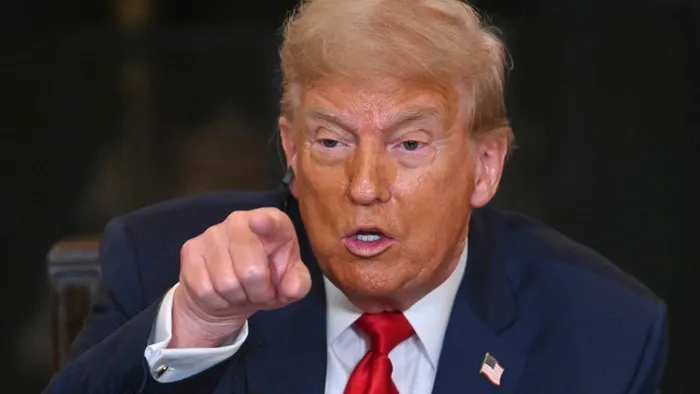
Donald Trump slammed SA with a tariff hike
Image: Jim Watson / AFP
US President Donald Trump’s plan to impose a 30% tariff on South African imports is drawing sharp criticism from economists, many of whom argue the move is politically motivated rather than based on real trade imbalances.
Economist Dawie Roodt believes the United States’ planned 30% tariff on South African goods is being driven more by geopolitical tensions than trade data — and warns that the move could signal deeper diplomatic shifts.
"This is, without a doubt in my view, driven primarily by politics — not economics," said Roodt.
"South Africa is economically irrelevant to the U.S., but we play a much bigger role internationally, especially in terms of our support for certain organisations and countries the Americans don’t like."
Roodt’s comments follow a formal letter sent by Trump to President Cyril Ramaphosa, informing him of the impending tariff, which is set to take effect on 1 August 2025.
In the letter, Trump criticised South Africa’s “persistent trade deficits” and suggested that the tariff could be adjusted — up or down — depending on the country’s willingness to change its trade practices and political stance.
Roodt, however, argued that the logic behind the tariff doesn’t hold up under economic scrutiny.
“All the economic calculations behind this are wrong. This is Trump trying to pressure South Africa to change its international political stance. Of course, there are also local factors — like the land expropriation issue — but the bigger picture here is clearly political.”
While the broader economy may not feel the immediate effects, Roodt warns that the agriculture and motor industries will be hit hardest.
“For an economy that's already in ICU, this is certainly not good news,” he said.
President Ramaphosa has acknowledged receipt of Trump’s letter and reiterated South Africa’s commitment to ongoing negotiations. The Presidency also challenged the U.S. interpretation of trade data, noting that 77% of U.S. goods enter South Africa duty-free, while the average tariff on imports stands at 7.6%.
As both governments prepare for further talks, Roodt said the focus should remain on diversifying trade partners — though he warns this won’t be easy.
“Everyone’s now chasing the same markets. Diversification takes time, but it’s more important than ever,” he said.
Economist Ulrich Joubert agreed, explaining that the proposed 30% U.S. tariff on South African imports is significant, especially given that the United States is South Africa’s second-largest export market, accounting for $8.21 billion or 8.2% of total exports in 2024.
While South Africa has a $1.23 billion trade surplus with the U.S., Joubert argued this is insignificant in the context of America’s global trade. He believes the tariff is politically motivated, driven by Trump’s push to reduce trade deficits with multiple countries — a goal Joubert said is unrealistic.
“Trump wants balanced trade with every country, which is economically impossible,” Joubert said. “This move is more about politics than economics.”
Joubert stressed the need for market diversification and consistent diplomatic engagement, warning that future investment could suffer if trade uncertainty persists. He also raised concern over AGOA possibly ending soon, which could further hurt key export sectors like agriculture and textiles.
He called for ongoing negotiations and strategic diplomacy, stating that uncertainty and rising protectionism pose a growing threat to South Africa’s export-led growth.
Weekend Argus