Lovebugs swarm South Korea's cities and hiking trails
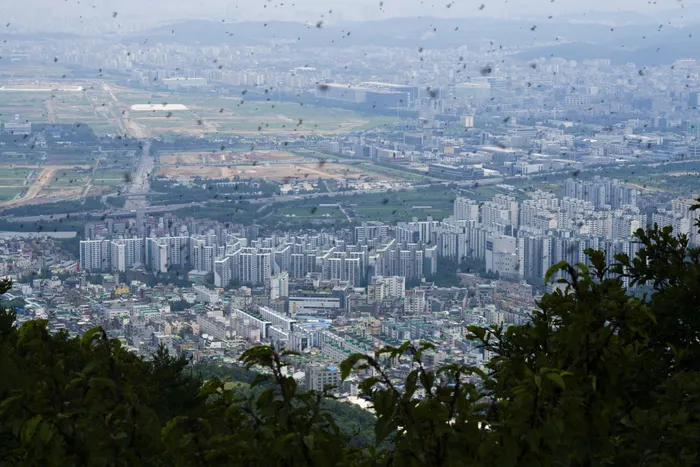
A portion of Incheon is seen behind a cloud of lovebugs.
Image: Jintak Han/The Washington Post
Lovebugs - so named for how the male and female cling together as they mate in flight - are swarming South Korea.
They can be seen in the hilltops that dot South Korea’s bustling cities. They’re on the windows of high-rise office buildings. They’re on sidewalks, inside convenience stores, on hiking trails and all over city streetlights. They’re everywhere.
The bugs are harmless, but they are becoming increasingly annoying to the country’s more than 50 million residents.
“I thought it was the apocalypse,” said Kim Jaewoong, a 36-year-old welder who ran into a swarm of these bugs last week on Gyeyangsan, a small mountain in the port city of Incheon, an hour drive west of Seoul.
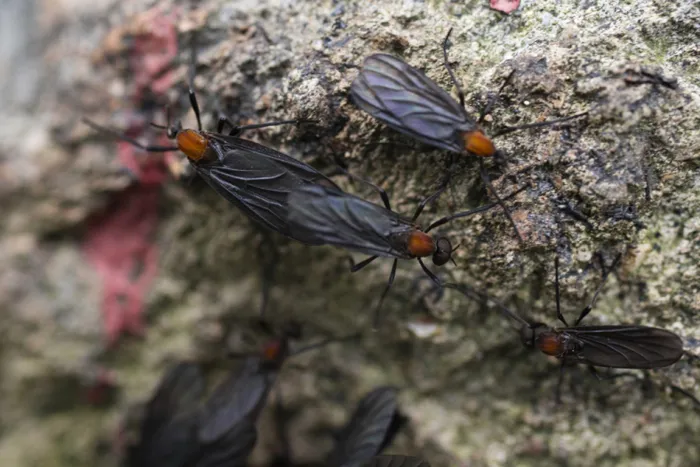
Mating lovebugs cover the side of a rock.
Image: Jintak Han/The Washington Post
Kim was jogging up the mountain on his usual weekend exercise route on Saturday and noticed clumps of dead and live plecia longiforceps, better known as lovebugs. the dark, winged insects typically measure just under half an inch. There were many of them, but Kim shrugged them off, thinking he would see fewer on the mountaintop.
At the summit, dead lovebugs were piled up in mounds up to 4 inches tall, he said. Adult lovebugs have a lifespan of three to seven days, according to South Korea’s Ministry of Environment.
“It became difficult to breathe. If you tried to breathe, you would get them in your nose and mouth,” he said.
The insects are not native to South Korea. The first photographic evidence of the lovebugs in South Korea is from 2015 in Incheon, according to Shin Seunggwan, an associate professor at Seoul National University’s School of Biological Sciences. Shin suspects they could be from China’s Shandong Peninsula, home to lovebugs whose genetics are the most similar to those in South Korea.
“We haven’t confirmed they’re from there,” Shin said. “But it’s the likeliest place of origin,” he added.
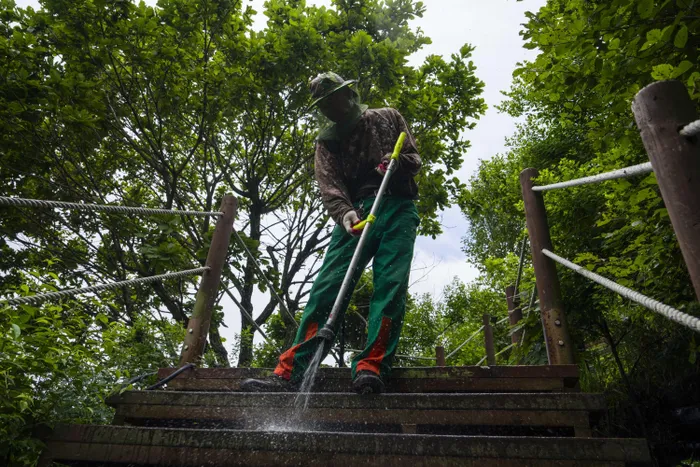
A municipal worker at the Gyeyangsan peak sprays water to clean dead lovebugs off of the stairs.
Image: Jintak Han/The Washington Post
The lovebugs are expected to abound in South Korea for the next several years, possibly a decade or more, according to Shin. Adult lovebugs have no natural predators and have high breeding rates, he said.
Animals that could feed on the insects need time to learn they are edible. It took at least a decade for native animals to recognize other nonindigenous species in Korea like the American bullfrog and Spotted Lanternfly as prey, he said. It took 30 years for adult lovebugs in Florida to become prey, he added.
Climate change could be a factor in their proliferation, Shin said. South Korea’s temperatures have risen by 1.4 degrees Celsius, or 2.5 degrees Fahrenheit, in the last 30 years compared to the 1912-1941 period, according to government tallies.
But the more direct cause for the explosion of the lovebug population here, Shin said, is likelier to be the urban heat island effect - a term used to describe how cities are hotter than rural areas due to the abundance of concrete and the lack of natural shade.
Higher temperatures in urban areas - where lovebugs tend to be found - allow more of the insects and their larvae to survive the winter, he said. Gyeyangsan, while covered with trees, is in the urban Incheon area.
At the bottom of Gyeyangsan on Thursday, store owners were busy trying to keep out the pesky insects, warning patrons to close the door quickly to prevent more of the insects from entering the establishment. But they were already getting settled - resting on the floor, the freezer windows and the lights.
A Washington Post photographer visiting the area almost ate one of the bugs when it flew onto his lips. Hikers wore disposable rain ponchos despite temperatures in the mid-80s. One person had brought a mesh onion bag to cover his face.
Lovebugs do not bite, nor do they spread diseases, Shin said. They first became a major nuisance in 2022, when they began appearing in huge numbers in northern Seoul, according to the South Korean Ministry of Environment, which advises against using pesticides, citing concerns that chemicals could kill or hurt other harmless insects and people.
“We may have to try reducing their numbers in the cities, where people live,” Shin said. “But we have to avoid using chemical sprays. They might kill other insects and plants. Lovebugs are also resistant to pesticides,” he added.