Volunteers hold regular clean-up campaigns, partnering with communities


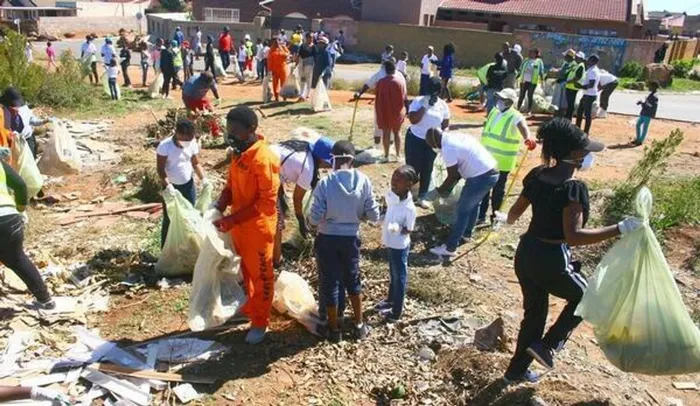
A Greenpeace recycling programme in full swing. l SUPPLIED
In an attempt to meet the global target of having a plastic free society by 2030, environmental and nature conservationists organisations are busily at work to raise awareness about recycling and greening across the country.
This is in line with the celebration of September as the National Recycling Week and Arbor Month. Government, environmentally-friendly businesses and non-profit organisations have been planting trees at schools, parks and open spaces and educating the public on conservation and recycling.
Nhlanhla Sibisi, climate and energy campaigner at Greenpeace Africa, said globally, only around 9% of plastics produced get recycled.
"South Africa is no exception to this figure as recycling is proving to not be the solution to reducing plastic waste. It is estimated that South Africa generates about 2.4 million tons of plastic waste annually.
“Our volunteers embark on regular clean-up campaigns, partnering with communities and partner organisations by highlighting, for example, the impact of plastic waste on the environment, marine life and people.
"Most of the plastic waste is generated from urban areas with cities and suburbs accounting for the majority of it.
“This also calls for the government to adopt a positive right political will to achieve this necessary milestone. New alternative materials and delivery systems are emerging all the time which will make this transition easier," said Sibisi.
Department of Environmental Affairs and Development Planning spokesperson, Rudolf van Jaarsveldt, said: "We are aware from observation in the City of Cape Town and other municipalities, that waterways are still being contaminated with all kinds of waste, including plastics.
“These are mostly coming from areas where waste management services are challenging due to accessibility to households, or where waste management systems are not aligned to the needs of these communities.
“Re-usable bags and paper bags are being used by many of the big supermarket chains but not in all of their stores. Some have changed to using plastic bags which can be recycled."
He said the challenge still lay with the smaller companies and stores, especially in rural areas where there is a general lack of awareness, or where people do not have the financial resources to explore other more environmentally-friendly options.
Meanwhile, Diane Hay is the marketing manager of Gravel Road Distribution Group. It is a Cape Town-based entertainment company which is one of the small companies that have already opted for a sustainable and renewable way of business.
"To do this, we have ensured that we have a zero-waste policy in the business and actively recycle on a weekly basis with the three-bin approach.
“Our compost is collected and taken to neighbouring farms and nurseries, our non-recyclable plastics are used to create eco brinks which are donated and used for building projects.
“We have also partnered with Greenpop where we plant five trees for every film we acquire, to date we have planted 500 trees. All the staff members are involved, we have already visited two schools in the vicinity where we have accompanied Greenpop as part of their urban greening project. We hope to set an example for other companies in the film industry," said Hay.
Jessie Leverzencie, Greenpop spokesperson, said they were busy educating the public about best practices for tree planting projects and raising funds for forest restoration projects.
Western Cape Minister of Agriculture Ivan Meyer, said the department's initiatives were directly linked to priority projects in the Western Cape Climate Change Response Framework and Implementation Plan.
They restored ecological infrastructure for increased landscape productivity, socio-ecological resilience and soil carbon sequestration. "An invitation is also extended to rural schools and non-profit organisations to apply for donations of trees," he said.