Celebrating 55 years of Artscape Theatre: A journey from exclusion to inclusion


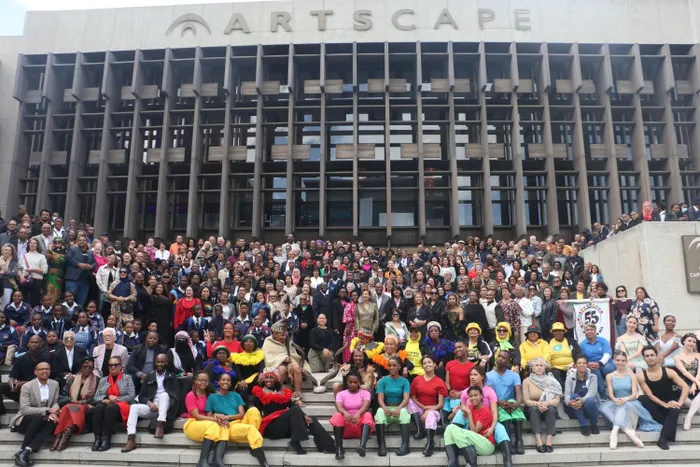
Artscape Theatre guests gathered for its 55th anniversary on 19 May.
Image: Yazeed Kamaldien
Actor and director Basil Appollis remembers a time in apartheid South Africa when he could not even apply for a job at Artscape Theatre, but he is now set to produce its 55th anniversary gala concert in November this year.
Back then the venue was still called Nico Malan Theatre and it had opened its doors to white people only on 19 May 1971.
On that date this week Artscape’s chief executive officer Marlene le Roux led a multi-racial crowd for a photo on the theatre’s front steps to mark the anniversary theme: ‘A Place For All’.
Appollis, who was among the celebratory crowd this week, said he “was not allowed to be here when it was Nico Malan. It was a place where I could not even apply for employment.”
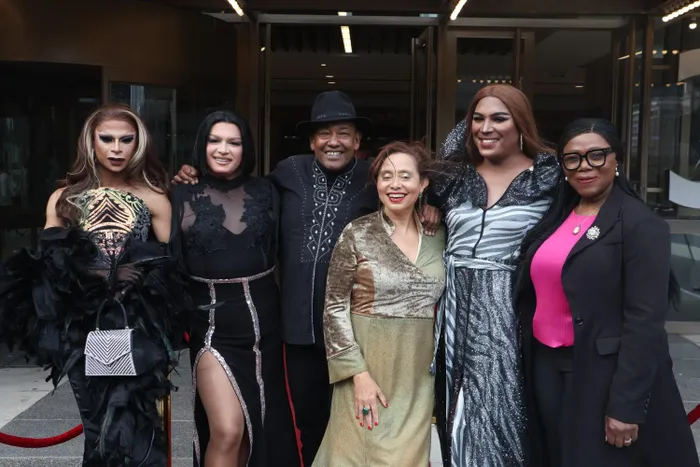
Artscape Theatre chief executive Marlene Le Roux (in green dress), Thuli Madonsela (wearing pink top) and actor Basil Appollis (with black hat) pose with drag artists at the theatre’s 55th anniversary this week.
Image: Yazeed Kamaldien
“Where we are standing now (at the front entrance), I did my first play at Artscape in the 1980s when I was at drama school. I was asked to play the angel Gabriel. I only learned later that we could not perform in the theatre as it would have been seen as blasphemy,” he said.
“We required a permit to enter. It was a whites-only venue, and changing this took considerable time and effort. At some point when we were able to come into this space on Tuesday and Thursday nights only, but we could not even use the toilets.
“Then there was another parliamentary sitting and it was decided the bar should also not be opened to coloureds. It remained like that for years.”
Appollis said it “was a slow integration and one still felt awkward” at the Nico Malan after the end of apartheid in 1994.
“I realised that at some plays I was the only person who was not white. But the moment of transformation is not so much for me. I see all these children watching their (high school) prescribed works here today and that brings joy to my heart.
“We still have to do a lot of work so that people can feel that they belong. The more we tell our own stories, and people can feel their story is presented on the stage, the more everyone will feel they can access the arts.”
Faheem Bardien, head of the lighting department at Artscape, has worked for the theatre for 31 years and recalls the early 1990s as a time when “people of colour could never really get a senior position”.
“Even though we were doing the same jobs as white colleagues, we were given junior roles. They created a system where they would justify a minimum salary,” he said.
“As a junior lighting technician I heard two white colleagues telling each other: ‘If these coloureds think they will be taking our jobs they have another thing coming.’ They knew that I was five metres from them and could hear what they were saying.
“I used that as motivation. I was loving what I was doing. I pushed and encouraged myself to higher levels in this industry.”
He added: “I’m fortunate that to have seen change here from Nico Malan to Artscape. In the early 2000s when Marlene (le Roux) joined us we started doing more community work.
“We didn’t have support from senior management but we took theatre to communities that never experienced it. We now see people of different backgrounds coming together to see the magic we can produce for them on stage.
“Once the house lights go out, it doesn’t matter who is sitting next to you. We are all just coming to enjoy a show together.”
The Nico Malan Theatre transformed into Artscape Theatre in 2001, the year when Le Roux, who is disabled and from a rural town, joined as a development manager. She was clear on one thing: “I would not be a tick-box exercise.”
Le Roux implemented a range of programmes and almost two decades after joining the theatre she was appointed its chief executive officer. She unveiled a memory wall at the anniversary, showing photos of the last 55 years.
“This is a permanent installation from 1971 to now so that in years to come people can see this was an apartheid institution and we actively worked to change this. The memory wall is about artists and staff over the years. It is about a history that must be told,” she said.
Le Roux still wants to shift certain perspectives and believes the “arts is magic but it’s also a job and we need to take it much more seriously in South Africa”.
“My vision is that artists need to be seen as professionals. They should have a salary. We need to have more companies in this building. There needs to be more productions that can tour the world,” she said.
“We want to launch an academy where we can train sound engineers, lighting designers, how to build a stage, accountants and all the jobs needed in this building, which is as big as three rugby stadiums.”
Former public protector Thuli Madonsela, who is now director of the Centre for Social Justice at Stellenbosch University, said at the anniversary the “transition of the Artscape from Nico Malan is an example of excellence in transformative leadership”.
“I have been here several times and this was a citadel for apartheid. Today it is a place for all. It feels like a place for all. And that’s not about race only. It’s also disability, gender and marginalised people,” she said.
The anniversary celebration included cake as well as a free lunchtime concert featuring opera singers and bands from various local schools.
Anniversary celebrations for the rest of this year will include more free shows, reduced ticket prices, masterclasses and a career expo on 6 June that will introduce young people to theatre jobs in lighting and sound design, costume design, technical operations and building management.