Developing writers for theatre: a new programme in Cape Town


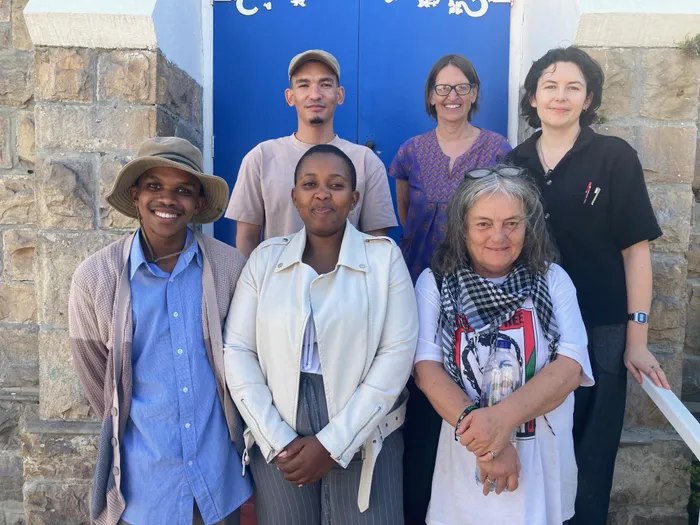
Participants in a new writing on theatre programme launched in Observatory. Back row, left to right, Chester Miggels, Caroline Calburn (creative director) and Oskar Keogh. Front row, left to right, Sange Mpambani, Zinobulali Goduka and Megan Choritz (mentor)
Image: Yazeed Kamaldien
A new programme, Developing Writers for Writing on Theatre, has had its first four graduates setting out to ensure the public is informed about shows across Cape Town’s stages.
Theatre Arts, an independent theatre in Observatory, ran the programme during February and March. Its creative director Caroline Calburn says they wanted to offer participants “skills and tools to write about theatre that they see”.
“I’m involved in the theatre community and this project is about strengthening it. We do not have sufficient writing on theatre and that is why we are losing audiences. People are not reading about theatre shows,” said Calburn.
She says the programme, which was funded by the National Arts Council, also aimed to reflect back to the theatre community on how to enhance what it does.
“For the last 15 years the kind of critique in South Africa has been peer cheer, which is about cheering on mediocrity. But that does not help us get better,” said Calburn.
“We need to improve writing and critique so that theatre can be better. Critical reviews challenge the theatre community to improve their craft.”
The four participants were Chester Miggels, Oskar Keogh, Sange Mpambani and Zinobulali Goduka. They were selected out of 70 applicants.
Participants attended writing masterclasses where they met experienced theatre writers, arts editors and interviewed theatremaker Brett Bailey.
Participants watched and reviewed numerous theatre shows throughout the two-month programme. Theatre writers Megan Choritz and Robyn Sassen mentored them throughout their writing exercises.
Miggels, an actor currently on a TV soapie, wanted to experience what it was like on the other side of acting.
“I am from the creative and performing side. I have no journalism experience. I came into this wanting to learn how to help. I want to help getting more visibility for theatre spaces,” he said.
“I remember there were newspaper pages with reviews and writing about theatre. Now it’s just a page with entertainment. There’s no designated column or writers for theatre. Nobody is telling people about the amazing theatre work in Cape Town. There are not platforms that tell people about theatre.”
Multimedia artist Oskar Keogh meanwhile grew up with parents who were both actors.
“My dad was part of the founding team of the Market Theatre (in Johannesburg). I grew up with my parents reading lines. I went into fine art but theatre has been calling me back,” she said.
“I’m really invested in critical engagement on artwork. I want to do that in theatre.
It’s not just being critical for criticism. I see this as a practice of care. If I was doing a production I would want to hear the truth about it.”
Mpambani, a curator from the Eastern Cape, said he plans to move back to that province to focus on “theatre in small towns and townships”.
“I want to continue writing about theatre. I’ve been thinking about creating my own blog. I want to also write in isiXhosa,” he said.
Goduka, who has worked as a videographer for theatre and dance performances, says her “heart is in helping theatremakers to create work that can appeal to a range of people and not just peer groups who will cheer”.
“Writing about theatre is scarce. There are only a few reviewers. A review is not just about what is good but it’s also about growth. Critics challenge creators to look at their blindspots,” she said.
“The benefit of being critiqued is being shown your blindspots, where you are not seeing clearly and your own biases. But a bad review also needs to offer direction. It enriches the theatremaker.”