Remembering Prof Ben Turok: a legacy of ethical leadership and activism


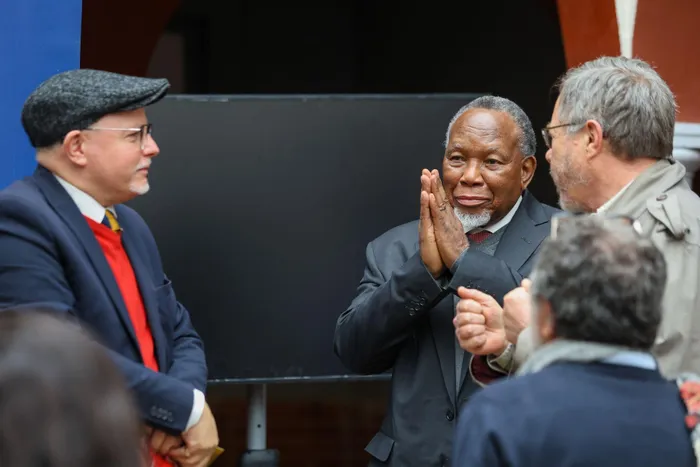
UWC Rector and Vice-Chancellor Prof Robert Balfour with former President Kgalema Motlanthe at UWC.
Image: UWC
Well known for his unwavering ethical leadership, Prof Ben Turok will be remembered as a fierce critic of corruption and for his stance against the controversial Protection of Information Bill, also known as the Secrecy Bill. In a watershed moment, the late ANC MP and activist, who died in 2019, broke ranks with his political party by refusing to vote with it to pass the draft legislation, widely feared it could be used to conceal corruption and mismanagement.
Last week, his legacy came alive at the University of the Western Cape (UWC)’s dialogue marking the 100th edition of New Agenda: South African Journal of Social and Economic Policy, the publication he founded 25 years ago. Held at the Centre for Humanities Research in Woodstock, the event also celebrated a partnership between the Institute for African Alternatives (IFAA), which publishes the quarterly journal, and UWC’s Institute for Social Development (ISD).
Since 2023, the ISD has served as the journal’s academic home, hosting its digital platform and providing editorial governance. Commenting on Turok’s legacy and activism, former President Kgalema Motlanthe, and chairperson of the IFAA Board, said the dialogue was more than a celebration of the journal’s longevity, but an opportunity to “reflect on the enduring intellectual and political legacy of Prof Ben Turok, and to examine the vital relationship between universities, activism and the public good”.
As IFAA’s Director, publisher and editor of New Agenda, Motlanthe said Prof Turok believed in a simple truth: “That great ideas are rarely born in isolation.”
“Long before collaboration became a buzzword, Ben Turok understood that real knowledge is produced together,” he said, adding that spirit lived on in the partnership between IFAA and UWC, which ensured the journal remained relevant for the next generation.
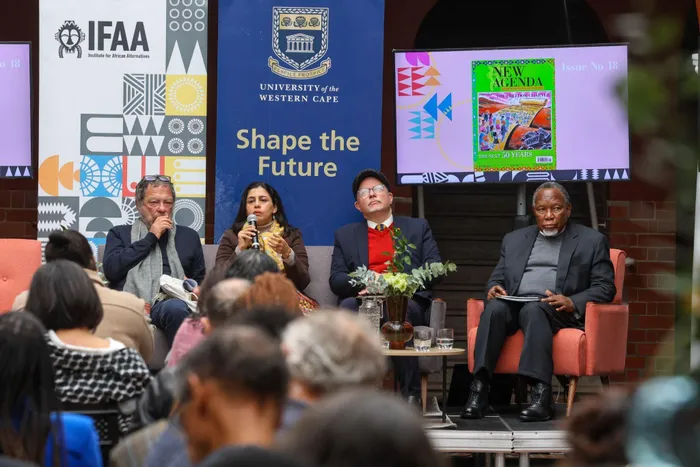
From left: Prof Ari Sitas, Prof Amiena Bayat, UWC Rector and Vice-Chancellor, Prof Robert Balfour and former President Kgalema Motlanthe during a dialogue at UWC. The event was facilitated by Prof Michelle Esau, Dean of Economic and Management Sciences.
Image: UWC
UWC Rector and Vice-Chancellor, Prof Robert Balfour, said that, given the growing global uncertainty, New Agenda provided a unique platform that combined activist work, community-based contributions and scholarship.
Prof Balfour said hosting the dialogue at the Centre for Humanities Research in Greatmore Street — a former segregated institution, once home to the former ‘whites-only’ Regent Street School in Woodstock — highlighted UWC’s commitment to the public good and to advancing intellectual work in historically significant spaces
“Impact cannot only be measured in outputs. It must also be seen in how universities engage with communities, with activists and with the urgent questions of our time.”
Prof Amiena Bayat, who is part of the New Agenda Editorial Board, recalled how the journal’s future faced uncertainty following Prof Turok’s death.
“New Agenda endured because people stepped forward. It endured because the journal had built a foundation worth defending, and it endured because of the real need for the kind of intellectual space it had created,” she said.
The link between scholarship, impact and activism was highlighted by social scientist and member of IFAA, Prof Ari Sitas, who said platforms like New Agenda became more than academic journals, but were sites of resistance and rethinking.