Transforming public transport: Cape Town’s MyCiTi bus service and the future of urban mobility


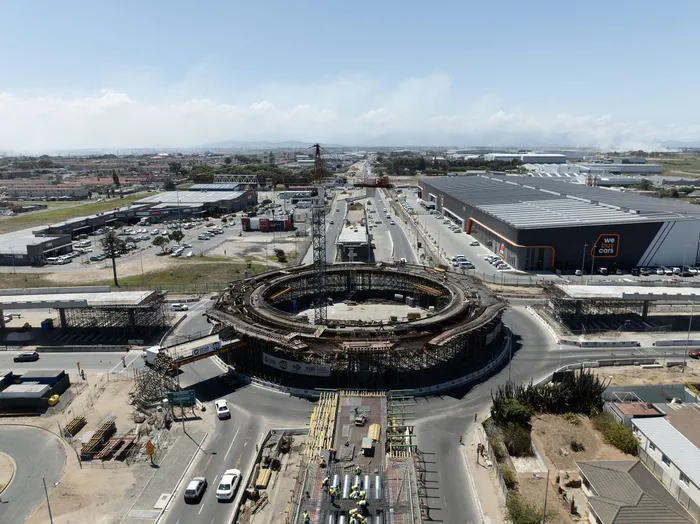
The City’s Urban Mobility Directorate has reached a key milestone with the casting of the first red bus lanes along Govan Mbeki Road, in the vicinity of the Sky Circle project in Lansdowne.
Image: City of Cape Town
Standing before the National Transport Conference in Midrand recently Rob Quintas, Cape Town's Mayco for Urban Mobility, didn’t just deliver a speech; he issued a manifesto for the future of South African cities. His message was clear: the era of treating public transport as a "stepchild" of government is over. In its place, Cape Town is building a massive, red-laned juggernaut designed to prove that local government isn’t just equipped to manage transit—it is the only sphere capable of doing so.
For many Capetonians, the MyCiTi bus service is already a daily lifeline. Currently, the first phase of the network handles a staggering 65,000 passenger journeys every weekday, totaling roughly 2.3 million trips per month. With a fleet of 347 buses—90% of which are operational at any given moment—the service has woven itself into the fabric of the CBD, the Atlantic Seaboard, and the West Coast.
Yet, as Quintas noted, the existing network is merely the foundation. The city is now aggressively pursuing "Phase 2A," a project described as the next frontier of urban mobility. This expansion is aimed squarely at the metro-south east, targeting areas where residents have historically been underserved by direct, scheduled transport.
Phase 2A is more than just more buses; it is a massive engineering undertaking designed to benefit 1.4 million residents. For years, commuters from Mitchells Plain and Khayelitsha heading to economic hubs like Wynberg or Claremont were forced to travel via the CBD—a grueling and inefficient detour.
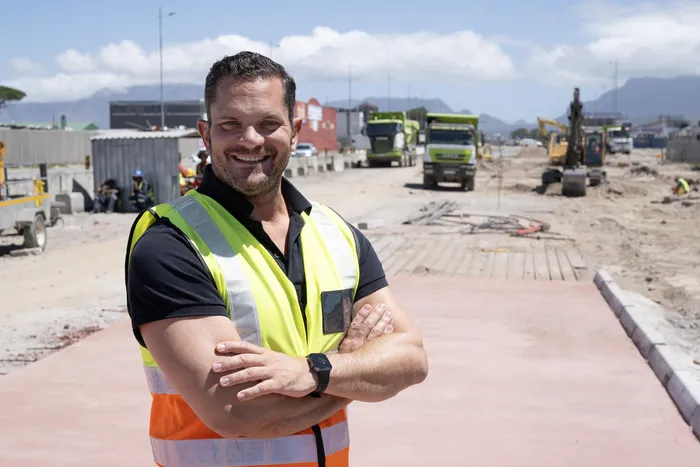
The City’s Mayoral Committee Member for Urban Mobility, Rob Quintas.
Image: City of Cape Town
The new corridor will change that,11 closed bus stations and 17.4 km of dedicated 'red lanes'; two new bus depots in Khayelitsha to anchor operations, and a "Sky Circle" in Lansdowne: A first-of-its-kind elevated traffic circle 6.2 meters above ground, dedicated exclusively to MyCiTi buses to bypass ground-level congestion.
“When you see the red lanes, you know we are on track,” Quintas said during a site visit to Govan Mbeki Road. These lanes are being cast with reinforced concrete designed to last 50 years, a long-term investment aimed at ensuring the service remains uninterrupted by road maintenance for decades to come.
Beyond the concrete and steel, Quintas addressed the "institutional cage" that often hampers delivery. While praising the Municipal Finance Management Act (MFMA) for ensuring clean governance, he candidly admitted it "stifles agility." To counter this, Cape Town is advocating for the use of Special Purpose Vehicles (SPVs) to manage transport—entities that retain municipal oversight but operate with the nimble procurement and speed of the private sector.
The City has already begun this transformation by insourcing specialized talent, from transport economists to data analysts, shifting its identity from a mere "road builder" to a holistic mobility authority. This internal capacity-building is the ammunition the City is using in its "urgent push" for the devolution of passenger rail to the municipal level.
The timeline is ambitious. By the second half of 2027, more than 30 neighbourhoods will be integrated into the network. For the commuters of Mitchells Plain and Khayelitsha, the dream of a reliable, affordable, and direct commute is no longer a distant promise—it is currently being laid in red oxide concrete across the Cape Flats.
As the Lansdowne project nears its December 2026 completion, the "Sky Circle" stands as a symbol of the City's ambition: an elevated path forward that rises above the gridlock of the past.