Farmer survives brutal attack by livestock thieves, suffers multiple head injuries



Farmer Hugo Louw was assaulted on his farm near Lamberts Bay.
Image: Supplied
Three men appeared in the Lamberts Bay Magistrate’s Court on Monday in connection with the attempted murder of a farmer who was brutally attacked after confronting alleged stock thieves on his property.
Farmer Hugo Louw was assaulted on his farm near Lamberts Bay after confronting individuals who were in the process of slaughtering sheep on his land. According to reports, the attackers allegedly assaulted him with knives, a spade and other dangerous implements before leaving him severely injured.
Louw was later discovered in nearby bushes, critically wounded. A local doctor and emergency services stabilised him at the scene before he was airlifted by helicopter to a hospital in Cape Town, where he remains in critical condition.
Police spokesman FC van Wyk said the victim sustained multiple head injuries during the attack and was initially taken to a nearby medical facility for treatment while police began investigating the circumstances surrounding the assault.
Van Wyk said police searching the area later found two suspects hiding in bushes close to the scene. Officers also discovered a slaughtered sheep concealed nearby, while the suspects were allegedly found with blood stains on their clothing.
Three suspects were subsequently arrested. Police have opened cases of attempted murder and stock theft as investigations continue.
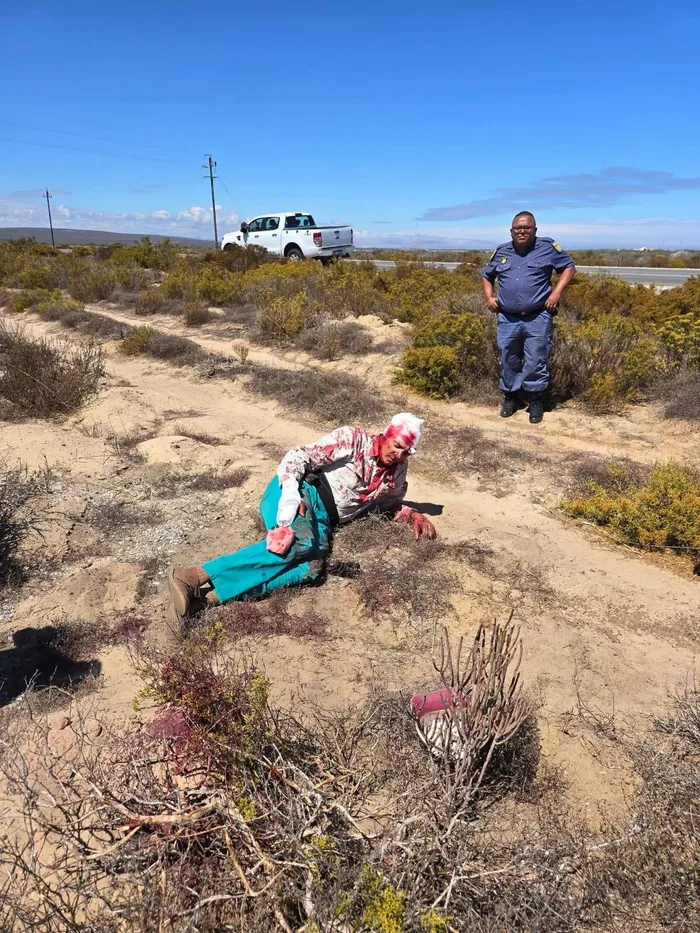
Farmer Hugo Louw was badly injured
Image: Supplied
During Monday’s court proceedings, the suspects abandoned their bail application and informed the court that they would not be seeking bail at this stage.
A large group of farmers, along with residents from the Leipoldtville and Lamberts Bay communities, gathered at court in a show of support for the injured farmer and his family.
The case has been postponed to 25 May 2026 for further investigation.
The violent attack has sparked outrage among farmers and rural communities across the West Coast.
Billy Claasen, Executive Director of the Rural and Farmworkers Development Organisation (RFDO), questioned what the outcome might have been had the farmer attempted to defend himself.
“What would have happened if that farmer carried a firearm and protected himself?” Claasen asked.
Claasen said he visited the farm on Sunday afternoon where he engaged with members of the surrounding community, including a church leader from the Leopoldtville community as well as relatives of the injured farmer.
During the visit he was shown several sheep that had been severely attacked.
“The scenes were deeply distressing,” Claasen said. “Some of the animals had to be euthanised due to severe injuries. In one case an attempt had been made to remove a sheep’s head from behind, and another animal had suffered the loss of an ear.”
He said photographic evidence documenting the condition of the animals is available.
According to local farmers and community leaders, stock theft remains a serious and ongoing challenge in the region. Residents have also raised concerns about limited police visibility and response capacity within the Graafwater policing precinct.
Community members say they often struggle to obtain timely assistance from law enforcement.
Claasen added that drug abuse remains a serious social problem in the area, contributing to broader community safety concerns. Local leaders believe stronger cooperation between police and the community is needed to address the challenges.
Among the proposals raised is a request for the Provincial Commissioner and the local police cluster commander to visit Leopoldtville to engage directly with farmers and residents about stock theft and drug-related crime.
The local church has offered its hall as a venue for a possible community engagement meeting.
Claasen also called for the deployment of a specialised provincial detective team to assist police stations in Lamberts Bay, Graafwater and surrounding areas with stock theft and cable theft investigations and prevention strategies.
“The community is deeply concerned and eager to work collaboratively with law enforcement to improve safety and restore confidence in policing services,” he said.
Meanwhile, Ivan Meyer, Western Cape MEC of Agriculture, Economic Development and Tourism, strongly condemned what he described as a surge in violent attacks targeting farmers, agri-workers and rural communities.
Earlier on Monday, Meyer attended the first court appearance of the suspects accused of attacking Louw.
Describing the assault as “brutal and violent”, Meyer urged the court to deny bail to the accused.
“My plea is that no bail should be granted. Together with the farmers of the West Coast, I am seeking justice for the victim. The perpetrators must face the full might of the law and be punished to the fullest extent,” he said.
Meyer warned that violent crime in rural areas threatens not only lives but also the agricultural economy.
“I am deeply saddened and outraged by these violent attacks. Each assault on a farmer or agri-worker is an attack on food security, the agricultural economy and the well-being of rural communities,” he said.
The minister also referenced another recent incident in the Swellendam area where two elderly tourists staying on a guest farm were forced to fend off three masked attackers.
“These kinds of crimes pose a severe threat to both agriculture and tourism — two pillars of the Western Cape economy. Farm attacks must stop,” Meyer said.
While commending the response by the South African Police Service and rural safety structures, Meyer said stronger policing resources and closer collaboration with local law-enforcement agencies, neighbourhood watches and farm watches are urgently needed to combat rural crime.
He also encouraged residents in rural areas to report safety concerns and incidents through the Western Cape Department of Agriculture’s Rural Safety Helpdesk.
Meyer conveyed his support to the injured farmer and his family and wished Louw a swift recovery, while reaffirming the provincial government’s commitment to improving safety in rural communities.