Community supports closure of Buttskop crossing after tragic history


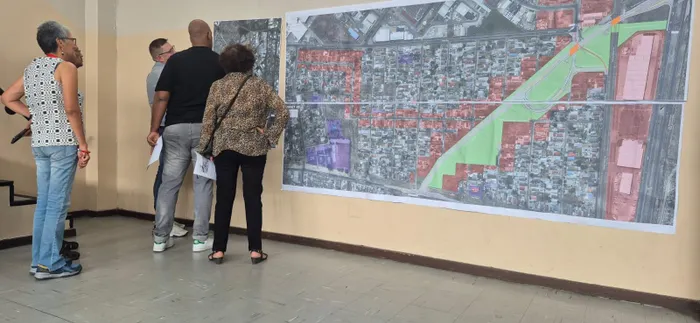
The public participation in Blackheath this week
Image: Tracy-Lynn Ruiters
A stretch of road, long associated with heartbreak and loss, could soon be reshaped, as the City of Cape Town places plans on the table to permanently eliminate the Buttskop rail level crossing in Blackheath.
While not yet finalised, proposals shared with the community this week outline the possible closure of the crossing and its replacement with a grade-separated bridge and reconfigured road network.
At a public participation meeting held during the week, City officials presented plans to close Buttskop Road between Trafford Road and Van Riebeeck Road, partially close Meadow Road, extend Trafford Road and construct a bridge over the railway line. The proposal forms part of what the City describes as a long-term safety intervention, but it remains subject to funding approval and ongoing public input.
For many residents, Buttskop is inseparable from the devastating crash that unfolded there in August 2010. Among the young lives lost was 13-year-old Jody Phillips. That morning, he boarded his school transport taxi as usual, but the vehicle attempted to cross the railway line despite the warning barriers being down and was struck by a train. The driver survived the collision.
Ten children were killed in the crash: Reece Smith, 7; Jade Adams, 10; Liesl Augis, 11; Michaelin de Koker, 11; Jody Phillips, 13; Nolan February, 13; Jean-Pierre Willeman, 13; Jason Pedro, 14; Cody Erasmus, 15 and Nadine Marthinissen, 16. The tragedy sent shockwaves through the Blackheath community and the country.
In 2011, the driver, Jacob Humphreys, was convicted on multiple charges, including murder and attempted murder, and initially sentenced to 20 years behind bars. The Supreme Court of Appeal later reduced the sentence to eight years and substituted the murder convictions with culpable homicide. He was granted parole in 2018.
Speaking to Weekend Argus, Jody’s mother, Valerie Phillips, said she had not been aware of the recent public participation meeting as she has since moved out of the area. Nonetheless, she believes the crossing should have been removed long before the tragedy that claimed her son’s life, describing the proposed changes as something that was needed years ago.
The site saw further loss in April 2018, when a bakkie transporting labourers reportedly drove through the barriers and was struck by a train, resulting in seven fatalities.
Since 2013, 32 incidents have been recorded at the crossing, involving 48 drivers and 11 passengers. City officials say failure to obey signals and collisions with the boom gates remain dominant risk factors, underscoring the potential for additional fatal crashes if the crossing remains in place.
Following recommendations from the Rail Safety Regulator, the City appointed consultants in 2017 to investigate alternatives in collaboration with Prasa. A preliminary design for the permanent elimination of the crossing was completed at the end of 2019, forming the basis of the plans now being presented.
The Frederick Street and Buttskop Road intersection was also realigned in 2020 to address safety concerns while longer-term solutions were explored.
The proposed intervention forms part of the broader Zewenwacht Link Road project, envisioned as a future arterial connecting Botterary Road in the north with EersrivWay/Spine Road in the south. The City says the new infrastructure would accommodate all modes of transport, including active mobility and universal access at intersections.
At this week’s public participation session, the majority of residents present stood in agreement that closing the crossing would be a positive and long-overdue step.
“That crossing has been a problem since 1985. It carried dangers since then,” one resident told Weekend Argus. “Up until today people take chances crossing that railway line. Taxis are seen trying to beat the train, driving zig zag through the booms.”
Another resident pointed to ongoing congestion and inconsistent functioning of the barriers. “Then it works, then it doesn’t work and the way traffic builds up over the line, so at least this is going to be a benefit for everyone,” the resident said.
Public participation around the proposed road closures is ongoing, with the City indicating that comments received will be considered and responded to by the project team. Construction funding has not yet been finalised, and timelines remain unclear.
To acknowledge the painful history of the site, the City erected a Memorial Wall at Welmoed Cemetery in honour of the lives lost. While engineering constraints may limit the feasibility of a marker at the exact crossing, officials say the community’s memory has been formally recognised.
For now, the future of Buttskop remains under discussion. But if the plans proceed, a crossing once remembered for devastating loss may eventually become a symbol of overdue reform a space redesigned with safety, remembrance and community voices at its centre.