Continuing a legacy: Cape Town, home to the first heart transplant, now celebrates its first Genicular Artery Embolization Procedure


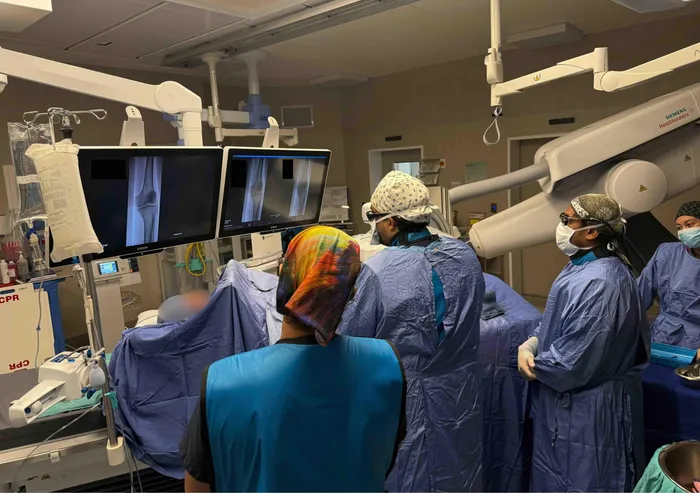
The first Genicular Artery Embolization Procedure
Image: Supplied
February 11 and Cape Town has long held a significant place in South African history.
From the 1990 release of Nelson Mandela from Victor Verster Prison, marking a turning point in the nation’s fight against apartheid, to the transformative stories of communities like District Six, the day is etched in the country’s collective memory as one of resilience, progress, and hope.
The very first Heart Transplant was also performed in Cape Town, by Professor Christiaan Barnard on December 3, 1967, at Groote Schuur Hospital
On Wednesday, 11 February 2026, Cape Town marked another milestone, this time in the field of medical innovation.
Interventional Radiologist Dr Dale Creamer and his team from Cape Town Interventional Radiology performed South Africa’s first Genicular Artery Embolization (GAE) procedure in both the private and public healthcare sectors at Mediclinic Constantiaberg Hospital.
GAE is a minimally invasive procedure designed to treat chronic knee pain caused by osteoarthritis, the most common chronic joint condition worldwide.
Osteoarthritis results from the breakdown of cartilage and underlying bone, leading to pain, stiffness, and reduced mobility.
During GAE, resorbable microscopic particles (Nexsphere), considered the gold standard in musculoskeletal embolization, are delivered via a catheter to selectively block small, inflamed blood vessels in the knee lining. This reduces inflammation and alleviates pain.
Dr Creamer, who completed his Interventional Radiology training at the University of Calgary in Canada and further honed his expertise in Europe, mastered the GAE technique abroad.
The procedure was pioneered by renowned Japanese Interventional Radiologist Dr Yuji Okuno and has been performed in Japan for more than a decade, with rapid adoption across Europe and the United States.
“It is an extremely exciting time for Interventional Radiology in South Africa as we continue to pioneer growth within the specialty,” Dr Creamer said.
“Our goal is to provide patients with access to the same advanced, evidence-based treatments available in leading healthcare systems around the world and we are beginning to see that vision realised.”
Although GAE remains relatively unknown in South Africa, clinicians at the University of Cape Town (UCT) are committed to keeping the country at the forefront of medical innovation.
The patient case was referred by Dr Marc Nortjé, an orthopaedic surgeon at UCT and in private practice at Life Vincent Pallotti Hospital, to Dr Creamer and his team for treatment.
GAE offers a non-surgical alternative for patients who are not candidates for, or who wish to delay, knee replacement surgery.
Performed under image guidance, a catheter is inserted through a small incision in the groin and navigated to the affected arteries. The procedure is typically completed on an outpatient basis with minimal recovery time, and many patients report noticeable pain reduction within a week.
By targeting the abnormal blood flow that drives inflammation, GAE provides a safe and effective option for managing moderate to severe knee pain and improving quality of life.
Dr. Creamer is Head of Interventional Radiology at Groote Schuur Hospital, practices privately at Cape Town Interventional Radiology based at UCT Private Academic Hospital and Mediclinic Constantiaberg Hospital, and serves as a Senior Lecturer at the University of Cape Town.
Canadian-trained (University of Calgary) and European Board (CIRSE) certified, Dr Creamer’s vision is to expand Interventional Radiology services and deliver world-class healthcare solutions in South Africa.
From its historical significance to its medical breakthroughs, 11 February continues to be a day that marks progress in the lives of a nation and in the health of its people.