South Africa's Film Industry on the brink: Protests demand urgent government action


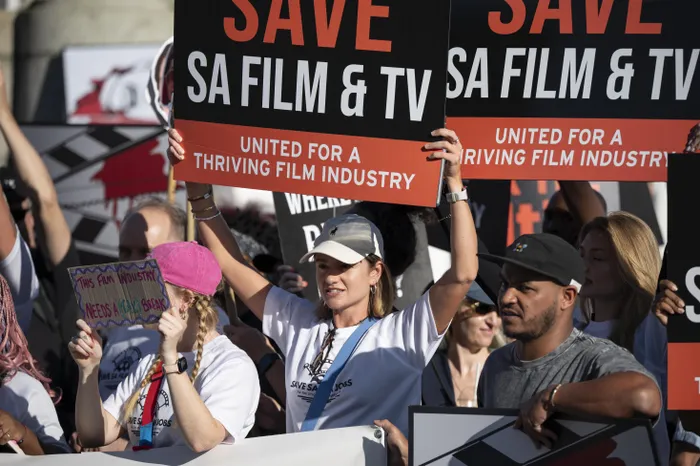
The Film and TV industry protest in Cape Town
Image: Armand Hough
South Africa’s film and television industry has intensified its pressure on the government, with workers and industry bodies warning that continued failures in the administration of the Department of Trade, Industry and Competition’s (DTIC) film incentive scheme are pushing the sector towards collapse.
On Wednesday, members of the Save SA Film Jobs coalition gathered outside Parliament in Cape Town, calling for urgent reform of the Film and TV Incentive Scheme and an end to what they describe as prolonged paralysis within the department.
The group has announced that a second protest will take place on Thursday outside the DTIC’s head office in Pretoria, signalling a coordinated national mobilisation.
The coalition says the incentive scheme, a rebate designed to stimulate production and attract foreign investment has become effectively non-functional due to the department’s failure to process applications or convene adjudication meetings. As a result, productions have stalled, investment has declined and thousands of workers across the value chain have lost income.
The coalition said mismanagement of the scheme has placed South Africa’s creative economy “on life support”, warning that the lack of approvals has triggered both economic and human consequences.
While the DTIC maintains that the incentive remains open, industry bodies argue that the absence of adjudication meetings since March 2024 has left a growing backlog of projects unable to move forward.
The Save SA Film Jobs coalition comprises a broad cross-section of the industry, including Animation SA, the South African Guild of Actors, the Independent Producers Organisation, the Personal Managers’ Association, the Writers’ Guild of South Africa and the South African Screen Federation. Together, these organisations represent thousands of workers from producers, financiers and directors to actors, writers, crew, post-production professionals and agents.
According to the coalition, the breakdown of the incentive system has driven major international productions and the foreign revenue they bring to competing territories with more predictable and transparent funding mechanisms. This erosion of investor confidence, they warn, has long-term implications for South Africa’s ability to sustain skills, infrastructure and employment in the sector.
Industry figures cited by the coalition show that before the current crisis, the film and television industry supported tens of thousands of direct jobs and more than 100 000 indirect positions, generating billions of rand in annual production value and foreign direct investment.
The workforce is also notably young, with more than two-thirds under the age of 35, making the sector a critical contributor to youth employment.
However, since 2020, the industry is estimated to have contracted by nearly half, with significant losses attributed to delayed approvals, unpaid rebates and administrative bottlenecks. Stakeholders argue that these outcomes are not the result of market decline, but of a rebate system hampered by red tape and a lack of meaningful engagement from the department.
The current protests follow earlier actio, when several industry bodies demonstrated outside the DTIC’s Pretoria campus and submitted a memorandum calling for immediate stabilisation measures.
These included the resumption of adjudication meetings and clarity on delayed payments. Despite assurances and engagements since then, the coalition says little progress has been made.
“This lack of response has made renewed national mobilisation unavoidable,” the group said, adding that continued inaction risks permanent damage to the industry.
Under the banner Save SA Film Jobs Fix the DTIC Film and TV Incentive, the January 2026 marches are calling on the Minister of Trade, Industry and Competition and senior DTIC leadership to immediately resume adjudication meetings, clear the backlog of applications, and reform the incentive in partnership with industry through structured working groups.
The coalition is also demanding greater transparency, including the public release of data on funds allocated and paid out, reporting on jobs sustained through the incentive, and a clear methodology for measuring economic impact.
Industry bodies maintain that with effective collaboration and a functional incentive framework, South Africa’s film and television sector has the potential not only to recover but to exceed its previous growth levels. However, they warn that as long as the current impasse continues, investment will remain stalled, productions will relocate, and much-needed jobs will remain out of reach.
Wandile Molebatsi, deputy chairperson of the Independent Producers Organisation, said the protest reflected both the scale and unity of South Africa’s creative sector.
“The strength of South Africa’s film industry lies in its production hubs across the country,” Molebatsi said. “Seeing animation artists, stunt performers, producers, actors, actresses, journalists, photographers and writers all coming together shows government that this industry is still united.”
He said the turnout in Cape Town demonstrated that the crisis cuts across race and politics, and is fundamentally about livelihoods.
“We are workers. We have jobs. And those jobs contribute to the economy,” Molebatsi said. “The support we saw today was overwhelming. This is not about colour. It is about people’s work and their ability to earn a living.”
Molebatsi said the memorandum also demands the establishment of joint working groups within 21 working days to develop both short- and long-term interventions.
The memorandum was accepted by Portfolio Committee chairperson Mzwandile Masina, who told protesters he would arrange a meeting between film industry leaders and the minister, and request that the department appear before Parliament.
The GOOD party, which attended Wednesday’s protest outside Parliament, has aligned itself with the demands of the Save SA Film Jobs coalition and other industry bodies, calling for urgent parliamentary intervention into the administration of the DTIC’s film incentive scheme.
GOOD representatives confirmed that a memorandum was formally handed over to the chairperson of the DTIC Portfolio Committee outside the National Assembly on Wednesday. The memorandum calls for immediate engagement with industry stakeholders, a recovery plan for the incentive scheme or viable alternatives, and an investigation into the alleged mismanagement of the programme.
According to GOOD, the Portfolio Committee chairperson committed to engaging the Minister of Trade, Industry and Competition within a ten-day period. The party said it would monitor the process from within Parliament to ensure that undertakings made to the industry are honoured.
The party has also echoed calls for greater transparency, including public access to information on how incentive funds are allocated and spent, and the publication of minutes from future engagements related to film funding.