Western Cape faces mounting water crisis as consumption spikes and municipalities across the province sound alarm


Dam levels at the Garden Route Dam is at a critical low
Image: Supplied
The Western Cape is once again staring down the barrel of a potential water crisis, with authorities warning that continued high water usage, combined with significantly reduced rainfall, could force the reintroduction of water restrictions across parts of the province.
The City of Cape Town has raised concern that without an urgent reduction in consumption, the current situation could deteriorate rapidly. Lower annual rainfall has resulted in reduced inflows to major dams, placing increased pressure on the metro’s water supply system at a time when usage remains well above recommended targets.
While officials have stressed that taps are not at risk of running dry at this stage, they caution that the margin for error is shrinking.
“Lower annual rainfall resulted in reduced inflows to dams, placing increased pressure on the City’s water supply system. While taps are not at risk of running dry at this stage, continued high water use could rapidly change the situation and result in restrictions unless consumption is brought down urgently,” the City said.
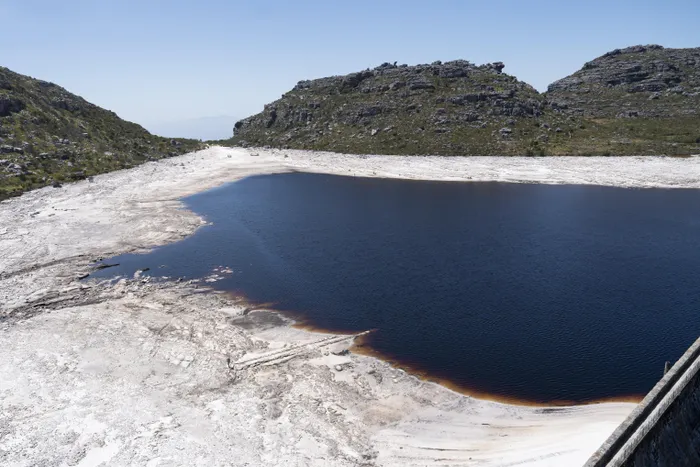
Woodhead Dam levels
Image: Armand Hough
Data published in the City’s weekly water dashboard shows that average daily water consumption by Capetonians has consistently exceeded the target of less than 975 million litres per day (MLD). On 10 December 2025, daily usage stood at 1 029 MLD, remaining unchanged on 15 December. This rose to 1 039 MLD on 22 December, dipped slightly to 1 010 MLD on 29 December, before spiking again to 1 048 MLD on 5 January 2026.
Current dam storage levels across the City stand at 69.1%, a figure that will need to sustain Cape Town until the next seasonal rainfall cycle.
Mayoral Committee Member for Water and Sanitation, Zahid Badroodien, said the situation demands immediate behavioural change from residents, businesses and industry.
“This is a critical moment for us, where we must reduce the unnecessary litres of water used in our homes, in industrial and agricultural processes and at work. We can’t afford to be complacent any longer and we must closely keep track of consumption indicators on a weekly basis,” he said.
“Early proactive measures are far more effective than emergency restrictions. We need to be water-wise at all times.”
The pressure on water systems is not limited to Cape Town.
In George, the municipality has confirmed a growing threat to its water supply after months of below-normal rainfall, with dam levels now significantly lower than during the same period last year.
The Garden Route Dam is currently at 44.5%, compared to 92.74% at this time last year, while the Haarlem Dam has dropped to approximately 34%, down from 98.7% in early 2025. George Municipality has confirmed that both dams are considered to be at risk, with reduced inflows linked directly to ongoing dry conditions.
Stricter water restrictions and emergency tariffs have already been implemented in line with the municipality’s Drought Management Policy.
“There is a threat to the Municipality’s raw water resources, as below normal rainfall has been experienced over the past months, and the forecast for the next few months is also for below normal rainfall,” said George Municipality Director of Civil Engineering Services, Jannie Koegelenberg.
Koegelenberg warned that while George is not yet at “Day Zero”, the situation remains highly dependent on consumption patterns and rainfall.
“Predicting a ‘level zero’ is not a simplistic calculation. With full public co-operation consumption can be reduced considerably, which will directly impact the availability of the raw water, and for what period,” he said. “Every drop really does count and without the cooperation of all parties, a Day Zero may in the future become a reality.”
Further along the Garden Route, the situation in Knysna has reached a critical stage. The municipality has warned that it has approximately two weeks of water remaining in the system at current consumption levels. Akkerkloof Dam, the primary source of water for Greater Knysna, is currently at just 20%, prompting urgent intervention.
A Joint Operations Committee comprising provincial and national authorities has been convened to respond to what has been described as a dire water situation. While the Balancing Dam is sitting at around 90%, officials have cautioned that it does not compensate for the rapid depletion of Akkerkloof Dam. Stricter enforcement of Level 4 water restrictions, alongside intensified monitoring of high-volume and non-compliant users, has been implemented in an effort to stabilise supplies.
In response to mounting pressure across the province, residents are urged to adopt strict water-saving practices. These include fixing leaks on private properties, closely monitoring household usage, watering gardens only at night to reduce evaporation, and avoiding unnecessary topping up of swimming pools.
Looking ahead, Cape Town is also progressing with strategic plans to diversify its water supply. To reduce dependency on rain-fed dams, new sources such as desalination and water reuse are scheduled to be added from 2031.
By contrast, conditions in the Theewaterskloof Municipality, which supplies water to towns in the Overberg region, remain manageable despite lower-than-average rainfall.
Spokesperson Tarren-Lee Habelgaarn said that while water resources are under some pressure due to hot summer weather and increased demand, there is no immediate threat to supply.
“Although rainfall has been lower than average and consumption has increased due to hot weather, all towns within the Theewaterskloof municipal area continue to have water and are able to supply residents. Our water network and technical teams are monitoring water resources closely on an ongoing basis and will make operational adjustments as required,” Habelgaarn said.
She noted that a Level 1 water restriction was implemented in December as a precautionary measure to encourage mindful consumption.
“Reduced rainfall has resulted in lower inflows into dams and mountain catchments this year. While some dam levels are lower than during the same period in higher rainfall years, they remain within a manageable range,” Habelgaarn added.
As dry conditions persist, authorities across the Western Cape have warned that without immediate and sustained reductions in water use, the province risks sliding deeper into another water crisis.