Navigating the dangers of the N2 and R300: A look at the Cape's 'Hell Way'


What should be a routine drive along the N2 and R300 has become a nightmare.
Families, tourists, and commuters now navigate what locals have dubbed the “Hell Way,” where stones and bricks rain down from bridges and roadsides, windscreens shatter, and drivers are left stranded in life-threatening situations.
In the past year alone, dozens of violent attacks have left motorists injured, traumatised, and in some cases, dead.
Among the most harrowing recent incidents, a family from Johannesburg, including a baby was targeted on 11 November when a stone struck their vehicle. The impact caused extensive damage, leaving the family severely traumatised.
Two days later, a doctor from Somerset West was attacked near the Borcherds Quarry off-ramp. He sustained chest injuries and had to be admitted to hospital.
Earlier this month, a mother reported that her son’s vehicle was struck by a stone on the Stellenbosch Arterial just before he turned onto the R300. These incidents highlight the growing and frightening trend along these corridors, where both residents and tourists are at risk.
The pattern of attacks is alarming. Stones or bricks are hurled from pedestrian bridges, roadsides, and edges of informal settlements, shattering windscreens and forcing motorists to stop.
This often leaves them exposed to robbery, hijacking, or physical assault. Some of the most serious attacks include a fatal shooting on 28 July 2025, when stone-throwers forced a motorist to stop on the R300, and a concrete block thrown at a moving vehicle on 1 August, seriously injuring a female passenger.
According to new data from the Cape Town Metro Police, more than 2 215 incidents were reported along the N2 and R300 between November 2024 and November 2025. Of these, 85% were breakdowns related to mechanical issues, motorists running out of fuel or as a result of flat tyres.
These incidents include stone-throwing, robberies, and shootings. In the airport precinct alone, 42 incidents of bricks being thrown at vehicles were recorded between April 2024 and March 2025, with at least five confirmed stone-throwing attacks in the past six months.
The statistics underscore the urgency of finding a solution to what has become a persistent and deadly problem.
Emre Uygun of the Freedom Front Plus said, “Drastic measures must urgently be implemented to prevent further injuries or deaths on the notorious ‘Hell Run.’ Every broken fence and unguarded bridge serves as an invitation for another attack. Prevention is not an option; it is absolutely crucial.”
In response, P Smith, Mayco member for Safety and Security, outlined the City’s current approach. "The City’s enforcement agencies conduct 24/7 patrols along the N2 and R300. The Traffic Service’s Highway Patrol Unit assists motorists daily and removes debris from the roadway when located or reported. CCTV networks are used to monitor known hotspots and redirect resources toward potential threats.
"The City has upgraded its CCTV equipment to ensure clear visual identification of suspects, assisting SAPS in investigations."
Smith emphasised that the South African Police Service (SAPS) is the lead agency on crime prevention, with the City’s enforcement agencies acting in a supporting role.
“Opportunistic criminals are not static at a given site and often move around,” Smith said.
He added that the majority of reported incidents around 85% were related to vehicle breakdowns, flat tyres, or fuel issues rather than criminal acts.
Bonteheuwel ward councillor Angus McKenzie said the City faces an increasingly unpredictable challenge.
“Hotspots change all the time. Unfortunately, you cannot have permanent visibility at one given spot. If you do have that, they shift the spot somewhere else. It’s a cat‑and‑mouse game,” he said.
McKenzie added that successful prosecutions for smash‑and‑grab crimes are rare, largely due to victims’ reluctance to report incidents.
“Victims are very reluctant to report, and there’s no inclination to sit in court for a year or two to get a prosecution for that crime,” he said.
He stressed that social media videos and posts do not count as official reports.
“Critically important: social media is not an official reporting mechanism. Not a single call was logged at the Emergency Call Centre after the latest incidents.”
According to McKenzie, a group of eleven individuals recently “went out and targeted as many cars as they could,” but reporting remains key to tracking and responding.
“If you see someone who looks like a smash‑and‑grabber, report it. CCTV can pick it up and dispatch officers.”
He said the problem is “three‑fold”. Hotspots shift constantly, victims do not report matters, and incidents are not reported through the correct channels.
McKenzie urged motorists to stop making themselves targets.
“People smash and grab to steal what they can see. Hide your belongings. Put them in the boot. There’s no need for your cellphone in your hand or your bag on the front seat.”
Residents are encouraged to report incidents directly to the City’s Public Emergency Communication Centre on 021 480 7700, providing detailed information.
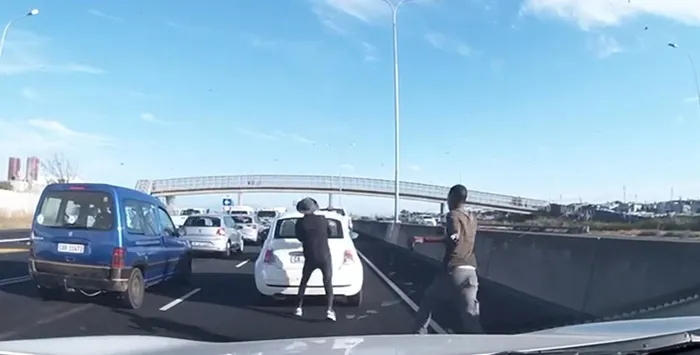
Smash and grabbers on the N2
Image: Screengrab
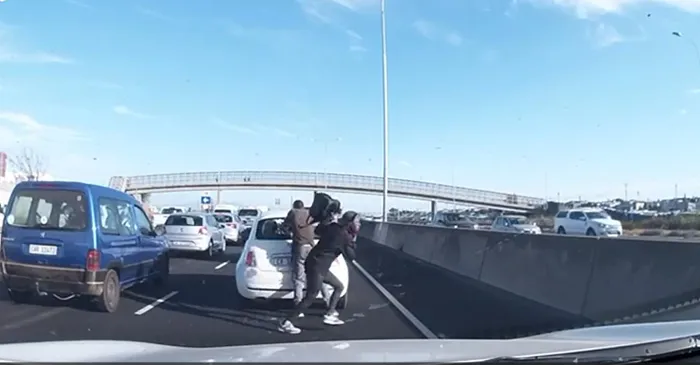
Bags being taken out of the car
Image: Screengrab
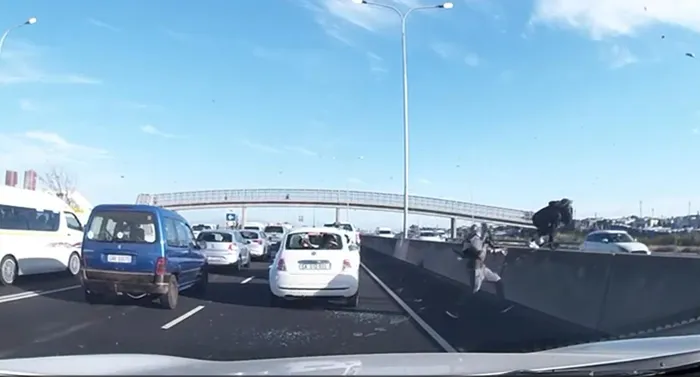
The criminals make a run for it
Image: Screengrab