Escaping justice: new strategies to combat court and prison breakouts in South Africa



Ismail George has been detained by police after he escaped from Wynberg Court holding cells.
Image: SAPS
After a number of escapes from holding cells and short-lived escapes from prisons in the Western Cape, authorities are beefing up security ahead of the festive season and beyond.
These plans include the the rollout of 35 virtual (close-circuit) courtrooms by March 2026, aimed at limiting the need to transport detainees.
Despite the headlines, the Department of Correctional Services (DCS) emphasised that escapes from state-managed correctional facilities remain rare.
“We have had only two escapees from DCS-managed facilities this year,” said DCS spokesperson Singabakho Nxumalo, adding that most recent incidents occurred at court holding cells, which fall under the South African Police Service (SAPS) and the Department of Justice, not Correctional Services.
Court-related escapes, although unusual, illustrate the challenges of managing detainees outside prison walls. In October, six awaiting-trial prisoners escaped from Wynberg Magistrates’ Court holding cells.
All were later rearrested, with the final suspect, Ismail George, caught in Mitchells Plain. Around the same period, three inmates escaped from Strand Magistrate's Court; one was rearrested the following day, while two remained at large into early November.
Escapes from actual correctional facilities remain low. One occurred at Pollsmoor Correctional Centre but was swiftly resolved with the inmate’s capture.
At Allandale Correctional Centre, inmate Graine Martin escaped from an agricultural work team and was later found deceased.
On 8 November, convicted rapist and murderer Jakob September escaped during a work detail at Helderstroom Correctional Facility but was rearrested the same evening after a police drone unit tracked him using thermal imaging technology.
Independent crime researcher Calvin Rafadi said court escapes typically occur when offenders exploit procedural gaps such as impersonating detainees granted bail or slipping away during hospital visits and work programmes.
He noted that high-profile incidents like Thabo Bester’s escape from a privately run facility are outliers. “Bester’s case exposed corruption and collusion, which is very different from escapes caused by administrative lapses,” Rafadi explained.
Forensic investigator Chad Thomas highlighted structural challenges that contribute to escapes, including overcrowding, ageing infrastructure, and staffing shortages. He also pointed to the role of organised prison gangs, such as the 26s, 27s, 28s, the Big Five, and smaller groups like the Royal Air Force, in exploiting weaknesses in supervision or procedures.
Thomas dismissed the notion that escapes increase during the festive season. “If someone wants to escape, they’ll do it when the opportunity presents itself not because it’s December,” he said.
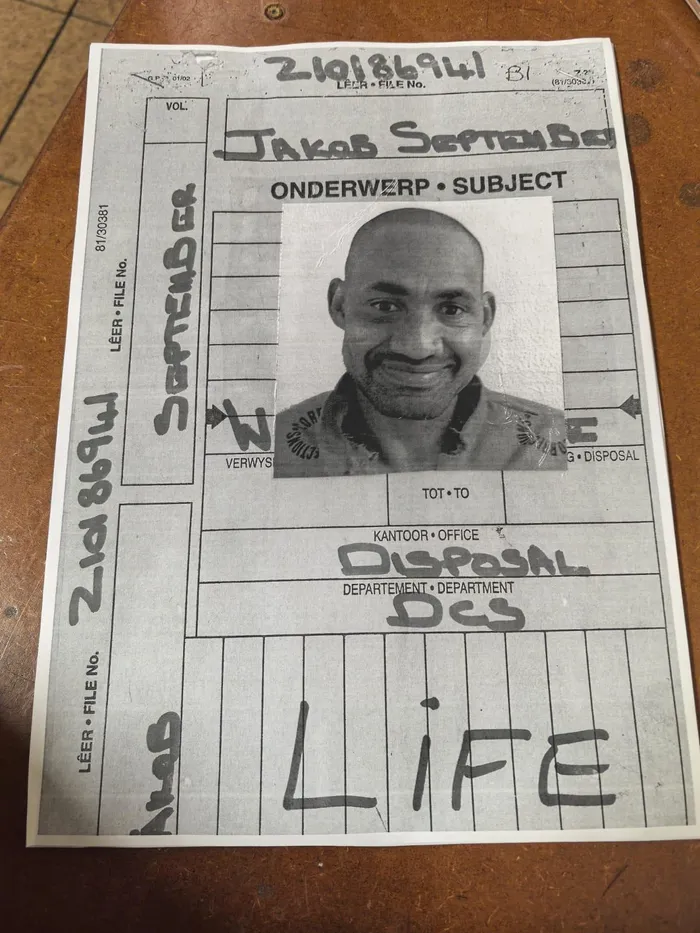
Prisoner, Jakob September is back behind bars.
Image: Supplied
Terrence Manase, spokesperson for the Minister of Justice and Constitutional Development said they can confirm that government continues to prioritise the strengthening of security at correctional and court facilities working closely with the South African Police Services.
To reduce escape risks, the Justice, Crime Prevention and Security (JCPS) Cluster has developed a coordinated plan across DCS, SAPS, and the Department of Justice.
Measures include:
- Enhanced supervision during work details and hospital visits
- Improved monitoring and coordination during court appearances
- Expansion of virtual court proceedings in 35 courts by March 2026
Rafadi further recommended body cameras for SAPS personnel in court holding cells and criminal charges against inmates caught with contraband or cell phones.
Thomas reiterated the need to address overcrowding, ageing infrastructure, and understaffing, while consistently monitoring high-risk inmates and gangs.
Both Rafadi and Thomas emphasised that accountability, oversight, and careful planning are essential to closing gaps and maintaining the safety of South Africa’s correctional and court systems.
The departments said that while escapes can occur, incidents remain limited, and the new measures aim to strengthen security and reduce the likelihood of future breakouts.