Cape Town puts cycling on the map
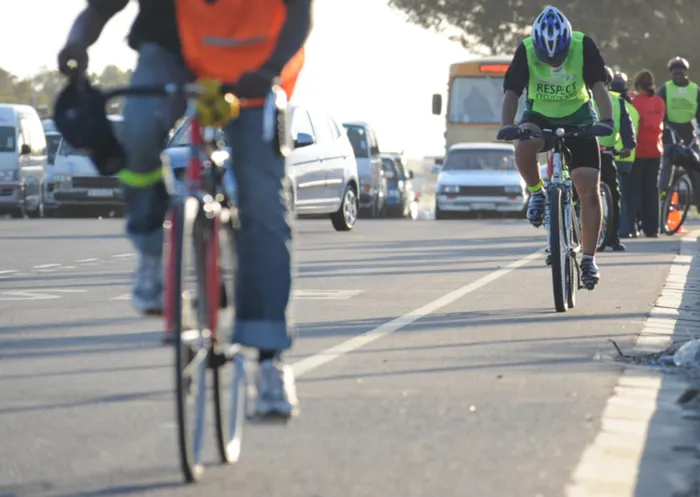
Capetonians on their way to work make use of the new cycling lanes. Capetonians on their way to work make use of the new cycling lanes.
As the bicycle revolution continues to sweep the city, taking to the saddle has become even easier with the release of Cape Town’s first bicycle map.
Cyclists have already expressed their delight with this development on the blog of Gail Jennings, editor of Mobility Magazine, the developer of the map.
Jennings, who commutes the 12km between her home in Noordhoek and her workplace in Westlake by bicycle, said she decided in 2006, when she first picked up a cycle map of New York during a visit there, that Cape Town should also have such a map.
“I thought that Cape Town really should have one, and wherever I travelled and took my bike – in London, Paris and Sweden – I gathered up this collection of bicycle maps.”
Jennings said that whenever she rode, she took her GPS along and explored “little back ways”.
After a while she realised she had gathered enough information and that, with the new MyCITI bike lanes, it was time to put the map together – which she did with the help of a photographer, designer and the tips of other cyclists.
She said the map included details of popular and safe routes in the central city, the MyCiTi route in the Milnerton area, and bike lanes in Rondebosch, Newlands, Fish Hoek and Sun Valley.
Parking racks, bicycle rental facilities, bicycle-friendly venues and eateries are also indicated.
The map can be ordered from http://capetownbicycle map.co.za/ website, and is also available at bicycle shops throughout the city, and at the offices of the Cape Town Partnership in Bree Street.
Jennings said work would start soon on a map for the Winelands and she had also had queries about creating one for Joburg.
“It was my hope to see an increase in people cycling. A lot of people don’t even know where to start,” she said.
While the most recent survey about cycling behaviour, conducted in 2003, estimated that less than 1 percent of people chose riding their bikes as transport, she had been seeing “a lot more people cycling than I used to”.
The cycling community had also become more diverse with, for instance, families deciding to cycle a few kilometres to the beach rather than take a car.
Asked about the city’s newly created cycling lanes, Jennings said they were “fantastic”, but that there were some dangerous areas that needed sorting out.
For instance, some kerbs were too high, while in other places bollards were hard to see.
In the central city it was “incredibly dangerous” to use the bicycle lanes, especially at some intersections where cyclists were invisible to motorists.
Jennings also urged the city to consider the construction of more bicycle lanes in areas where people were already commuting by bicycle to a large degree, but were forced to contend with dangerous traffic.
In Kalk Bay and Muizenberg Main Road, for instance, many people from poorer areas commuted to work on an “extremely dangerous section of road”.